

Day 97/365 The Urban Mirror: Finding Geometry in the Grime
EXIF Data
Ricoh GRIII | 1/320 sec | f/8 | ISO 250
The Critique
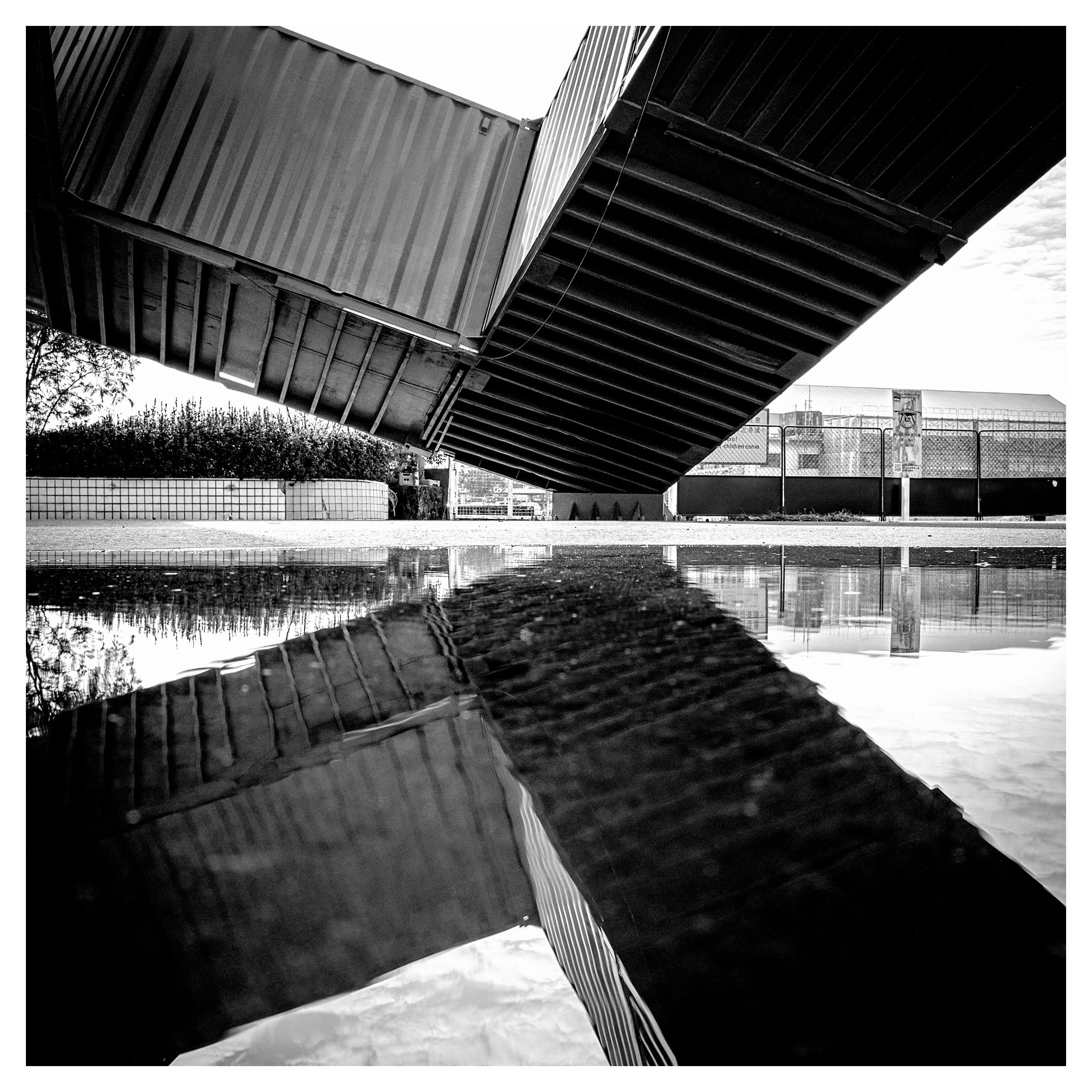
This image is a striking exercise in architectural abstraction. You have utilized the Ricoh GRIII’s legendary high-contrast black and white profile to great effect here, stripping away the distraction of color to focus entirely on form and texture. The composition is anchored by a formidable diagonal—the corrugated underbelly of what appears to be a shipping container—which slices through the frame with aggressive precision.
The duality created by the reflection in the puddle is the image's strongest asset. It grounds the massive industrial weight above, creating a "visual echo" that softens the brutality of the steel. The texture of the water breaks the rigid lines of the container, introducing a necessary organic element to an otherwise sterile subject. The exposure is competent; f/8 was the correct choice here to ensure depth of field, keeping both the looming metal and the asphalt texture sharp.
However, the image risks feeling somewhat static. While the geometry is sound, it lacks a narrative "punctuation mark"—a human element or a disruption in the pattern to give the eye a final resting place. It is currently a beautiful stage set waiting for an actor.
Advice for Improvement
To elevate this from a graphic exercise to a narrative photograph, consider the concept of the "passive frame." You have established a strong geometric frame; the next step is patience.
• The "Ghost" in the Machine: In future attempts, hold this composition and wait. A stray dog, a passing bicycle, or a lone pedestrian reflected in that puddle would provide scale and a sense of isolation that industrial landscapes often crave.
• Post-Processing: While the high contrast works, the shadow areas in the upper left are approaching a "black hole." A subtle dodge (lightening) in the mid-tones there could reveal just enough detail to keep the viewer's eye moving, rather than falling off the edge of the frame.
Becoming a Better Photographer: The Data Approach
You asked how to use data to improve. Photography is often seen as purely intuitive, but it is also mechanical. I recommend you start a simple "Keeper Log" (a spreadsheet or notebook) where you audit your best 50 images of the year.
Record the Focal Length, Shutter Speed, and ISO for each "keeper."
• If 80% of your best shots are at ISO 1600+, you are a photographer of atmosphere and grain; stop fearing noise and embrace it.
• If your best work is consistently around 1/500s or faster, you have an eye for freezing chaos.
• If you find you are constantly cropping, you need to physically move closer to your subjects.
This data will tell you who you actually are as a photographer, not who you think you want to be.
Study Materials
To refine your eye for this specific style of high-contrast, geometric urban photography, I recommend the following deep dives.
Photographers to Research:
• Fan Ho: For his mastery of light, shadow, and geometric composition in Hong Kong. He was the master of finding the "stage" and waiting for the actor.
• Daido Moriyama: For his raw, gritty, high-contrast approach to the Japanese street. He teaches us that a photograph doesn't need to be clean to be true.
• Chien-Chi Chang: Since you are based in Taiwan, study Chang’s work (specifically The Chain). While the subject matter is different, his rigorous composition is a masterclass.
Books to Read:
• The Americans by Robert Frank: Essential reading. Study how Frank uses the "road" and industrial symbols to tell a story about a nation.
• Tokyo Compression by Michael Wolf: This will show you how to frame tight, claustrophobic urban environments effectively.
• Ravens by Masahisa Fukase: A darker, more abstract exploration of solitude that mirrors the mood of your reflection shot.
Videos to Watch:
• Fan Ho: The Art of Light and Shadow – A look at how Ho used geometry to frame the chaos of the street.
• Daido Moriyama: The Shocking Truth About His Style – An analysis of the "Are, Bure, Boke" (grainy, blurry, out-of-focus) aesthetic.