

Day 98/365 The Art of Layering: Finding Depth in the Surface
EXIF Data
Camera Model: Leica D-Lux 8
Shutter Speed: 1/125
Aperture: f/2.8
ISO: 640
Critique
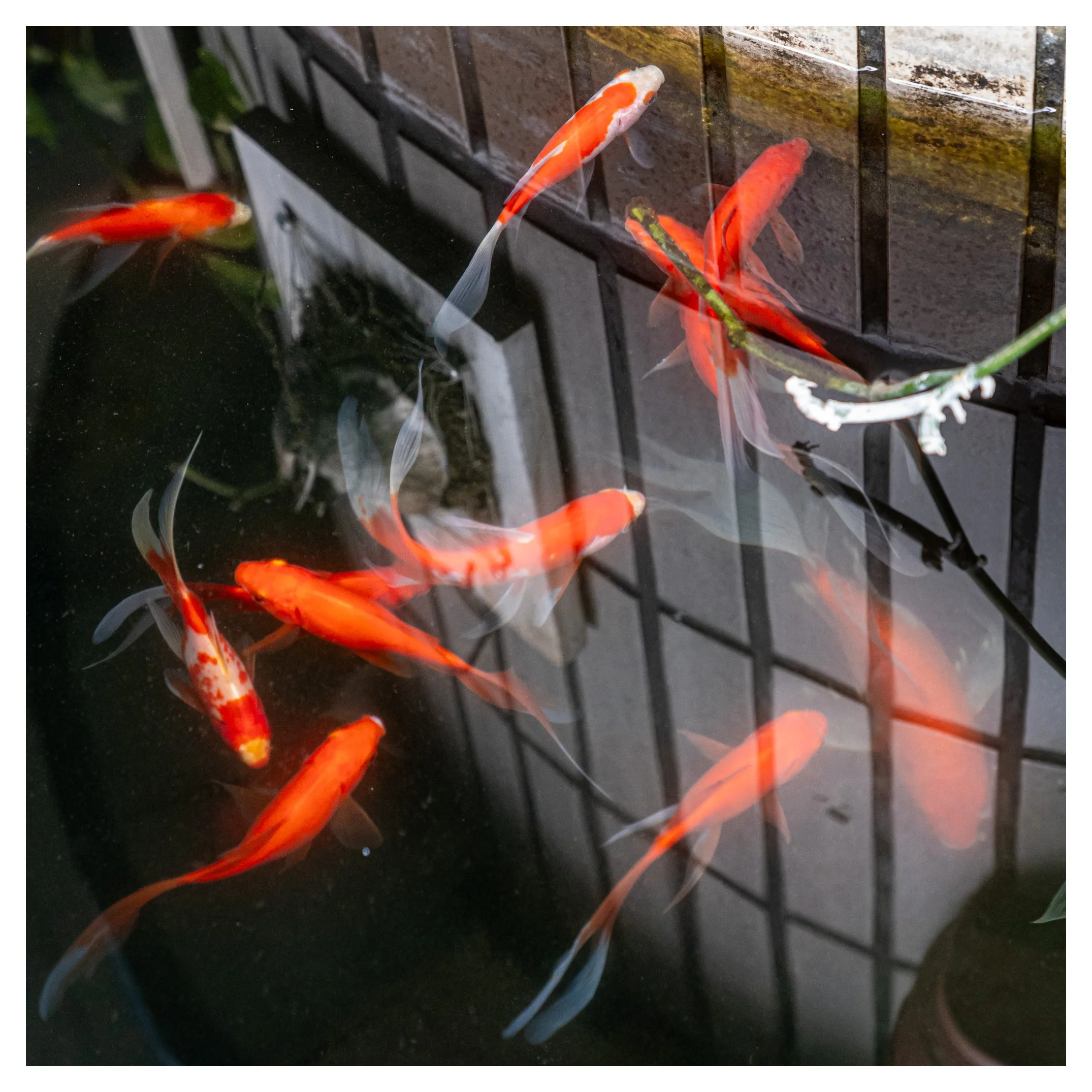
This image operates on two distinct visual planes: the physical reality of the koi fish and the reflected reality of the architecture above. What strikes me immediately is the tension between these two worlds. You have the fluid, chaotic movement of the bright orange fish contrasted against the rigid, rectilinear grid of the reflected tiles and window bars.
The "art" here isn't the fish—koi are a common motif—but rather how the reflection dissects them. The white window grille cuts across the frame like a scar, disrupting the softness of the water. The choice of f/2.8 was wise here; it provided enough light to keep the shutter at 1/125, freezing the motion of the fish while maintaining the integrity of the reflection. The exposure is balanced, retaining the vibrant oranges without blowing out the white highlights of the reflection.
However, the composition feels slightly accidental. The branch entering from the right is a distraction; it breaks the clean geometry of the tiles without adding a meaningful organic counterpoint like the fish do. The image hovers between a nature shot and an abstract study, not fully committing to either.
Improving This Image
To elevate this from a "snapshot of a pond" to a "study in layers," consider the concept of subtraction. The branch on the right adds clutter. A slight shift in your position could have framed the image entirely around the grid of the tiles and the fish.
Furthermore, patience is your greatest tool here. You captured the fish in a cluster, but the composition would be stronger if you waited for a "decisive moment" where the fish aligned with the grid lines of the reflection—perhaps swimming parallel to the tiles or crossing them at a perfect diagonal. This would transform the image into a deliberate geometric composition rather than a random capture.
Becoming a Better Photographer: Data Compilation
You asked how to improve over time using data. This is a practice often overlooked by artists but embraced by professionals.
You should perform a "Metadata Audit" every few months. Import your images into cataloging software (like Lightroom or Capture One) and filter your library to show only your 5-star or "best" images. Analyze the metadata for these select few:
• Focal Length: Do you consistently favor wide angles (24mm) or tighter crops (75mm)? This tells you how you naturally see the world.
• ISO: Are your best shots grainy and high-ISO, or clean and low-ISO?
• Shutter Speed: Do you prefer freezing motion (like this 1/125 shot) or the blur of slow shutters?
If you find, for example, that 80% of your best work is shot at 35mm, you know that this is your "voice." You can then consciously push yourself to master that focal length, or conversely, force yourself to shoot only 75mm for a month to expand your range.
Recommendations for Further Study
To master the art of reflections and layering, you must study those who saw the world as a complex visual puzzle.
Photographers to Research
• Saul Leiter: A pioneer of color and abstraction. He famously shot through windows, mirrors, and rain-spattered glass to turn New York City into painting-like layers. He is the master of the "obscured view."
• Fan Ho: Given your platform is "Photos of Taiwan," you likely know him, but look deeper at his use of geometry. He often used light and shadow to create rigid structures that framed his organic subjects, much like the tiles in your image.
• Alex Webb: For a more chaotic, modern take on layering. He fills the frame with multiple subjects at different distances, creating complex, dense images.
Books to Read
• Early Color by Saul Leiter: This is the bible for the aesthetic you are approaching in this image. It will teach you how to use mute colors and reflections to create mood rather than just documentation.
• Minutes to Midnight by Trent Parke: Parke’s work is high-contrast and often deals with the interaction of light and water. It is a masterclass in pushing the limits of exposure to create emotion.
• The Suffering of Light by Alex Webb: Read this to understand how to organize complex frames where foreground and background compete for attention.
Video to Watch
This video explores the narrative and compositional techniques of Fan Ho. It is particularly relevant to your image because it discusses how he used geometric lines and high contrast to frame his subjects, turning ordinary street scenes into cinematic art.
The Narrative Photography of Fan Ho
The video breaks down how Fan Ho utilized geometry and patience to turn chaotic scenes into structured masterpieces, directly addressing the improvement points for your koi image.