

Chasing the Light: The Kinetic Energy of the Urban Moment
The Critique: A Study in Motion and Monoliths
As an art critic, I often look for the "breath" in a photograph. Does the image inhale and exhale?
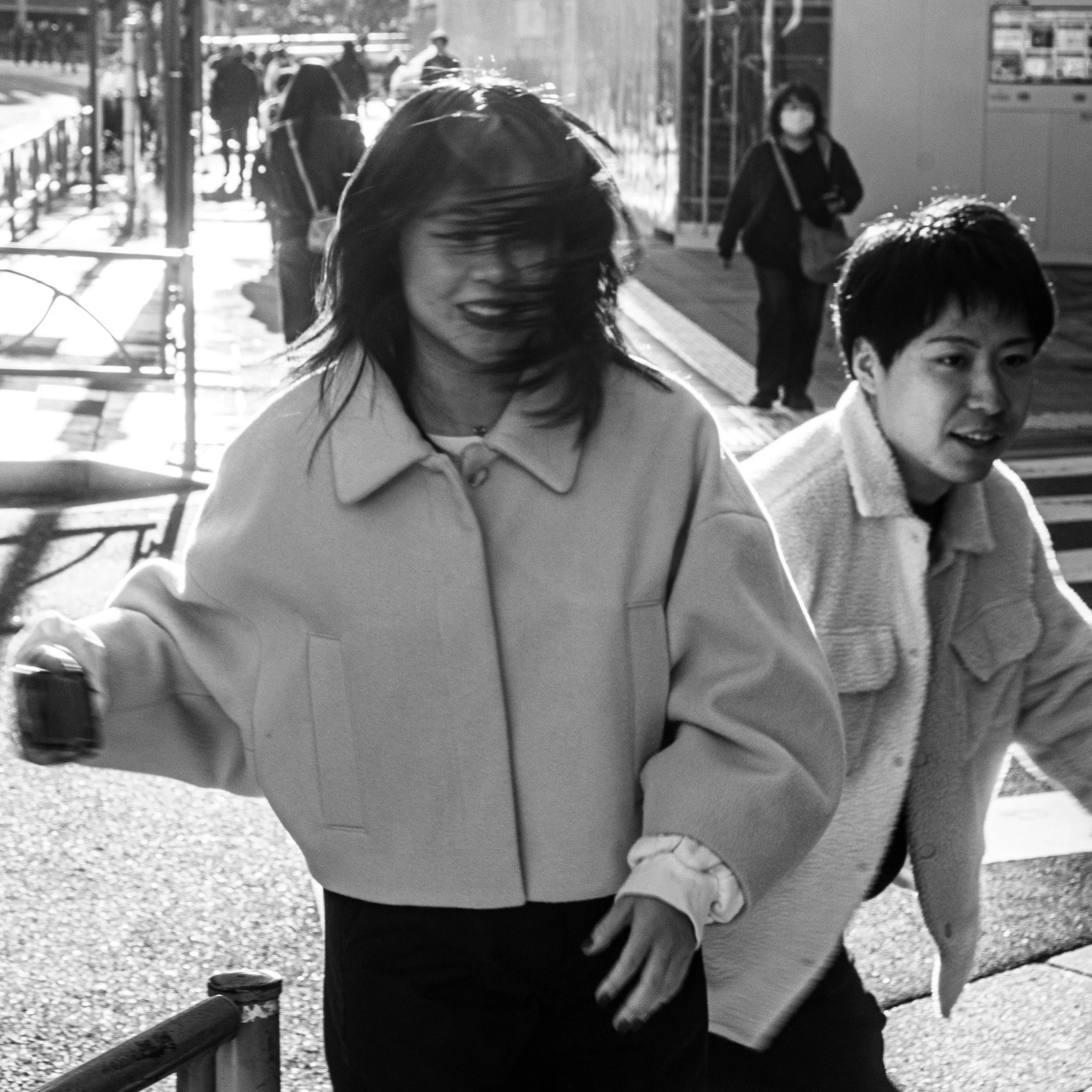
In this submission, "Running Girls," the breath is rapid, almost panting. This is a striking example of high-contrast street photography. You have eschewed the safety of mid-tones for a bold, graphic approach that is reminiscent of the Japanese Provoke era.
What Works
The "Accident" of Identity: The wind whipping the hair across the central subject’s face is the strongest element here. It transforms a specific person into a universal symbol of youth and rush. It adds a layer of surrealism—a momentary mask created by the elements.
Rim Lighting: The way the sunlight catches the texture of the fleece jacket and the edges of the hair is exquisite. It separates the subjects from the darker, busy background, creating a "halo" effect that guides the eye.
The Narrative Arc: The second figure, looking forward with a clearer expression, provides a counterpoint to the obscured face of the main subject. Are they running towards something or away from something? That ambiguity is the hallmark of great street work.
Areas for Refinement
The Frame's Edge: There is a distinct tension on the left side of the frame. The hand holding the object (a camera? a phone?) is nearly cut off. In street photography, we often want the subject to have "room to run." Cropping so tightly against the direction of movement can make the viewer feel claustrophobic.
Tonal Crushing: While the high contrast is stylistic, the blacks in the lower quadrant (the trousers) are completely crushed, losing all detail. A slight lift in the shadows during post-processing might reveal texture without sacrificing the dramatic mood.
Practical Advice: Refining Your Eye
To elevate this image and your future work, consider these adjustments:
Lead Room: When photographing moving subjects, always try to frame them with empty space in front of them. This psychological "lead room" allows the viewer's eye to travel with the subject.
Zone Focusing: This image is sharp, which is a feat in itself. However, to consistently catch these split-second moments, master zone focusing. Pre-focus your lens to a specific distance (e.g., 2 meters) and shoot from the hip. This bypasses the split-second lag of autofocus.
Embrace the Environment: Don't be afraid to step back. The context of the Taiwanese street—the signage, the pavement texture, the architecture—adds a "sense of place" that grounds the kinetic energy.
Becoming a Master: The "Data of Vision"
You asked how to improve over time. The answer lies in treating your photography habits as data points. You must become a scientist of your own art.
Create a "Metadata Journal": Every month, review your top 50 images and compile the following data:
Focal Length: Are you always shooting at 35mm? Try 28mm or 50mm for a month to force a new perspective.
Aperture: Do you default to f/1.8? If your "keepers" are mostly blurry, the data will tell you to stop down to f/8 for street work.
Time of Day: Analyze when your light is best. If your best shots are at 4:00 PM (Golden Hour), schedule your walks then.
The Contact Sheet Exercise: Don't just look at your best shots. Look at the 10 shots before and after the best one. Did you stop shooting too early? Did you move your feet? Studying your "failures" teaches you more than admiring your successes.
Theo’s Recommendations
To deepen your understanding of this high-contrast, kinetic style, I recommend the following study materials.
Photographers to Study
Daido Moriyama: The master of grainy, high-contrast, blurry, and out-of-focus ("are-bure-boke") photography. Your image shares a spiritual DNA with his work in Shinjuku.
Garry Winogrand: For his ability to capture chaotic energy and multiple narratives within a single frame.
Fan Ho: Though his work is more composed, study him for his mastery of backlighting and shadow in an Asian urban context.
Books to Read
"The Nature of Photographs" by Stephen Shore: This is essential for understanding the physical and mental levels of an image.
"Magnum Contact Sheets": This book reveals the "misses" behind iconic photos, showing you the work required to get the shot.
Videos to Watch
"The Many Lives of William Klein" (Documentary): Klein broke every rule in the book regarding focus and framing. Watching him work will liberate you from the need for "technical perfection."
John Free’s Street Photography talks (YouTube): Excellent, no-nonsense advice on the philosophy of being present on the street.