

Framing the Divine: Elevating Your Black and White Photography
Greetings. Let us step into the quietude of this frame.
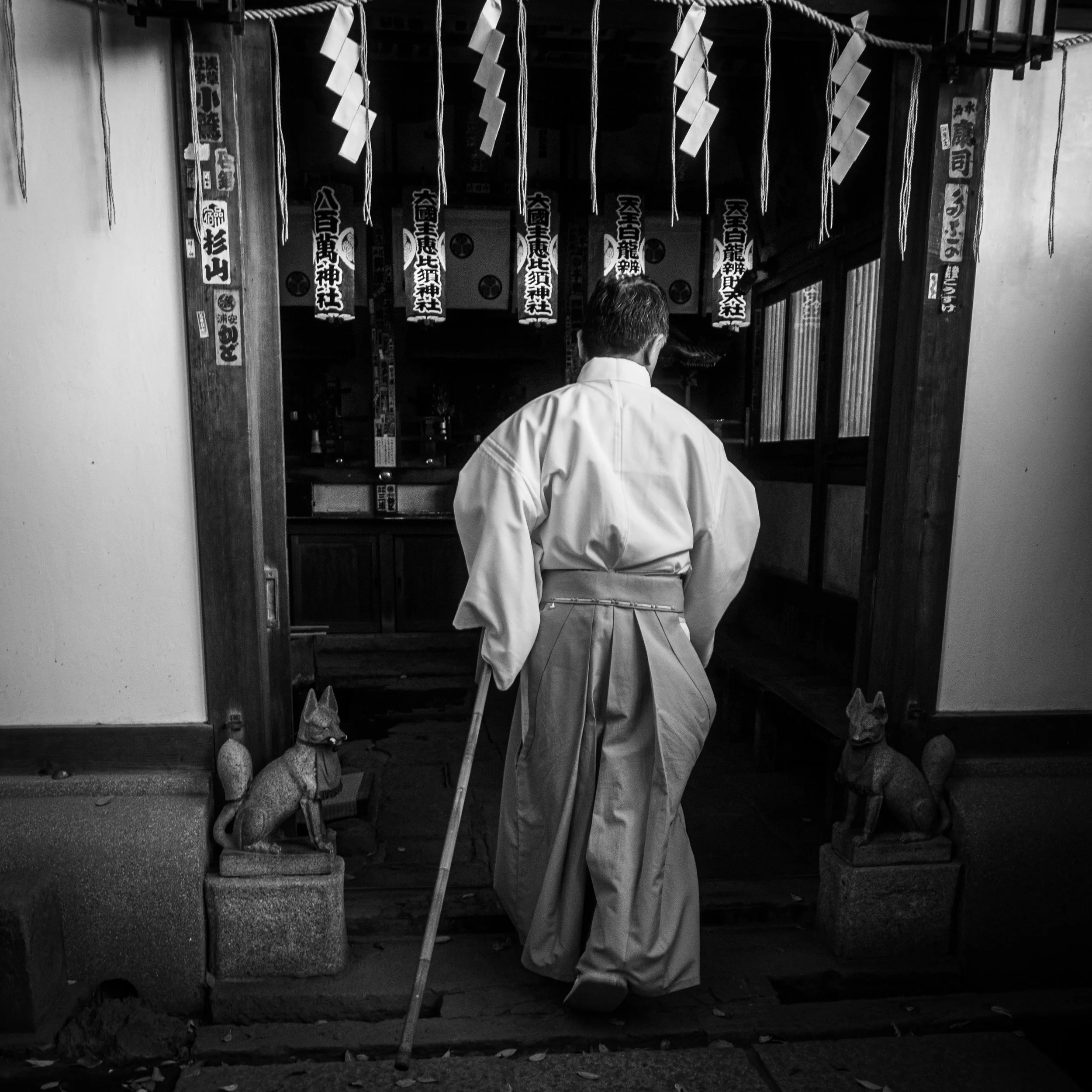
Photography, at its most elevated, is not merely about recording a scene; it is about organizing chaos into a coherent emotional statement. In this image of a Shinto priest (kannushi) entering a shrine, you have captured a moment of significant gravitas. It is a "threshold" image—a literal and metaphorical step from the profane world into the sacred.
However, to move from a competent documentation to a transcendent piece of art requires a ruthless eye for detail and a mastery of tonal dynamics. Let us analyze what you have achieved and where you must push further.
The Critique
1. The Anchor of Narrative: The Cane
The most compelling element here is not the robe, but the cane. It provides a human counterweight to the spiritual uniform. It suggests age, frailty, and the physical effort required to serve the divine.
Strengths: You have caught the priest in a moment of transition—the dorsal view (back to the camera) works well here, inviting the viewer to follow him into the darkness.
Weaknesses: The framing at the bottom is perilously tight. We lose the connection between the cane and the earth. In the future, allow your subject to "breathe." A few millimeters more at the bottom would have grounded the subject, giving the viewer’s eye a solid foundation before traveling upward.
2. The Guardians: Texture and Context
The flanking Kitsune (fox) statues serve as excellent sentinels. The texture in the stone is rendered beautifully in this black and white conversion.
Insight: In Shinto belief, the fox is the messenger of Inari. By framing them symmetrically, you acknowledge the formal structure of the shrine. However, the symmetry is almost too perfect. A slight shift in perspective—perhaps stepping six inches to the right—might have created a more dynamic diagonal relationship between the stone gaze of the fox and the human movement of the priest.
3. Tonal Value and the Void
You have handled the highlights on the white joe (robe) admirably; they are bright but retain texture.
Improvement: The interior of the shrine is a crushing void of black. While this adds mystery, a "perfect" print usually retains a whisper of detail even in the deepest shadows. A very subtle dodge (lightening) of the interior wood details would create more depth, turning the black hole into a three-dimensional space.
The Path Forward: Improving Your Eye
You asked how to improve over time. The answer lies not just in shooting, but in analyzing your own output with the rigor of a scientist.
The "Emotion Delta" Spreadsheet
I recommend you compile data on your images to escape your own biases. Create a simple log with these columns:
Pre-Visualization: What emotion did I feel when I took the shot? (e.g., Solemnity, Isolation).
Result: What emotion does the final image convey? (Be honest).
Technical Variance: Focal length, Aperture, Shutter Speed.
The Keeper Rate: How many shots did you take of this scene vs. how many were usable?
Why this works: You will likely find a pattern. Perhaps you consistently shoot too wide, diluting the emotion. Or perhaps your "solemn" shots are actually "chaotic" because you aren't waiting for the background to clear. By tracking the delta between feeling and result, you will learn to bridge the gap.
Recommendations for Study
To refine your understanding of high-contrast monochrome and Japanese aesthetics, you must look to the masters who walked this path before you.
1. The Master of Light and Shadow: Fan Ho
You must study Fan Ho. Known as the "Cartier-Bresson of the East," he was a master of the "decisive moment" but with a cinematic, almost theatrical approach to lighting.
Why: Your image relies on high contrast. Fan Ho utilized steam, smoke, and harsh shafts of light to turn street scenes into theatre. He often "directed" his subjects or waited hours for the perfect arrangement.
Read: Portrait of Hong Kong by Fan Ho. This body of work exemplifies how to handle the stark blacks and bright whites you are experimenting with.
2. The Dark Obsession: Masahisa Fukase
For a deeper, perhaps darker emotional connection to the Japanese landscape, look at Masahisa Fukase.
Why: His series Ravens (Karasu) is a masterclass in using high-contrast grain to convey solitude and obsession. While your image is respectful, Fukase teaches us how to be raw. He photographed ravens as a reflection of his own post-divorce melancholy.
Read: Ravens by Masahisa Fukase.
3. The Outsider's Eye: Robert Frank
To understand how to document a culture that is being observed, study Robert Frank.
Why: His seminal work The Americans captured a nation with a gritty, unvarnished truth. He was an outsider looking in—much like you are when photographing this shrine.
Read: The Americans by Robert Frank.
Video Recommendation
Watch a video analysis on Hiroshi Sugimoto’s "Theaters". Sugimoto captures the passage of time by leaving his shutter open for an entire film, resulting in a glowing white screen. It is the opposite of your "decisive moment," but it will teach you about the "sacred void"—the concept of emptiness (Ma) which is central to Japanese art.
Next Step for You:
Would you like me to analyze your "Keeper Rate" if you provide the total number of shots taken for this specific shrine visit, or should we refine the cropping on this image together?