

The Urban Palimpsest: Deciphering Night at Shinkuchan
Category: Street Photography / Critique
Location: Kaohsiung, Taiwan
There is a specific texture to the nights in Kaohsiung—a humidity that seems to thicken the air, trapping light and sound in a way that makes the city feel incredibly intimate despite its density.
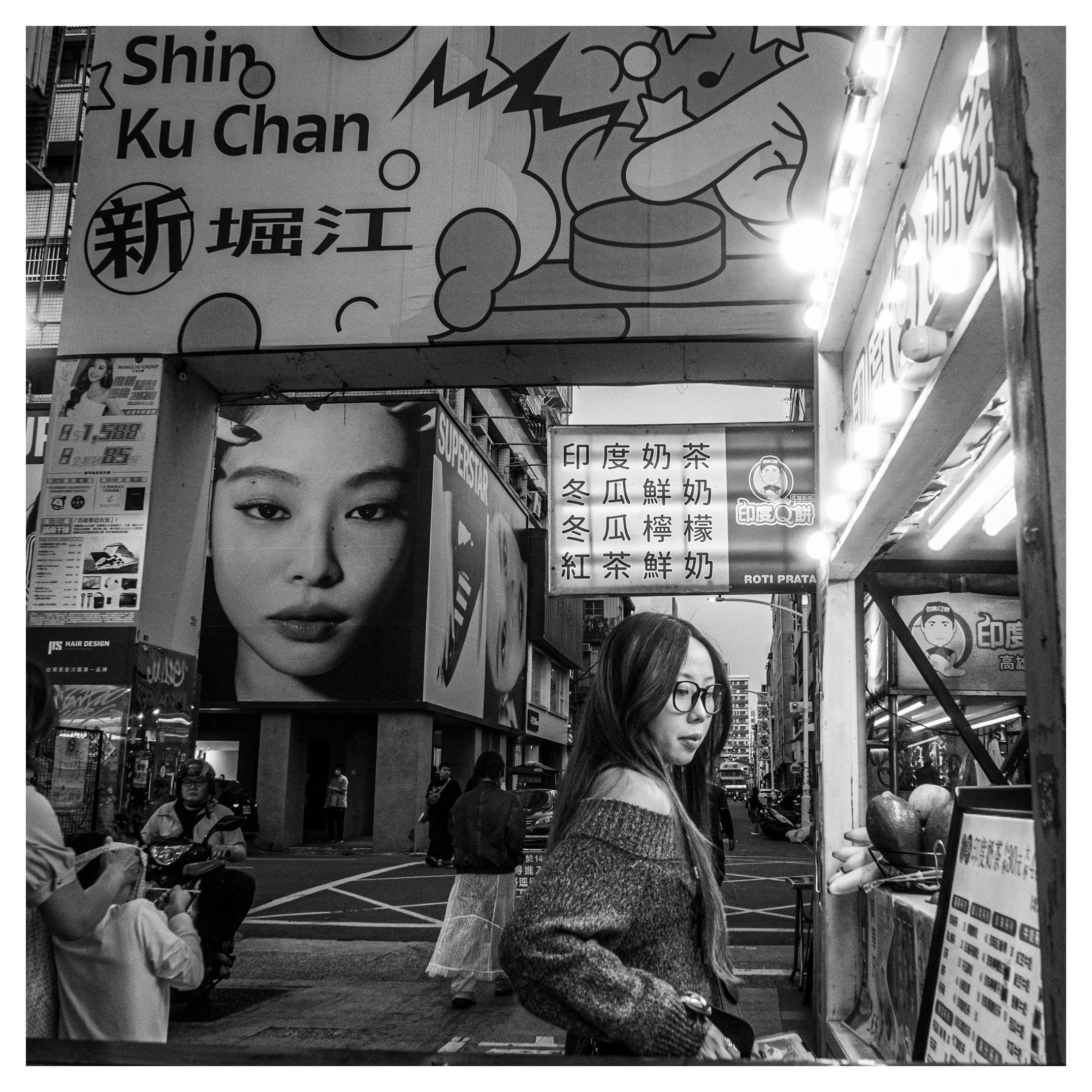
In this striking monochromatic capture from the Shinkuchan (New Juejiang) shopping district, we are presented with more than just a street scene; we are given a masterclass in layering and visual hierarchy.
As an art critic, I often look for the "decisive moment"—Henri Cartier-Bresson’s elusive split second where form and content align perfectly. This image captures a decisive moment not of action, but of attention.
The Architecture of the Frame
The composition here is structurally complex. The photographer has utilized a natural proscenium arch—the overhead "Shin Ku Chan" signage—to create a stage. This is a classic framing technique that immediately tells the viewer: look here, the play is beginning.
> "The image functions as a collage of realities: the cartoonish graphic design above, the hyper-polished commercial advertising in the background, and the gritty, tactile reality of the street in the foreground."
>
The depth of field is particularly successful here. By stopping down the aperture (or focusing deeply), the photographer ensures that the narrative extends from the texture of the woman’s sweater in the foreground all the way to the fading pedestrians in the distance. This is "deep space" composition, inviting the eye to wander rather than fixing it on a single point.
The Dialog of Gazes
What makes this photograph psychologically arresting is the triangulation of sightlines:
* The Advertisement: The gigantic, billboard-sized face (reminiscent of K-pop iconography) stares directly out at the viewer with a polished, unblinking gaze. It represents the idealized, commercial dream of the shopping district.
* The Subject: The woman in the foreground, clad in a textured off-shoulder knit, looks away from the camera and away from the ad. Her gaze is directed sharply to the right, toward the brightly lit stall (advertising Indian Milk Tea/Roti Prata). She is grounded in the immediate, physical need (hunger/consumption) rather than the aspirational image behind her.
* The Photographer/Viewer: We are the third point in the triangle, observing this disconnect between the dream (the billboard) and the reality (the street).
Lighting and Tonality
Converting this image to black and white was a sophisticated choice. Street photography in Taiwan is often defined by its chaotic neon colors—cyans, magentas, and neon greens. By stripping the color away, the photographer forces us to focus on luminance and structure.
The lighting on the right side—the harsh, exposed bulbs of the food stall—creates a chiaroscuro effect (strong contrast between light and dark). It creates a halo around the foreground subject, separating her from the busy background. The grain in the shadows adds a cinematic, almost noir quality, recalling the gritty Japanese street photography of the post-war era (think Daido Moriyama), yet the content is distinctly modern Taiwanese.
The Verdict
This is a photograph that captures the "organized chaos" of Shinkuchan perfectly. It balances the overwhelming visual noise of urban signage with a quiet, human moment in the foreground. It documents not just a place, but a feeling—the sensory overload of a night market, frozen in a quiet scale of greys.
It is a reminder that in the city, we are always being watched—by cameras, by crowds, and by the giants on the billboards—even as we just look for a snack.