

Day 100/365 The Weight of Wire: Constructing Narrative on the Streets
EXIF Data:
• Camera Model: Ricoh GRIII
• Shutter Speed: 1/320 s
• Aperture: f/4
• ISO: 800
The Critique
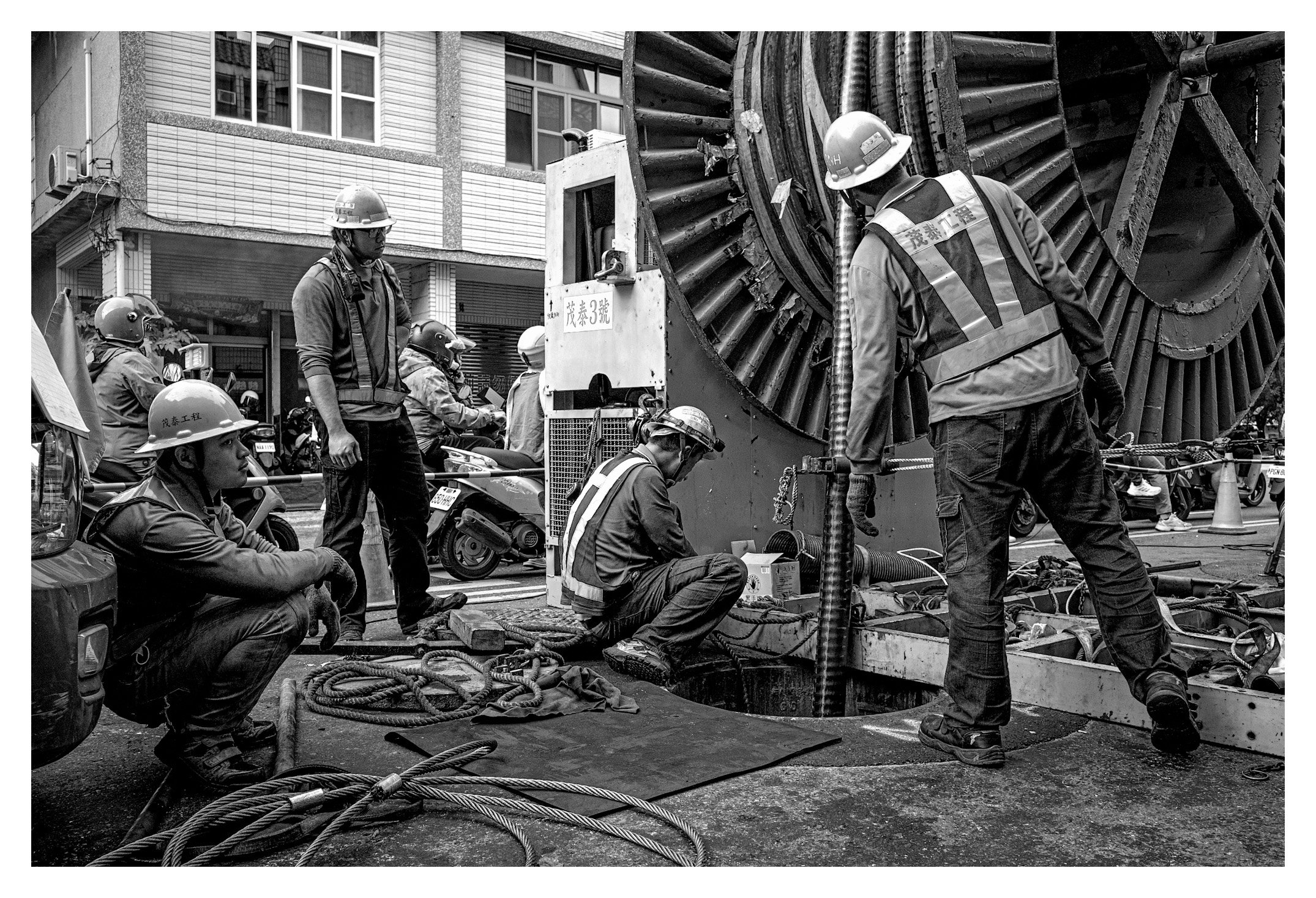
This image is a study in industrial geometry and the quiet dignity of labor. You have effectively utilized the "Ricoh look"—high contrast, gritty black and white—to emphasize the textures of the cable, the asphalt, and the workers' vests.
The composition is anchored by the large cable reel on the right, which acts as a heavy, looming visual weight. This circular form contrasts beautifully with the angular postures of the workers. The strongest element here is the triangulation of the figures: the standing worker on the right pulling the cable, the standing worker on the left supervising, and the squatting figure in the foreground.
The squatting worker is the emotional center of the frame. His gaze, directed out of the frame to the left, creates a sense of "off-screen" tension—we wonder what he is looking at, expanding the narrative beyond the borders of the photograph.
However, the left edge of the frame is slightly cluttered. The truck’s headlight and bumper intrude into the scene without adding narrative value. A slight step to the right, or physically moving closer to the squatting worker, would have simplified the background and intensified the intimacy of the moment.
How to Improve: The Data-Driven Photographer
You asked how to use data to improve over time. This is a technique often overlooked by artists who rely solely on "feeling," but the masters know their tools intimately.
To improve, you must audit your own habits using the metadata filters in your cataloging software (like Lightroom or Capture One):
1. The "Handshake" Audit: Filter your library by Shutter Speed. Look at your "rejects" versus your "keepers." You might discover that at 1/60th of a second, your sharpness rate drops to 50%, whereas at 1/250th (like this image's 1/320s), it’s 90%. This data tells you your personal physical limit for hand-holding the camera.
2. The ISO Comfort Zone: Filter by ISO. If you find you avoid editing photos shot above ISO 3200 because of grain, you know you need to either embrace the noise (like Daido Moriyama) or invest in faster glass.
3. Focal Length Fixation: The Ricoh GRIII is a fixed 28mm equivalent. Filter your past work from zoom lens cameras. If 80% of your best shots were at 50mm, you might be forcing a wide-angle perspective that doesn't fit your natural vision.
Recommendations for Study
To refine your eye for industrial landscapes and complex street compositions, I recommend the following resources.
Photographers & Books
• Chien-Chi Chang: As a Taiwanese Magnum photographer, his work is essential study for you. His ability to document repetitive labor and alienation is masterful.
• Read: The Chain. This body of work, depicting mental asylum patients chained together, uses repetition and raw black and white tonality similar to your image.
• Read: Jet Lag. This explores the disorientation of travel, using alienation as a visual theme.
• Josef Koudelka: A master of chaotic composition and grit. He often organizes seemingly messy scenes into rigorous geometric shapes.
• Read: Gypsies. Look at how he positions figures in a landscape; he never shies away from dirt or clutter but organizes it into a visual language.
• Robert Frank: The father of the snapshot aesthetic.
• Read: The Americans. Study this for how he sequences images of distinct American life to create a cohesive, often melancholic narrative.
Videos to Watch
• Josef Koudelka – Composition Masterclass
This analysis breaks down how Koudelka uses geometry and spacing between subjects—directly applicable to how you positioned the workers against the reel.
• Magnum Photos: Chien-Chi Chang on "The Chain"
Understanding the context behind Chang's most famous work will help you approach documenting difficult or gritty subjects in Taiwan with empathy and rigor.
Watch here (Contextual article with visual analysis)
• Robert Frank's "The Americans" - Analysis
A look at how Frank broke the rules of composition to create emotional resonance.