

Day 99/365 Electric Vespers: Deconstructing Light and Faith on a Taiwanese Corner
EXIF Data
Camera Model: Ricoh GRIII
Shutter Speed: 1/25 sec
Aperture: f/2.8
ISO: 500
The Critique
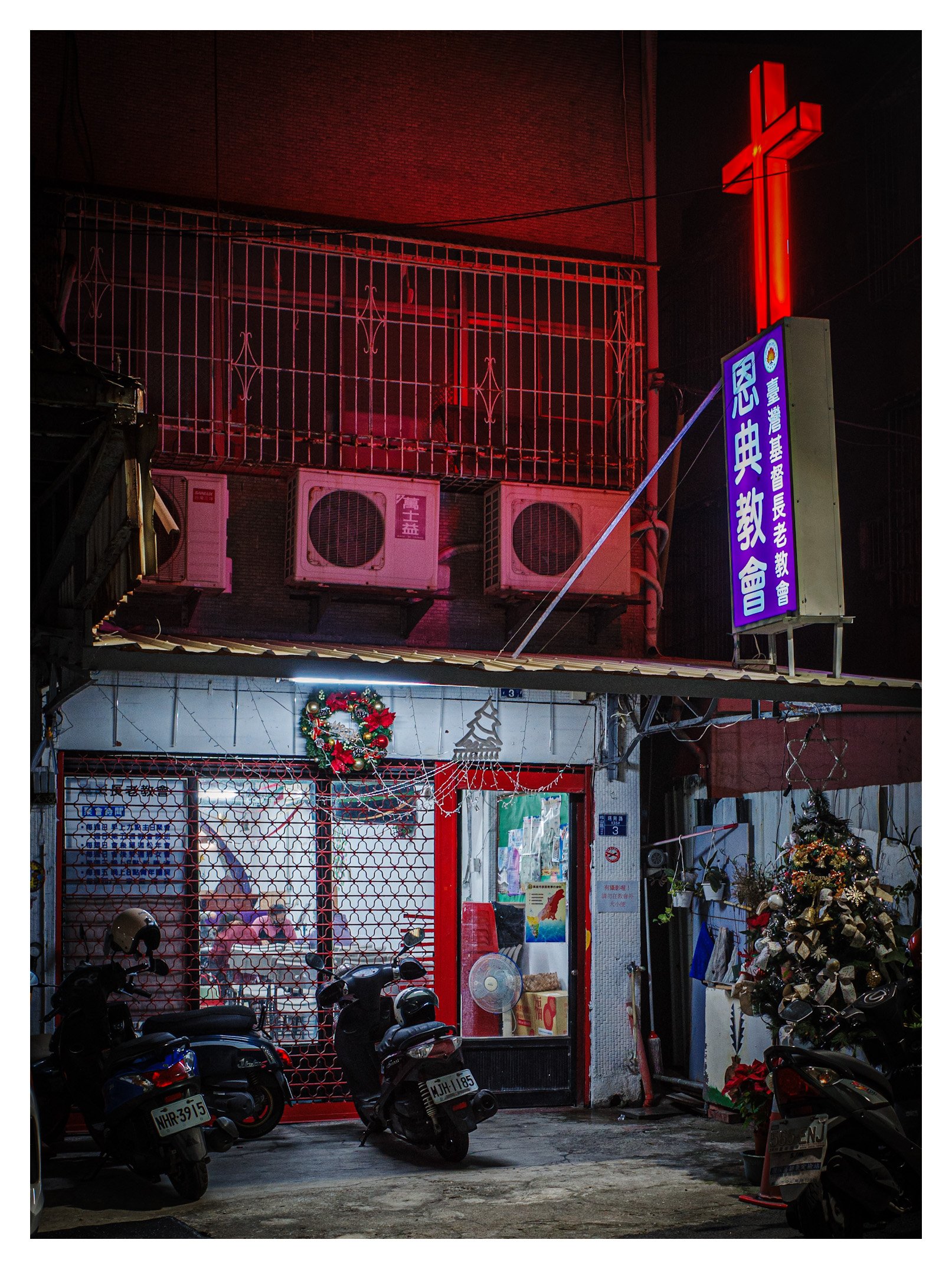
This image operates on a fascinating tension between the ethereal and the vernacular. You have captured a quintessential moment of Taiwanese night life: the juxtaposition of the "Grace Christian Church" (En Dian Jiao Hui) sign—beaming in electric violet and urgent red—against the gritty, grounded reality of parked scooters and a closed metal shutter.
The Ricoh GRIII is a formidable tool for this kind of street work, known for its sharp lens and ability to render high-contrast scenes. Your choice of f/2.8 was necessary here to gather light, and it successfully isolates the subject while keeping the background dark, creating a natural chiaroscuro. The red light from the cross bleeds beautifully onto the white awning and the metal gate, unifying the upper and lower halves of the frame.
However, the shutter speed of 1/25 is a dangerous game. While it worked here because your subjects (the scooters and the sign) are static, it risks micro-blur from handheld shake. The Ricoh’s IBIS (In-Body Image Stabilization) likely saved you, but the image feels slightly "thick" or soft in the mid-tones.
How to Improve:
1. Exposure Discipline: At ISO 500, the Ricoh GRIII is barely breaking a sweat. You could easily push this to ISO 1600 or 3200. This would allow you to increase your shutter speed to 1/125, guaranteeing tack-sharp architectural lines, or conversely, stop down to f/4 or f/5.6 to get more depth of field on the scooters in the foreground.
2. Compositional Breathing Room: The crop feels somewhat tight on the left. The "Grace" of the church is squeezed. Stepping back two feet—or utilizing the 28mm equivalent width more deliberately—would allow the cross to feel less like it is looming and more like it is presiding over the street.
3. The "Third" Element: You have the setting (the shop/church) and the props (the scooters). You are missing the actor. In the future, wait. Wait for a figure to pass under the red light, or a stray dog to trot by. This adds a narrative vector that static architecture lacks.
Becoming a Better Photographer: The Data Approach
You asked how to improve by compiling data. This is a method rarely taught but used by masters. Do not just hoard your images; audit them.
Create a spreadsheet (similar to the book database you already possess) for your own portfolio. Log your "Keepers" with the following columns:
• Time of Day (e.g., Night, Golden Hour, Mid-day)
• Aperture Used
• Focal Distance (Close-up vs. Wide scene)
• Subject Matter (Architecture, People, Abstract)
The Goal: After 50 "Keepers," analyze the data. You might discover, for example, “90% of my best shots are vertical compositions taken at night between f/2.8 and f/4.” This data reveals your subconscious visual signature. Once you know you are a "Night/Vertical" photographer, you can stop wasting time shooting sunny landscapes and focus entirely on mastering your specific niche.
Recommendations for Study
Based on your current library and this image, you are drawn to the "New Topographics" style but with a desire for color and mood.
1. Shen Chao-Liang
Since you are in Taiwan, Shen is essential study. His series STAGE documents the cabaret trucks of Taiwan. Like your image, he deals with the intersection of night, gaudy artificial light, and Taiwanese culture. He creates surreal portraits of these trucks that look like glowing temples in the dark.
• Book: STAGE (Found in your database)
• Video: Shen Chao-Liang: Illusion and Reality
2. Greg Girard
Girard is the master of Asian nocturnal atmosphere. His work in Phantom Shanghai and Tokyo-Yokosuka explores how neon light interacts with decaying architecture. He often shoots in low light, letting the color temperature of street lamps dictate the mood—exactly what you are attempting with the red cross here.
• Video: The Photographer who Captured Vanishing Cities - Greg Girard
3. Saul Leiter
For the composition and color aspect. Leiter was a pioneer in using "obstruction"—shooting through windows, grates, or past signs. Your image uses the metal grate as a texture; Leiter would teach you how to use it as a framing device to add mystery.
• Video: Saul Leiter: In No Great Hurry (Trailer/Clips) (Search for the full documentary In No Great Hurry if possible).
4. Chien-Chi Chang
I noticed The Chain in your database. While his work is often black and white and focused on alienation (Magnum style), his rigorous discipline in composition is something to emulate. He captures the "Taiwanese psyche" in a way few others do.
• Video: Chien-Chi Chang: Magnum Photos Profile (This links to a Greg Girard video from M+, but search specifically for "Magnum Photos Chien-Chi Chang" for his portfolio reviews).