

Day 102/365 Electric Vernacular: Deconstructing the Night
EXIF Data
Camera Model: Fujifilm X-Pro2
Lens: 23mm F1.4 R
Shutter Speed: 1/60
Aperture: f/1.4
ISO: 200
The Critique
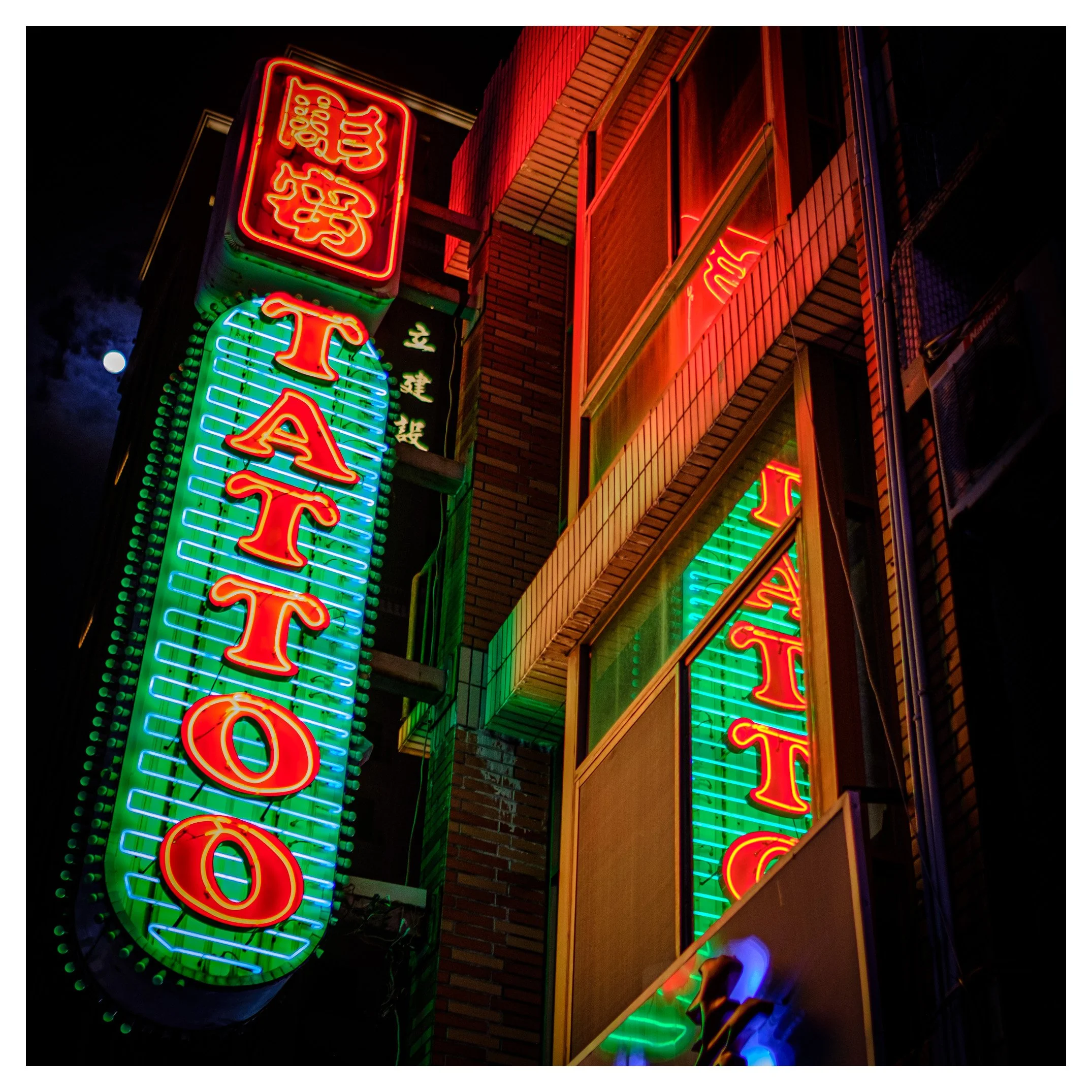
There is an undeniable allure to the "Wong Kar-wai" aesthetic—that saturated, nocturnal melancholy that drenches a city in electric greens and crimsons. You have captured that mood successfully here. The exposure is handled well, which is no small feat when dealing with the extreme dynamic range of neon signage against a night sky. The choice of the Fujifilm X-Pro2 with the 23mm lens is classic street photography heritage, and you are using it to paint a very specific feeling.
However, the image suffers from a certain claustrophobia. While the sign is the protagonist, it feels crowded against the left edge of the frame. In architectural and urban landscape photography, negative space is not just "empty" space; it is the context that allows the subject to exist. By framing the "TATTOO" sign so tightly, you rob the viewer of the environmental context that makes the sign interesting in the first place. Is this a lonely alleyway? A bustling district? The building on the right offers a hint of warmth, but the relationship between the cool green neon and the warm interior light feels slightly accidental rather than composed.
Furthermore, shooting at f/1.4 creates a razor-thin depth of field. While this is excellent for isolating a subject, in a shot like this where the geometry of the sign and the building are both strong graphic elements, stopping down to f/2.8 or f/4 would have rendered more of the scene in critical focus without sacrificing the ambient light quality.
Becoming a Better Photographer Through Data
You mentioned compiling data to improve. This is a rigorous, scientific approach to art that I highly commend. Do not just look at your images; interrogate them.
To do this effectively, you must treat your image library as a dataset. Every month, perform the following audit in your cataloguing software (like Lightroom or Capture One):
1. The "Keeper" Audit: Filter your library to show only your 5-star images (your absolute best work). Now, look at the metadata for only these images. What focal length appears most often? You might find that despite owning a zoom, 80% of your best shots are at 23mm or 35mm. This tells you your "native" field of view.
2. The ISO Threshold: Filter by your "rejected" images. Check the ISO. Are you consistently losing image quality above ISO 3200? Or are you losing shots to motion blur because you refuse to raise the ISO? This data will teach you your camera's limits better than any manual.
3. The Aperture Trap: You shot this at f/1.4. Run a filter for all photos taken at f/1.4. How many are actually sharp where you wanted them to be? We often buy fast glass for the potential of low light, but data often reveals we miss focus more frequently at maximum aperture. If your "miss" rate at f/1.4 is high, force yourself to shoot at f/2 for a month and compare the results.
Recommendations for Further Study
Your library already contains Shen Chao-Liang’s Stage, which is the gold standard for Taiwanese neon documentation. You also possess Saul Leiter’s Early Color, the bible of abstract street color. To grow, you must now look at photographers who bridge the gap between Leiter’s abstraction and Shen’s documentation.
Photographers to Research
• Greg Girard: He is the essential study for your style. His work in Phantom Shanghai and City of Darkness explores the color of Asian cities at night with a mastery that is unparalleled. He captures the artificial light of modernization better than anyone.
• Harry Gruyaert: Since you appreciate strong color, Gruyaert is the next logical step. He does not use color to "fill" a shape; color is the subject of his photographs. He composes with light and hue rather than just geometry.
• Liam Wong: For a more contemporary, "cyberpunk" take on the nocturnal city, look at Wong. He embraces the digital, high-ISO aesthetic that modern cameras allow, pushing color grading to its cinematic extreme.
Books to Read
• "Greg Girard: Tokyo-Yokosuka 1976-1983" – This will show you how to shoot gritty, nocturnal urban environments without relying solely on neon signs.
• "Harry Gruyaert: East/West" – A perfect study in how color temperatures (the clash of warm tungsten and cool twilight) can create emotional tension in an image.
Videos to Watch
• The Atmospheric Landscapes of Greg Girard
This interview dissects how Girard approaches the mood of a city, specifically looking at his work in Japan and Shanghai. It is essential viewing for understanding how to frame urban decay and modernization.
• Harry Gruyaert: Master of Color Photography
This video by Magnum Photos breaks down Gruyaert’s philosophy. Pay attention to how he discusses "waiting for the light" and how he organizes complex, chaotic scenes into cohesive color palettes.
• Book Flip-through: TO:KY:OO by Liam Wong
Seeing the layout of Wong’s book will give you ideas on how to sequence your own blog posts. Notice how he balances wide cityscapes with tight, abstract details similar to your neon sign.