

Day 131/365 The Digital Drift: Youth and Isolation in the Concrete Jungle
Technical Specifications
Camera Model
Leica D-Lux 8
Shutter Speed
1/2000
Aperture
f/2.8
ISO
100
The Critique: A Study in Modern Friction
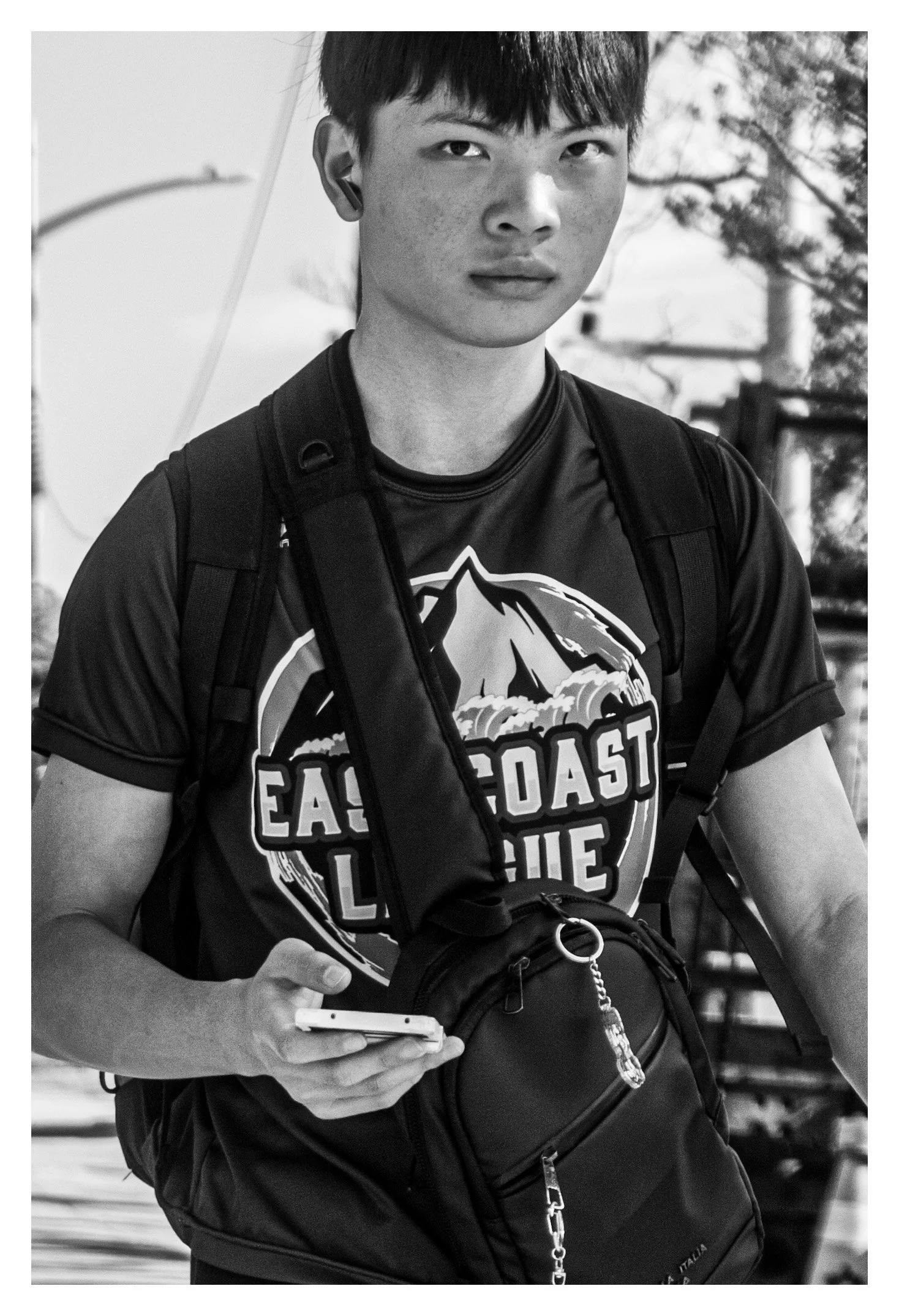
There is an immediate, confrontational energy in this portrait. The subject’s direct eye contact anchors the image, creating a tension that contrasts sharply with the passive nature of the devices he carries—the smartphone in hand and the earbud tucked away. We are presented with a paradox of the modern flâneur: a young man physically present in the urban landscape but digitally insulated from it.
The choice of monochrome is particularly effective here. By stripping away the distracting colors of street fashion and urban signage, you have forced the viewer to focus on the textures—the grit of the skin, the synthetic sheen of the backpack straps, and the graphic mountain on his shirt. This mountain motif serves as a subtle, perhaps accidental, irony: a symbol of the vast outdoors pinned against a backdrop of urban clutter.
However, the composition feels somewhat claustrophobic. The tight vertical crop cuts through the subject’s arms and the backpack, which restricts the "breathability" of the frame. While this reinforces the feeling of urban density, it slightly undermines the environmental aspect of the portraiture.
Refining the Frame
To elevate this work, consider the following adjustments:
• Environmental Context: While the subject is compelling, the background is currently a blur of indistinct shapes. Incorporating a bit more of the Taiwanese streetscape—perhaps a hint of a local shop sign or specific architecture—would ground the subject in a unique sense of place. * Depth and Separation: At f/2.8, your depth of field is shallow, which is excellent for isolation. However, watch for "merged" elements. The tree or pole in the upper right appears to grow out of the subject’s head. Moving your feet just a few inches to the left or right would have separated these planes.
• Tonal Range: The highlights on the subject's forehead and the phone are quite hot. In post-processing, bringing down those highlights slightly would reveal more detail and prevent the eye from "sliding" off the bright spots of the image.
The Long Game: Building Your Vision
To grow from a hobbyist to a master, you must treat your catalog as a living database. Start a "Shoot Diary" where you tag every image with two distinct categories: Intent (What did I want to say?) and Execution (Did the technical choices support that?). Over time, you will notice patterns—perhaps you rely too heavily on center-focusing, or you find your best work consistently happens at a specific focal length.
Recommended Research
Master Photographers to Study
• Chien-Chi Chang: A fellow Magnum photographer from Taiwan. Study his "The Chain" for a lesson in how to use repetitive framing to convey alienation.
• Bruce Davidson: Specifically his "Subway" series. Notice how he uses flash and tight framing to capture the psychological weight of people in transit.
• Fan Ho: For a masterclass in how to use shadows and light to turn a mundane street scene into a geometric masterpiece.
Essential Reading
• The Decisive Moment by Henri Cartier-Bresson: The foundational text for street photography, focusing on the intersection of geometry and timing.
• The Americans by Robert Frank: Observe how an "outsider" perspective can reveal the soul of a culture through candid, often gritty imagery.
• Bystander: A History of Street Photography: This will give you the academic reference needed to understand how the genre has evolved from the 19th century to today.
Educational Media
• The Beauty of Street Photography (The Photographic Eye): A deep dive into the philosophy of the genre.
• https://www.youtube.com/watch?v=kYv_I-3k0Yk
• Daido Moriyama: In Pictures: An exploration of the "Provoke" era's grit and high-contrast style, which aligns with your monochrome aesthetic.