

Day 151/365 The Decisive Friction: Life and Spirit at Shi Luo Dan
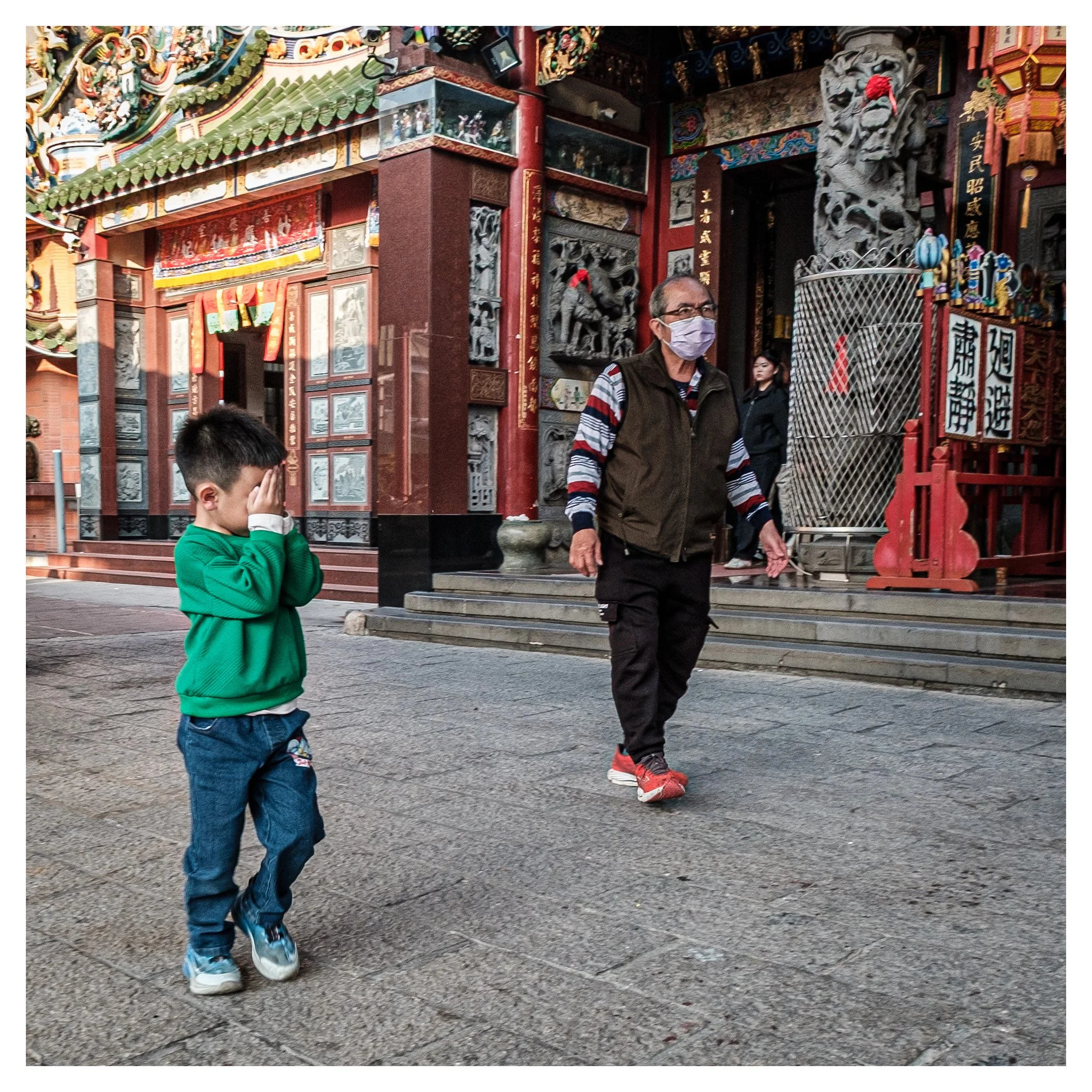
Street photography in Taiwan offers a unique blend of ancient tradition and rapid modern movement. In this analysis of a candid moment at the Shi Luo Dan temple in Tainan, we explore how spatial tension and color theory can transform a simple observation into a compelling narrative of generational contrast.
EXIF Data
Camera Model: Fujifilm X-Pro2
Shutter Speed: 1/250
Aperture: f4
ISO: 400
The Critique: A Study in Urban Synchronicity
This image captures a fascinating moment of psychological and physical "near-miss" in front of the Shi Luo Dan temple in Tainan. The composition is built upon a strong primary color palette—the vibrant green of the child’s sweater contrasting against the deep reds of the temple architecture and the man’s vest.
The true strength of the frame lies in the opposing kinetic energies. On the left, we have a child, stationary and introspective, covering his face in a moment of private play or shyness. On the right, an older man strides purposefully across the frame. This creates a "friction" between the two subjects that mirrors the transition of time and focus within a sacred cultural space.
However, the framing feels slightly congested. The man’s feet are dangerously close to the bottom edge of the frame, which creates "unintentional tension"—a technical distraction that pulls the eye away from the subjects' expressions. The wide-angle lens has also introduced slight vertical distortion on the temple pillars, which pulls the viewer out of the realism of the scene.
Paths to Improvement
To elevate this specific image, I would suggest a lower vantage point. Dropping the camera height would have allowed the child to loom larger against the ornate background, emphasizing his role as the focal point. Additionally, waiting a fraction of a second longer for the man to move further into the frame would have provided more "breathing room" for his stride, completing the story of his movement.
Long-term Growth: Compiling Your Vision
Becoming a master of the craft requires moving from "taking pictures" to "making a body of work." You should begin a Metadata Audit. Every few months, analyze your most successful frames to find your "optical DNA." Are you consistently shooting at the wider end of your lens? If so, you may be a "spatial" photographer who thrives on environment. Understanding your technical habits allows you to lean into your strengths or intentionally break them to find new perspectives.
Recommended Research and Study
To further your development, I recommend looking into the following masters and resources:
Photographers to Study
• Fan Ho: A master of light, shadow, and monochrome street life.
• Chien-Chi Chang: Known for "The Chain," he uses environmental portraiture to tell deep stories within Taiwan.
• Alex Webb: Study his work in "The Suffering of Light" to understand complex frames with vibrant, competing colors.
• Shen Chao-Liang: His "STAGE" series offers a brilliant look at Taiwan's unique cultural landscapes.
Essential Reading
• The Decisive Moment by Henri Cartier-Bresson: The fundamental text on geometry and timing.
• William Eggleston's Guide: A masterclass in the use of color as a primary subject.
• Thoughts on Street Photography: Provides a philosophical approach to why we capture candid moments.
Curated Video Lessons
• The World of Fan Ho: A visual exploration of his "stage-like" lighting in the streets.
https://www.youtube.com/watch?v=8p_h9Y32XIk
• Alex Webb & Rebecca Norris Webb on Street Photography: Insight into layering and complex compositions.
https://www.youtube.com/watch?v=f0fHsh87_I8
• Joel Meyerowitz: What you look at is what you get: A fantastic look at the mindset required for candid street work.