

Day 157/365 Vertical Ambition: Looking Up at Kai Syuan 2nd Road
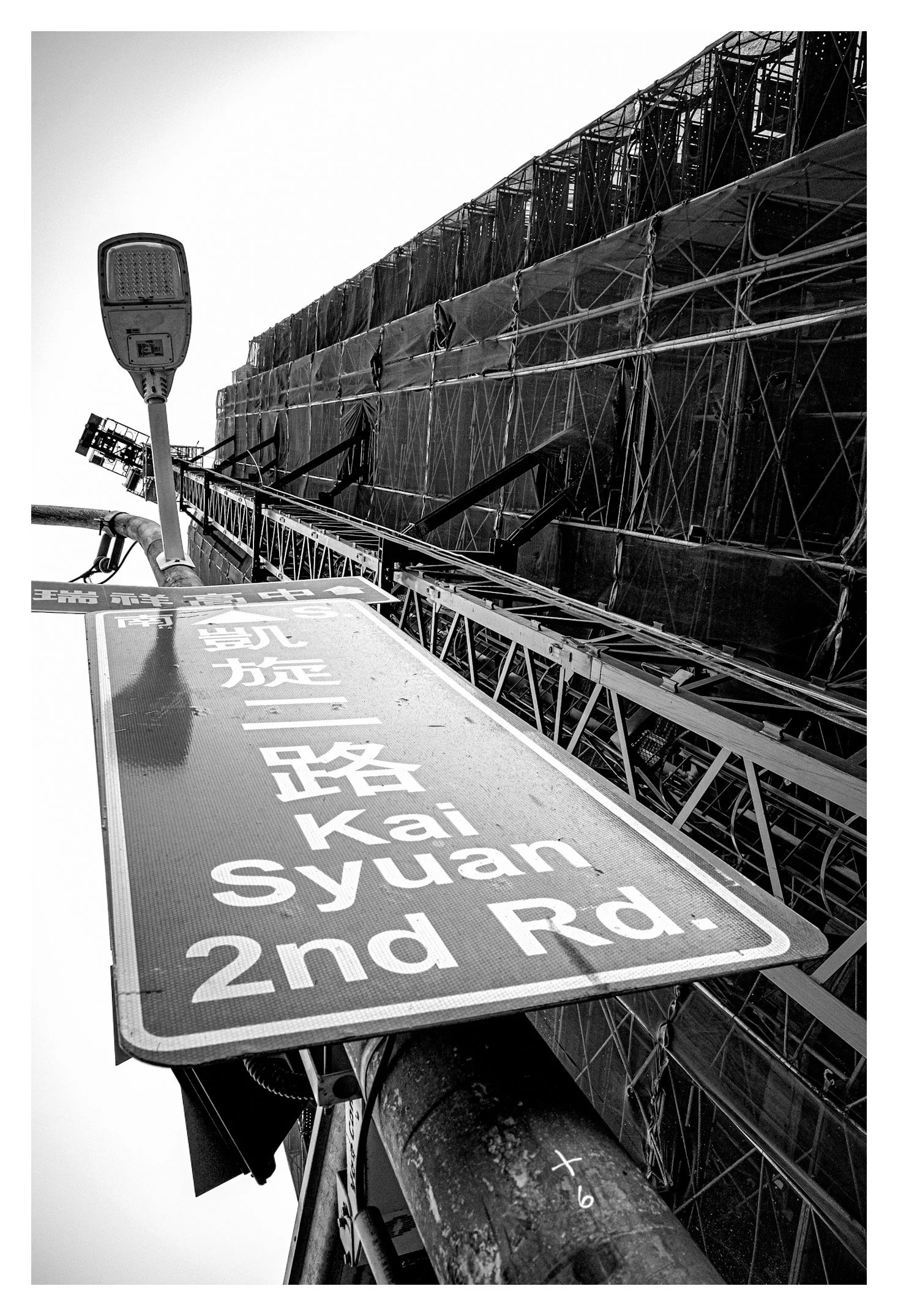
Struggling with the weight of a 365-day commitment? In this critique, I break down a striking low-angle perspective from Kaohsiung that nearly didn't happen. You will discover how a change in viewpoint can rescue a creative rut and why rigid geometry is your best ally when inspiration fails.
EXIF Data
Camera Model: Ricoh GRIII
Shutter Speed: 1/320
Aperture: f8
ISO: 400
The "365 Project" is a notorious double-edged sword. It forces the eye to work when the heart isn't in it, but as you’ve demonstrated here, that friction often produces your most disciplined compositions. By dropping the camera low and pointing it toward the heavens, you’ve transformed a mundane street sign and a construction site into a towering, expressionistic monument.
The choice of monochrome is particularly effective. It strips away the distractions of Kaohsiung’s urban palette, allowing the viewer to focus entirely on the interplay of the diagonal lines and the dense, rhythmic textures of the scaffolding.
Refiniing the Frame
While the upward thrust of the composition is powerful, there are two areas where you could push the "graphic" nature of this image further:
• The Left Margin: The street lamp and the stray pipe on the far left introduce a slight organic clutter that competes with the clean, sharp lines of the sign and the building. In the future, try a minute adjustment in your physical position to either fully embrace those elements as a frame or exclude them entirely to let the primary diagonal breathe.
• The Tonal Gradient: Your sky is quite bright, almost "bleached." With a Ricoh GRIII, you have incredible RAW latitude. In post-processing, consider a slight graduated filter to darken the top-left corner. This would create a "vignette of intent," pushing the viewer's eye back down the scaffolding toward the text on the sign.
The Path to Mastery: Data and Discipline
To move from "taking pictures" to "making work," you must become a student of your own habits. Start a digital log—a spreadsheet or a dedicated notebook—where you record more than just EXIF data.
1. Tag Your Mood: Mark images with how you felt (e.g., "Inspired," "Frustrated," "Routine"). Over six months, you will see if your "frustrated" days actually produce more rigorous, minimalist work like this one.
2. Focal Length Analysis: Since you are using a fixed 28mm equivalent, track your distance from the subject. Are you always 2 meters away? Challenge yourself to get 50cm away or 10 meters back.
3. Light Conditions: Note the weather. You’ll eventually identify which atmospheric conditions best suit your "Photos of Taiwan" aesthetic.
Curated Inspiration
Photographers to Study
• Fan Ho: Master his use of "Classic Composition" and how he used shadows to create scale in urban environments.
• Takuma Nakahira: Study his "Provoke" era work for a lesson in "urban" and "political" grit that utilizes high contrast and experimental angles.
• Yasuhiro Ishimoto: Look for his "Katsura" series to see how architecture can be turned into pure geometric abstraction.
Literature for the Shelf
• "The Decisive Moment" by Henri Cartier-Bresson: This is the "bible" for understanding "geometry" and "time" in a single frame.
• "For a Language to Come" by Takuma Nakahira: Essential for understanding how to capture the "raw" energy of a changing city.
• "Uncommon Places" by Stephen Shore: While in color, his mastery of the "large format" aesthetic will teach you how to see "cultural landscapes" with more intention.
Educational Video Resources
• The Art of Street Photography (Magnum Photos): A deep dive into the "process" and "behind the scenes" of world-class shooters.
• https://www.youtube.com/watch?v=68H9T-Vsz_I
• The Genius of Fan Ho: An exploration of his "nostalgia" and "shadow" work in mid-century Hong Kong.
• https://www.youtube.com/watch?v=l_v-2G_vG0k
• The Philosophy of Photography: A look at "theory" and "essays" that help transition from technical execution to "wisdom".
• https://www.youtube.com/watch?v=17XpD-kLqIs
Don't let the 365 project become a chore. When you feel the "fun" slipping away, lean into the geometry. The camera doesn't care if you're tired; it only cares where you point it. Keep looking up.