

Day 158/365 The Smiling Sentry: Street Anthropomorphism in Taiwan
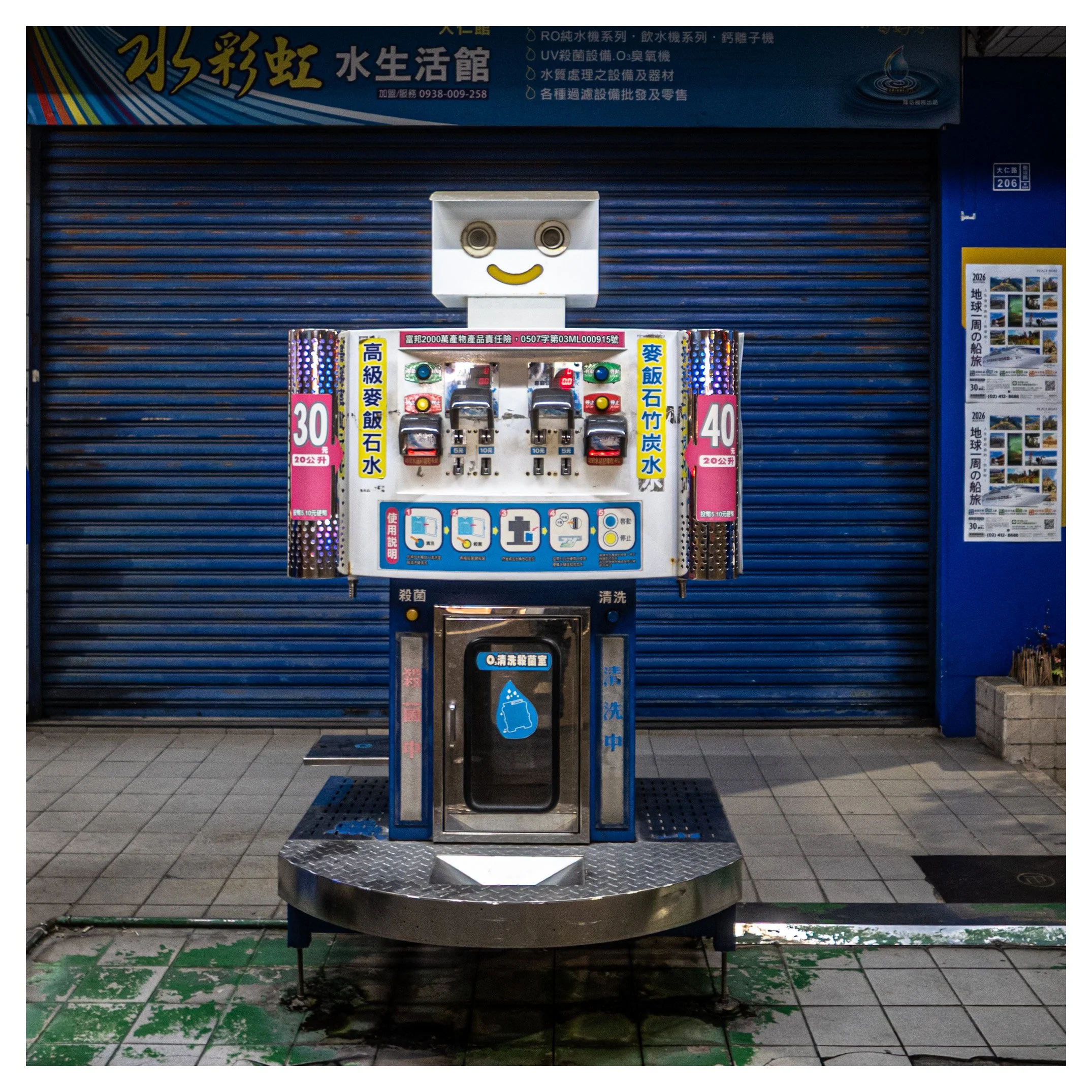
From the bustling sidewalks of Taiwan comes an image that turns a utilitarian object into a character with a soul. You will learn why this "robot" water station succeeds as a study in urban personality and how adjusting your depth of field could transform your street portraiture forever.
Camera Metadata
• Camera Model: Leica D-Lux 8
• Shutter Speed: 1/30
• Aperture: f1.7
• ISO: 400
The Critique: Finding the Soul in the Machine
As a critic, I am always hunting for the "found" character within the urban landscape. This image is a delightful example of anthropomorphism—the attribution of human traits to non-human entities. By centering this water dispensing station, you have transformed a piece of industrial infrastructure into a friendly "Smiling Sentry."
The choice of a low-angle perspective lends the subject a heroic, almost monumental presence. The symmetry of the blue rolling shutter behind the machine provides a rhythmic, textured backdrop that makes the white and blue of the station pop. Your Leica has rendered the colors with a lovely, natural fidelity, capturing the specific teal and cobalt tones common in Taiwanese street life.
However, the composition feels slightly "taped" to the center. While the symmetry is intentional, the inclusion of the green-stained pavement at the bottom is a bit distracting. It anchors the robot, but the texture of the mossy ground competes with the intricate buttons and signage on the machine itself.
How to Improve This Image
To elevate this specific shot, I recommend two primary adjustments:
• Step into the Subject: Move closer and tilt the camera slightly more upward. This would crop out the distracting pavement and emphasize the "face" of the machine against the blue shutter.
• Manage the Background: While f1.7 is a wide aperture, the proximity to the background shutter means we still see a lot of detail in the metal slats. To create more separation, try to find subjects that are further away from their background to let that Leica glass truly "melt" the surroundings into a creamy bokeh.
Becoming a Master: Compiling Your Vision
To grow as a photographer, you must stop looking at your photos as individual captures and start seeing them as a database of intent. I suggest you maintain a digital ledger—similar to the books_database reference—where you tag your images with keywords like "Taiwan," "Street Portraiture," or "Surrealism."
Over time, look for patterns. Do you always shoot at 1/30? Are you always at f1.7? If you find you are always shooting wide open, challenge yourself to shoot at f8 for a week to see how "deep" focus changes your storytelling.
Research and Study
To broaden your perspective on street photography and the cultural landscape of Taiwan, I recommend the following resources:
Photographers to Study
• Shen Chao-Liang: Specifically his STAGE series. He captures Taiwanese "stage wagons" with a similar sense of nighttime surrealism and cultural landscape.
• Michael Wolf: Look at his work on "Architecture of Density" or "Tokyo Compression" to see how to handle repetitive urban patterns.
• Fan Ho: For a masterclass in how to use light, shadow, and geometric composition in Asian street scenes.
Books to Read
• The Americans by Robert Frank: A seminal work on being an "outsider" looking at a culture, providing a raw and influential look at the social landscape.
• The Decisive Moment by Henri Cartier-Bresson: The "bible" of photography that focuses on geometry and timing.
• Magnum Contact Sheets edited by Kristen Lubben: To see the process behind the masterpieces and how great photographers "work" a scene.
Videos to Watch
• The Mind of a Master - Henri Cartier-Bresson: A deep dive into the philosophy of the "decisive moment."
https://www.youtube.com/watch?v=eiOtc7I38S0
• Fan Ho: The Master of Light and Shadow: An exploration of his legendary Hong Kong street photography.
https://www.youtube.com/watch?v=L_6vE_76-wM
• How Robert Frank Changed Photography: A breakdown of his aesthetic and why "The Americans" remains so vital today.