

Day 160/365 Reflections in Monochrome: Brielle at Tiny Cafe
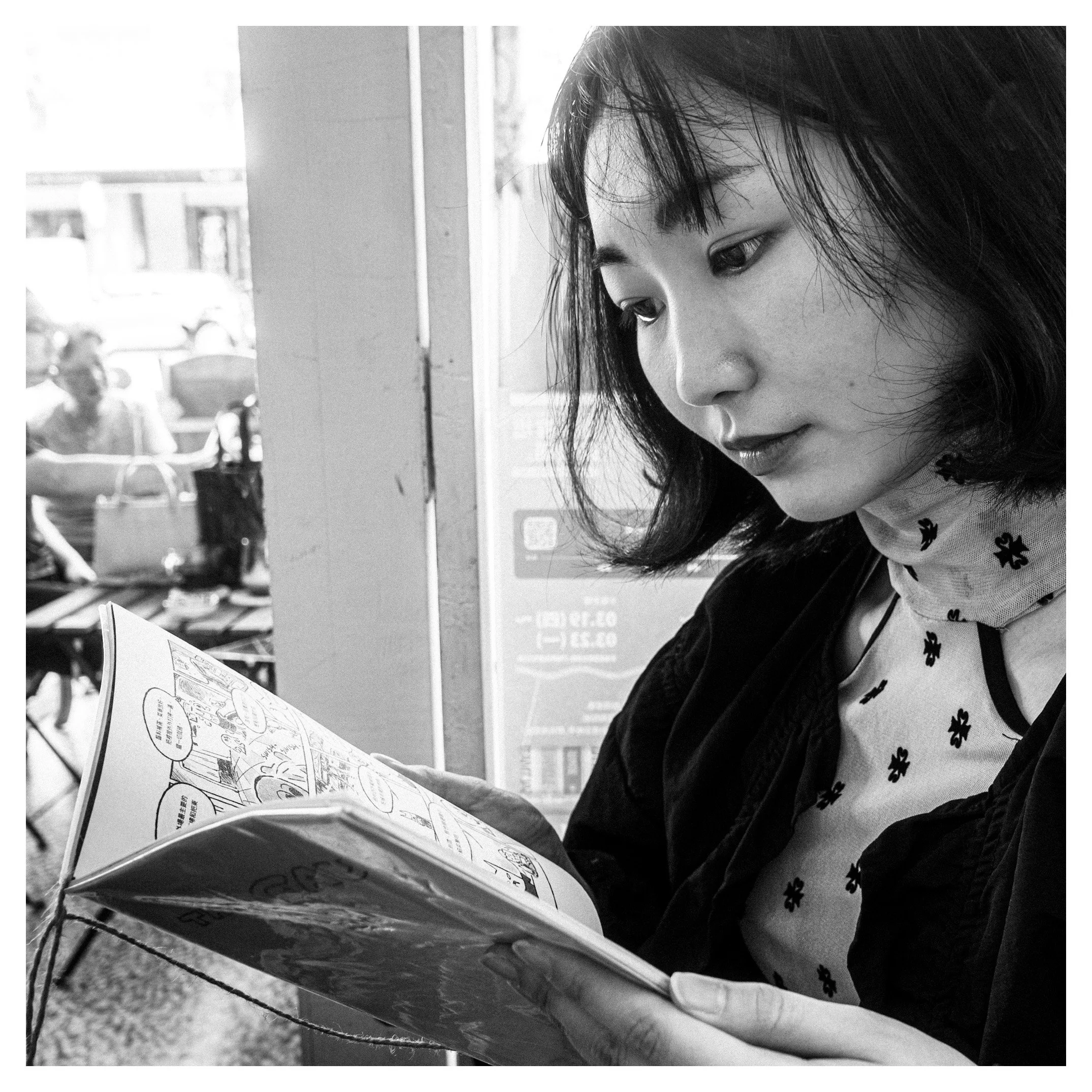
Step inside the quiet corners of Kaohsiung’s Tiny Cafe for an intimate encounter with actress Brielle. In this critique, we dissect the delicate balance of light and shadow in street portraiture. You will discover how a single reflected line can transform a candid moment into a cinematic narrative.
EXIF Data
Camera Model: Leica D-Lux 8
Shutter Speed: 1/30
Aperture: f4
ISO: 400
The Critique: A Study in Quiet Intimacy
There is a palpable sense of "the interval" in this frame—a moment of pause in the bustling life of an actress. By choosing a black-and-white treatment, you have stripped away the potential distractions of cafe decor, forcing the viewer to engage with the texture of the scene and the intensity of Brielle’s gaze.
The composition utilizes a strong vertical division. The window frame acts as a secondary border, creating a "frame within a frame" effect that separates the interior sanctuary from the out-of-focus world behind her. This highlights her solitude. The exposure on her face is handled with remarkable sensitivity; the highlights on her forehead and nose provide a soft, sculptural quality that contrasts beautifully with the dark, patterned fabric of her attire.
However, the image's greatest strength is also its challenge. The book she is reading—the primary object of her attention—is slightly "hot" in terms of exposure and falls at the very bottom edge of the frame. This leads the eye downward and out of the image rather than cycling it back toward her expression.
Pathways to Improvement
To elevate this specific shot, consider the following technical and stylistic adjustments:
• Mind the Highlights: The page of the book is pulling significant visual weight because it is the brightest part of the frame. In post-processing, a subtle local adjustment to bring down the highlights on the paper would keep the focus on Brielle’s eyes.
• Depth and Focal Plane: At f4, you have achieved a nice fall-off, but at a shutter speed of 1/30, there is a risk of micro-blur from subject movement or camera shake. Increasing your ISO to 800 would have allowed for a faster shutter speed, ensuring the eyelashes and fine details are tack-sharp.
• Spatial Breathing Room: Give the book just a fraction more space at the bottom. Cutting off the edge of the subject's hands can feel abrupt. Allowing the hands to be fully encased in the frame adds to the "completeness" of the gesture.
Developing Your Photographic Eye
To become a master of the craft, you must move beyond the single frame and begin to see your work as a data set.
Compiling Your Data
Start a "Shooting Diary." For every hundred photos, identify three that failed and one that succeeded. Note the lighting conditions and your emotional state at the time. Over six months, look for patterns: Do you consistently underexpose in cafes? Do you favor a specific profile? This analytical approach turns "luck" into "intent."
Recommended Research
• Photographer to Study: Fan Ho. His work in mid-century Hong Kong is the gold standard for using light, shadow, and scale in Asian urban environments. Study how he uses geometric shadows to lead the viewer's eye.
• Book to Read: "The Decisive Moment" by Henri Cartier-Bresson. This is the "Bible" of street photography. It will teach you the relationship between geometry, time, and the human element.
• Secondary Study: "The Americans" by Robert Frank. Study this for its raw, outsider perspective on everyday life.
Watch and Learn
• The Art of Street Photography (Magnum Photos): To understand the philosophy of the masters.
https://www.youtube.com/watch?v=6e3_K_8L6_M
• Fan Ho: Visual Poet of Hong Kong: A deep dive into the lighting techniques of the master mentioned above.