

Day 161/365 The Crimson Arc: Geometry and Tension in the Urban Landscape
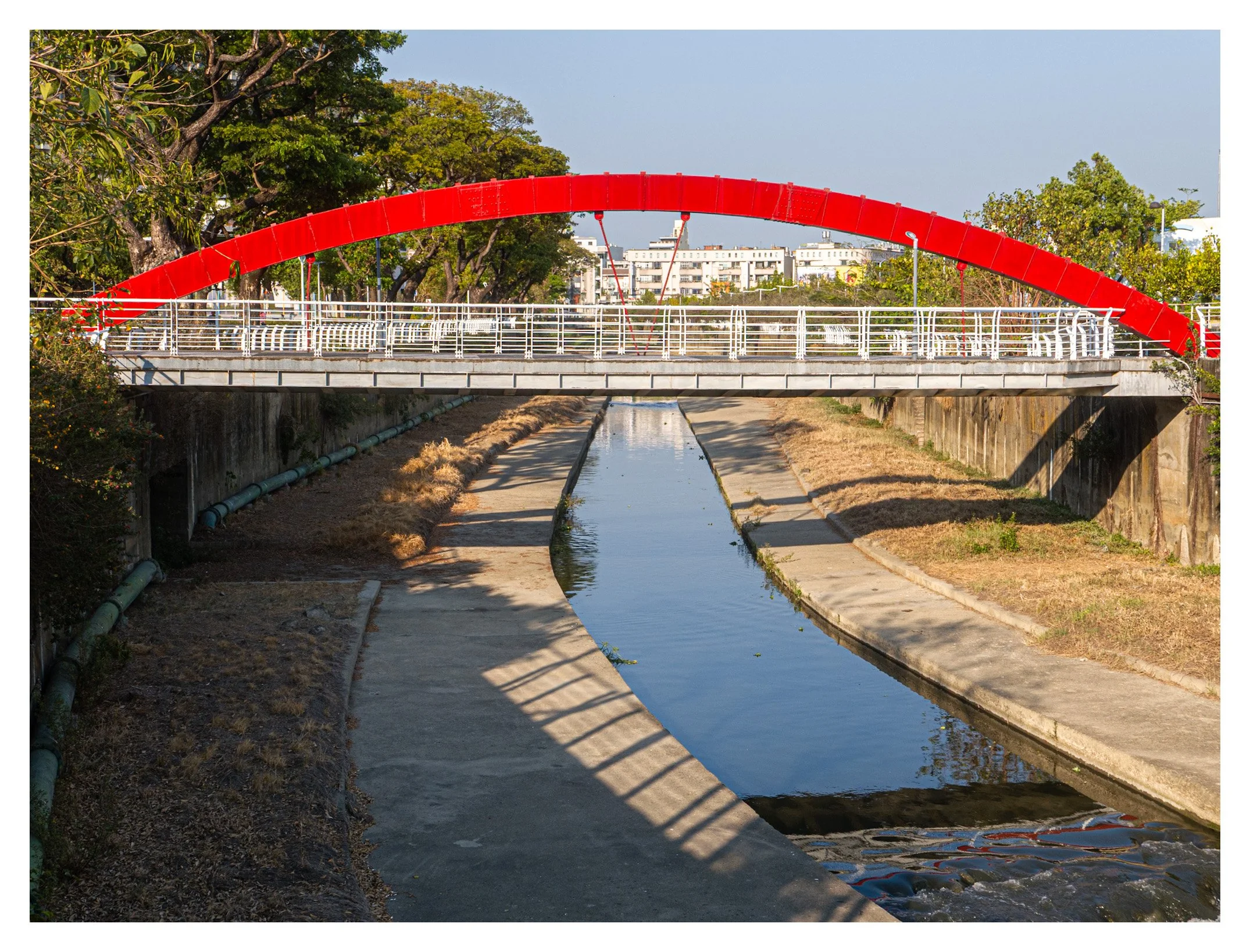
A single bold stroke of red can redefine an entire composition. In this critique of a contemporary Taiwanese scene, we explore how architectural geometry interacts with natural light. You will learn why the placement of this bridge creates a unique visual tension and how to refine your eye for industrial symmetry.
Image Metadata
Camera Model: Leica D-Lux 8
Shutter Speed: 1/500
Aperture: f/5.6
ISO: 200
The image presented is a fascinating study of linear perspective and color theory. The primary strength lies in the aggressive contrast between the vibrant red of the pedestrian bridge and the muted, earthy tones of the concrete canal. This "Crimson Arc" acts as a powerful visual anchor, preventing the viewer's eye from escaping through the top of the frame.
The low-angle perspective successfully emphasizes the receding lines of the canal walls, creating a strong sense of depth. However, the composition currently feels somewhat "centered," which can lead to a static energy. The harsh midday shadows, while adding texture to the concrete, create high-contrast patches that compete with the bridge for the viewer's attention.
Refined Advice for Improvement
To elevate this specific scene, consider the following technical and creative adjustments:
• Wait for the "Golden Hour": The current lighting is quite harsh. Shooting during the late afternoon would cast longer, softer shadows and bathe the red metal in a warmer, more cinematic glow.
• The Power of Inclusion: The image is a "landscape of things," but it lacks a "protagonist." A single person walking across that red bridge would provide a sense of scale and a narrative element that transforms a record of a place into a story about a place.
• Simplify the Foreground: The foliage on the left is slightly distracting. By stepping further to the right or using a slightly tighter focal length, you could eliminate the cluttered edges and focus entirely on the intersection of the arc and the canal.
Developing Your Vision Over Time
Becoming a master of the craft requires more than just a good eye; it requires a systematic analysis of your own evolution. I recommend keeping a digital contact sheet of your "near misses." Every month, look at your ten best images and your ten worst. Identify the common denominator. Is it a specific aperture you favor? Is it a tendency to center the subject? By compiling this data, you move from "taking" photos to "making" them with intent.
Curated Resources for Study
To further your understanding of color, street photography, and urban landscape, I recommend diving into the following masters:
Photographers to Research
• Fan Ho: For his unparalleled mastery of light, shadow, and geometric composition in urban settings.
• Stephen Shore: Specifically his work in Uncommon Places, to understand how to find beauty in "boring" or industrial locations.
• Chien-Chi Chang: A Magnum photographer whose work, such as The Chain, demonstrates the power of psychological depth in Taiwanese contexts.
Books to Read
• The Decisive Moment by Henri Cartier-Bresson: The foundational text on timing and geometry.
• Think Like a Street Photographer by Matt Stuart: A contemporary guide to developing a quick, observant eye for humor and coincidence.
• William Eggleston's Guide: Essential for understanding how to use bold, saturated color as the primary subject of a photograph.
Videos to Watch
• The Art of Photography: Composition: A deep dive into how lines and shapes guide the human eye. [https://www.youtube.com/watch?v=Zp_v_E_G3p0]
• The Photography of Alex Webb: Webb is a master of complex compositions and vibrant color. This profile explores his process. [https://www.youtube.com/watch?v=680X6_QnUrc]
• Joel Meyerowitz - What You Saw and How You Felt: An inspiring talk on the transition from looking to truly seeing. [https://www.youtube.com/watch?v=Xm90v_l6e0E]