

Day 176/365 The Irony of the Urban Oasis: Water, Waste, and the Night Shift
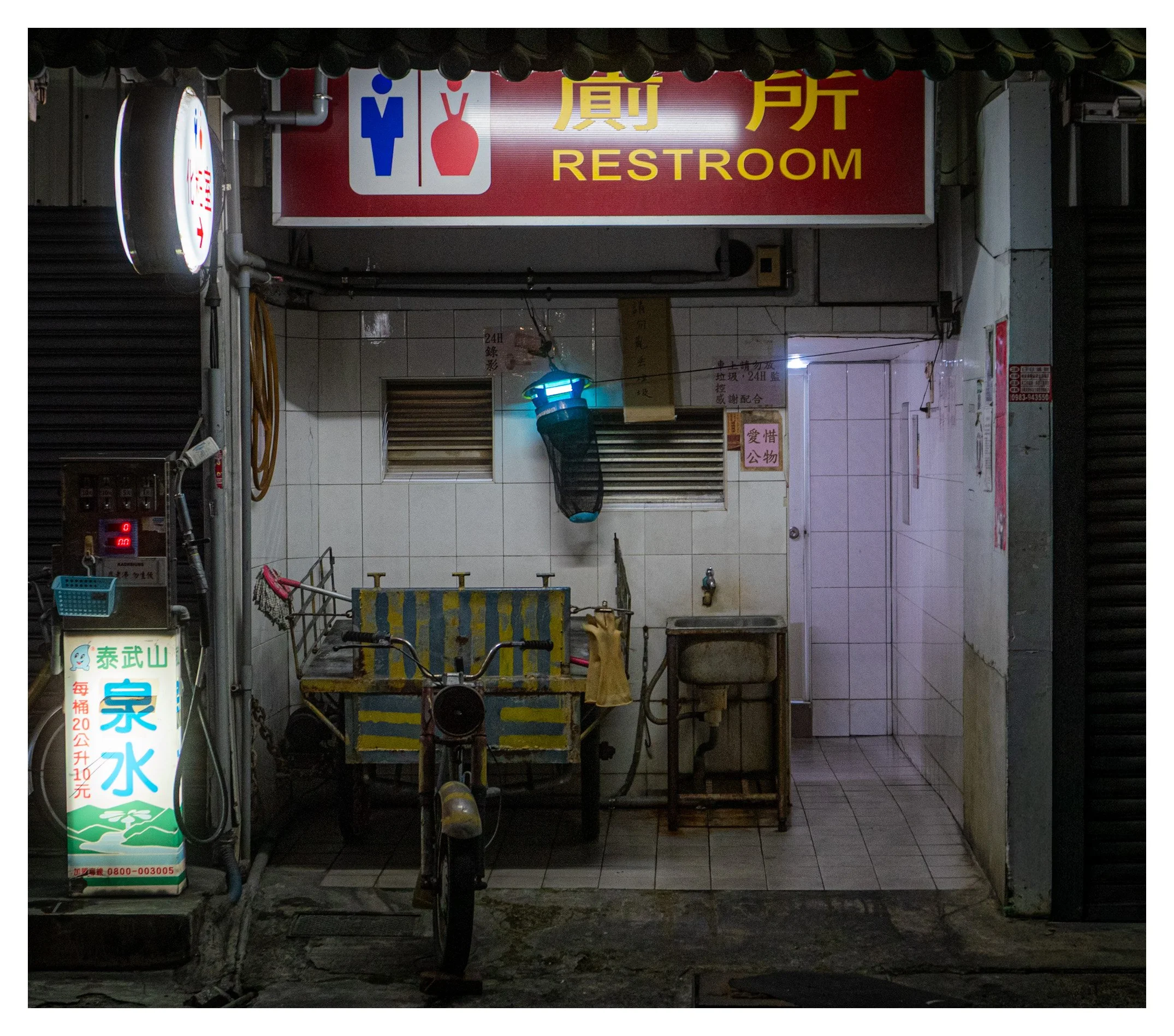
When we look at the mundane corners of our cities, what do we truly see? Explore how a chance encounter between a public restroom and a water kiosk reveals a deeper narrative of urban absurdity. You will learn why this specific composition works—and where it falters.
Technical Metadata
• Camera Model: Leica D-Lux 8
• Shutter Speed: 1/30
• Aperture: f/2.8
• ISO: 500
The Critique
There is a delightful, gritty irony at play here. You have captured a quintessential "slice of life" in Taiwan—the utilitarian intersection of the body's needs. On the left, we have the "Mount Tai Spring Water" kiosk, promising purity for ten dollars, while the bold red signage above points toward the inevitable destination of that same water. This is a classic "cultural landscape" shot, bordering on the surreal.
The color palette is remarkably cohesive. The warm yellow of the restroom sign and the weathered "stage wagon" style cart in the center provides a tonal anchor against the sterile white tiles. However, the true star is that cyan bug zapper. Its cool, artificial glow creates a secondary focal point that prevents the eye from lingering too long on the dark, empty doorway to the right.
Path to Improvement
While the juxtaposition is amusing, the framing feels slightly hesitant. To elevate this image, consider the following:
• Verticality and Alignment: The horizontal line of the "RESTROOM" sign is slightly skewed. In architectural or urban photography, precision is paramount. A perfectly level horizon would make the "absurdity" feel more intentional rather than accidental.
• Depth of Field: At f/2.8, you have a decent amount of light, but the background inside the restroom is slightly soft. Stopping down to f/5.6 or f/8 (perhaps with a tripod to compensate for the slower shutter speed) would bring those interior tiles into sharp relief, emphasizing the "claustrophobic" nature of the urban environment.
• Negative Space: The black shutters on the far right and left add "dead weight." Cropping in tighter to focus on the water kiosk, the tri-cycle, and the sink would intensify the narrative.
Long-Term Growth: Data and Curation
To become a master of your craft, you must move beyond the "one-off" shot. Start compiling your metadata into a structured database. By tracking your aperture and ISO choices alongside the "emotional success" of your photos, you will notice patterns. Are your best night shots consistently at ISO 500? Do you prefer the compressed look of a tighter crop?
Curation is the critic’s greatest tool. Look at your work as a "retrospective". Group your images by themes—Taiwanese night life, urban ironies, or "cultural landscapes". This transforms a collection of photos into a cohesive body of work.
Curated Recommendations
Photographers to Study
• Shen Chao-Liang: Specifically his "STAGE" series. He excels at capturing Taiwanese stage wagons and the surreal quality of local night life.
• Michael Wolf: Study his "Tokyo Compression" series to understand how to handle tight, urban spaces and the feeling of claustrophobia.
• Fan Ho: For a masterclass on how to use light and shadow within the "nostalgia" of Asian street scenes.
Books for Your Library
• The Chain by Chien-Chi Chang: A masterpiece in environmental portraiture and the exploration of mental/physical spaces.
• Uncommon Places by Stephen Shore: This will teach you how to find the extraordinary within the ordinary, "mundane" American (or global) landscape.
• The Decisive Moment by Henri Cartier-Bresson: The "bible" of geometry and timing in photography.
Videos to Watch
• The Beauty of Mundane Objects: A look at how to find art in the everyday.
• https://www.youtube.com/watch?v=V7z7BAZMA2s
• Mastering Night Photography with Leica: Technical tips for handling low light without losing detail.
• https://www.youtube.com/watch?v=fS_65WvTscM
• Composition and Color Theory in Street Photography: Understanding how colors like red and yellow guide the viewer’s eye.