

Day 206/365 Monsoon: A Self-Portrait in Endurance
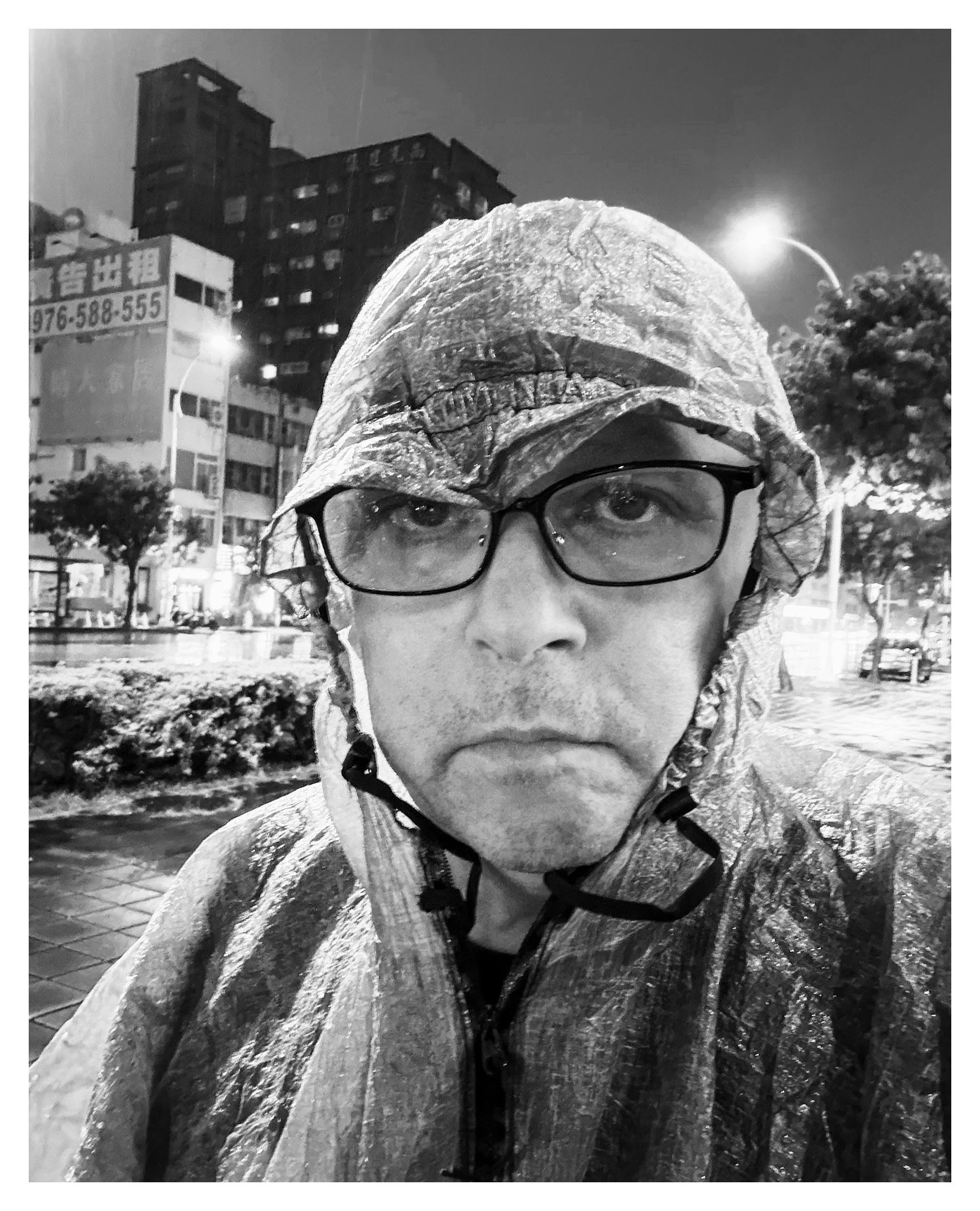
Hooded in crinkled Cuben fiber, glasses beaded with rain, a self-portrait taken on yet another wet night in Kaohsiung. A direct, unglamorous study in fatigue, weather, and the particular expression a person makes when they’re simply done with it.
Camera Model: Apple iPhone
Shutter Speed: 1/15 sec
Aperture: f/1.9
ISO: 640
The Critique
This self-portrait belongs to a very specific and honest tradition within photography: the artist turning the camera on themselves not to flatter, but to document a genuine state — here, exhaustion with a monsoon season that has simply refused to let up. Lee Friedlander built an entire, career-spanning body of work called Self Portrait, using his own reflection and shadow as a recurring, often deadpan presence within his street photography, less interested in vanity than in simply being honest about his own place within the frame. This image works in that same unglamorous register — no posing, no flattering angle, just a direct, close confrontation with the camera under a hood of ultralight technical fabric.
The expression is doing all the emotional work here, and it’s genuinely well caught: a flat, faintly exasperated look, mouth set in a slight downward line, eyes half-lidded behind rain-speckled glasses. There’s no performance in it. This reads exactly like what it is — a person who has been out in the rain for days on end and has stopped pretending otherwise. That honesty is worth protecting; it’s tempting, in a posed self-portrait, to soften an expression for the camera, and the refusal to do that here is the photograph’s real strength.
Technically, the close framing and the hard artificial light source (likely a nearby streetlight, visible glowing in the upper right) create dramatic, almost theatrical illumination across the face, catching the texture of both skin and the poncho’s distinctive surface in fine detail. The hood is made of Cuben fiber — properly known as Dyneema Composite Fabric, an ultralight technical material favored by long-distance hikers for its strength-to-weight ratio — and its crinkled, semi-translucent, papery sheen reads almost architecturally under this raking light, closer in texture to sailcloth or rice paper than to anything disposable. That material detail adds a nice layer of specificity most viewers won’t clock consciously but will register as slightly unusual and worth a second look.
The black-and-white treatment suits the mood precisely — color would have introduced a garishness that stripped tone avoids, letting the image sit in a properly somber, weather-worn register. The background, softly blurred but still legible — wet pavement, a lit high-rise, a real estate signboard — grounds the image firmly in a specific, ordinary Kaohsiung street rather than anywhere generic.
Where the image could be pushed further is in the shallow depth of field at f/1.9 combined with the slow 1/15s shutter speed — handheld selfies at this combination risk motion softness, and there’s a slight touch of softness across the eyes that a marginally faster shutter speed (even at the cost of a stop or two more ISO) might have resolved more crisply.
How This Image Could Be Improved
• Consider a faster shutter speed for handheld self-portraits at night. 1/15s is demanding even with image stabilization; bumping ISO further to allow 1/30s or faster would likely sharpen the eyes and glasses detail.
• Highlight the Cuben fiber’s texture more deliberately. It’s a genuinely unusual, technical material with a distinctive optical quality under raking light — a future frame that plays up its translucency or sheen could make the fabric itself a stronger secondary subject.
• Try a version with slightly more headroom. The hood crowds close to the top of the frame; a touch more space above could ease the composition without losing the tight, confrontational intimacy.
Becoming a Better Photographer Over Time
• Build a personal self-portrait practice, even briefly. Regularly turning the camera on yourself, especially during difficult or notable moments, creates an honest visual diary that’s genuinely rare and valuable over time.
• Resist the urge to perform for your own camera. The strength of this image comes from an unguarded expression; practice catching yourself in genuine states rather than composed ones.
• Study available night light as your primary tool for self-portraiture. Streetlights, shopfronts, and ambient urban glow can produce dramatic, characterful lighting without any additional equipment — learn to position yourself relative to these sources deliberately.
Photographers to Study
• Lee Friedlander — for his decades-long, unglamorous self-portrait practice woven into his street photography.
• Francesca Woodman — for her raw, emotionally direct engagement with self-portraiture.
• Rineke Dijkstra — for her unflinching portraits capturing people in states of genuine physical and emotional rawness.
• Peter Hujar — for his intimate, direct black-and-white portraiture, often self-directed.
• Anders Petersen — for his gritty, emotionally honest black-and-white night photography.
Books Worth Reading
• Lee Friedlander: Self Portrait
• Francesca Woodman (Guggenheim retrospective monograph)
• Rineke Dijkstra: A Retrospective
• Peter Hujar: Speed of Life
• Café Lehmitz by Anders Petersen
Videos Worth Watching
• Ted Forbes, The Art of Photography channel — for historical context on Friedlander’s self-portrait tradition and its influence on documentary photography.
• Sean Tucker’s channel — his videos on authenticity and presence apply directly to catching genuine, unguarded expressions, including your own.
• Search “self-portrait photography honesty over vanity” tutorials — several photographers cover the specific challenge of avoiding performance when turning the camera on yourself.