

Day 307/365 Downpour on Lingya: A Vertical Study in Rain and Facade
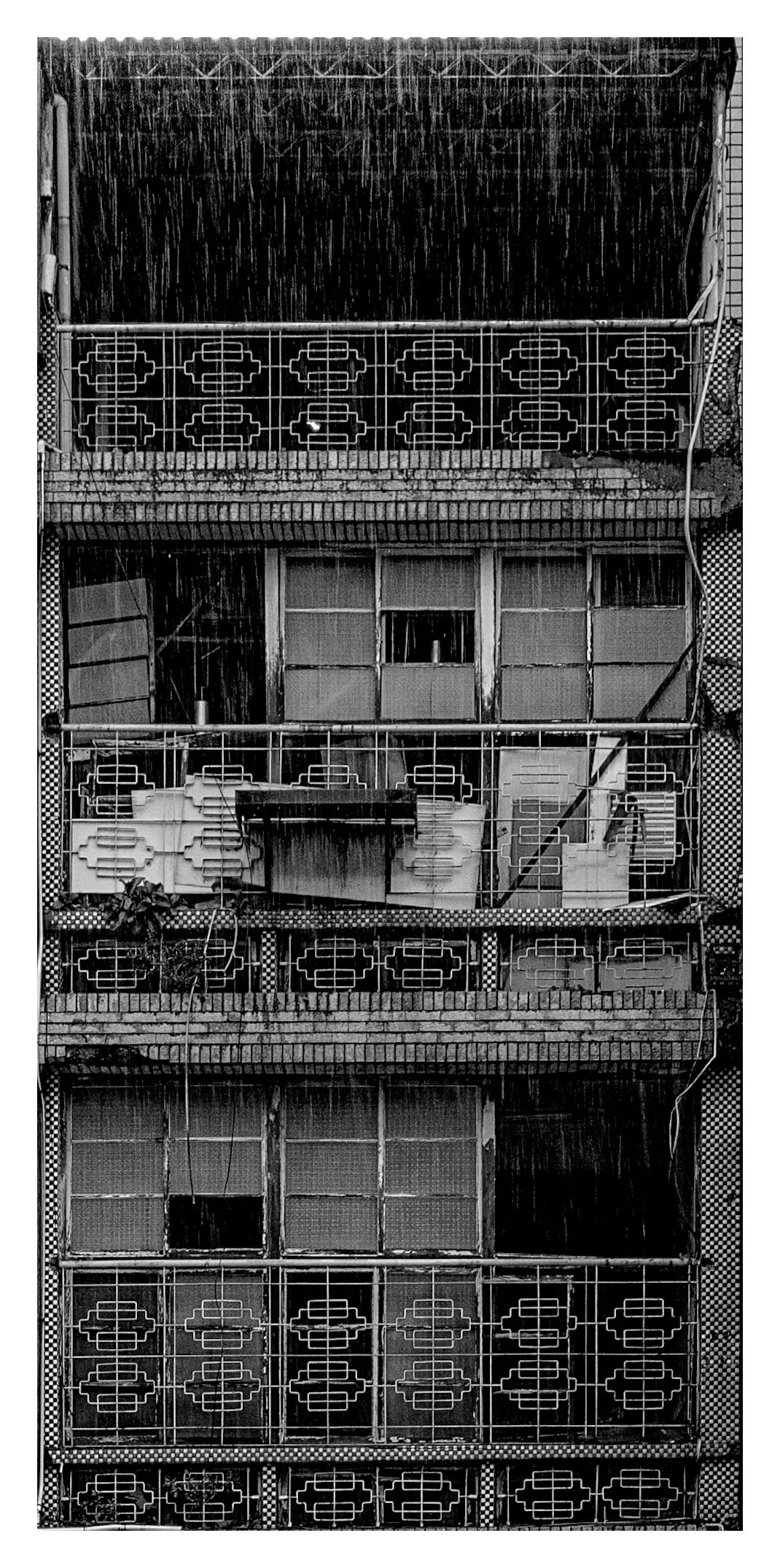
A tall apartment facade, its decorative grilles and cluttered balconies streaked top to bottom by heavy monsoon rain. A vertical black-and-white study in texture, weather, and the accumulated life visible behind a building’s ornamental screens.
Camera Model: Ricoh GR III
Shutter Speed: 1/100 sec
Aperture: f/4
ISO: 500
The Critique
This photograph captures Kaohsiung’s monsoon rain not as an obstacle to work around, but as the actual subject — visible, textural, rendered as fine vertical streaks cutting down through the entire frame at 1/100th of a second, fast enough to freeze individual rain lines rather than blur them into a wash. That’s a genuinely important technical choice: at a slower shutter speed, this would read as generalized haze; here, the rain has real linear presence, almost like static or film grain laid directly over the architecture beneath it.
There’s a meaningful connection to Shōmei Tōmatsu here, who began his career photographing the aftermath of floods and typhoons in his native Nagoya, driven by direct personal experience of the devastating 1953 and Ise Bay typhoons that killed thousands. Tōmatsu’s lifelong interest in how extreme weather and disaster leave their mark on ordinary Japanese life — and how photography could document that relationship with unflinching directness — resonates with this frame’s straightforward commitment to showing exactly what heavy rain does to an aging residential building, without romanticizing or minimizing it.
The vertical composition is doing serious structural work. Stacked floor upon floor, the facade’s repeating decorative security grilles — a traditional geometric lattice pattern common across older Taiwanese apartment buildings — create a rhythmic visual base that the rain streaks then cut directly across, producing a genuine tension between the building’s fixed, ornamental geometry and the weather’s chaotic, linear intrusion. The cluttered balconies, visible through and around the grillework — stacked boards, a small potted plant, tangled wiring, an old chair — add real documentary richness, evidence of decades of accumulated domestic life stored in these narrow outdoor spaces.
Technically, the black-and-white treatment and tight tonal control keep the rain streaks legible against the dark, wet facade without letting the image collapse into pure noise — a real risk when photographing heavy rain against a busy, detailed background. Where the composition could be pushed further is in the very top of the frame, where the roofline and drainage grate read slightly compressed; a touch more headroom might have let that architectural detail breathe a bit more within the overall vertical sweep.
How This Image Could Be Improved
• Consider a touch more headroom at the top. The roofline and drainage element feel slightly cramped against the frame edge; a small adjustment could ease that compression.
• Watch for consistency in rain-streak direction across future frames. Wind angle changes how rain reads in a photograph; this frame’s mostly vertical streaks work well, but experimenting with more diagonal rain in windier conditions could produce a different, equally compelling effect.
• Explore a companion dry-weather shot from the same position. A before-and-after pairing showing this exact facade under clear skies would make the rain’s transformative effect even more vivid by contrast.
Becoming a Better Photographer Over Time
• Treat difficult weather as subject matter, not an obstacle. Tōmatsu’s career-shaping early encounters with typhoons suggest that extreme conditions, properly documented, can become some of the most powerful material available — actively seek out storms and heavy rain rather than waiting them out.
• Study shutter speed’s effect on rain rendering specifically. Log a range of speeds across different rain intensities to build a personal library of how each setting transforms falling water into visible texture.
• Return to distinctive local architecture repeatedly in different weather. A facade like this one, with its traditional grillework, will read completely differently in flat overcast light, harsh sun, or heavy rain — building a weather-based series around a single building can be genuinely rewarding.
Photographers to Study
• Shōmei Tōmatsu — for his foundational documentation of Japanese weather, disaster, and its lasting mark on ordinary life.
• Miyako Ishiuchi — for her textural, tactile black-and-white studies of aging buildings and surfaces.
• Issei Suda — for his quiet, observational documentation of everyday Japanese urban decay and detail.
• Toshio Shibata — for his dramatic, high-contrast treatment of architecture and infrastructure.
• Bernd and Hilla Becher — for the underlying typological discipline evident in this facade’s repeating grille structure.
Books Worth Reading
• Shomei Tomatsu: Skin of the Nation
• Miyako Ishiuchi: Scars
• Fushi Kaden by Issei Suda
• Toshio Shibata: Constructed Landscapes
• Bernd and Hilla Becher: Typologies of Industrial Buildings
Videos Worth Watching
• “The MOST Influential Japanese Street Photographer EVER // Shomei Tomatsu” — a solid overview of Tōmatsu’s career, including his early disaster and weather-focused documentary work.
• “The Photography of Shomei Tomatsu | Postwar Japan Through the Lens” — further context on his approach to memory, trauma, and place.
• Ted Forbes, The Art of Photography channel — for broader grounding in postwar Japanese photography and its documentary traditions.