

Day 305/365 Corridor of Light: A Walk Through Taichung’s Green Museumbrary
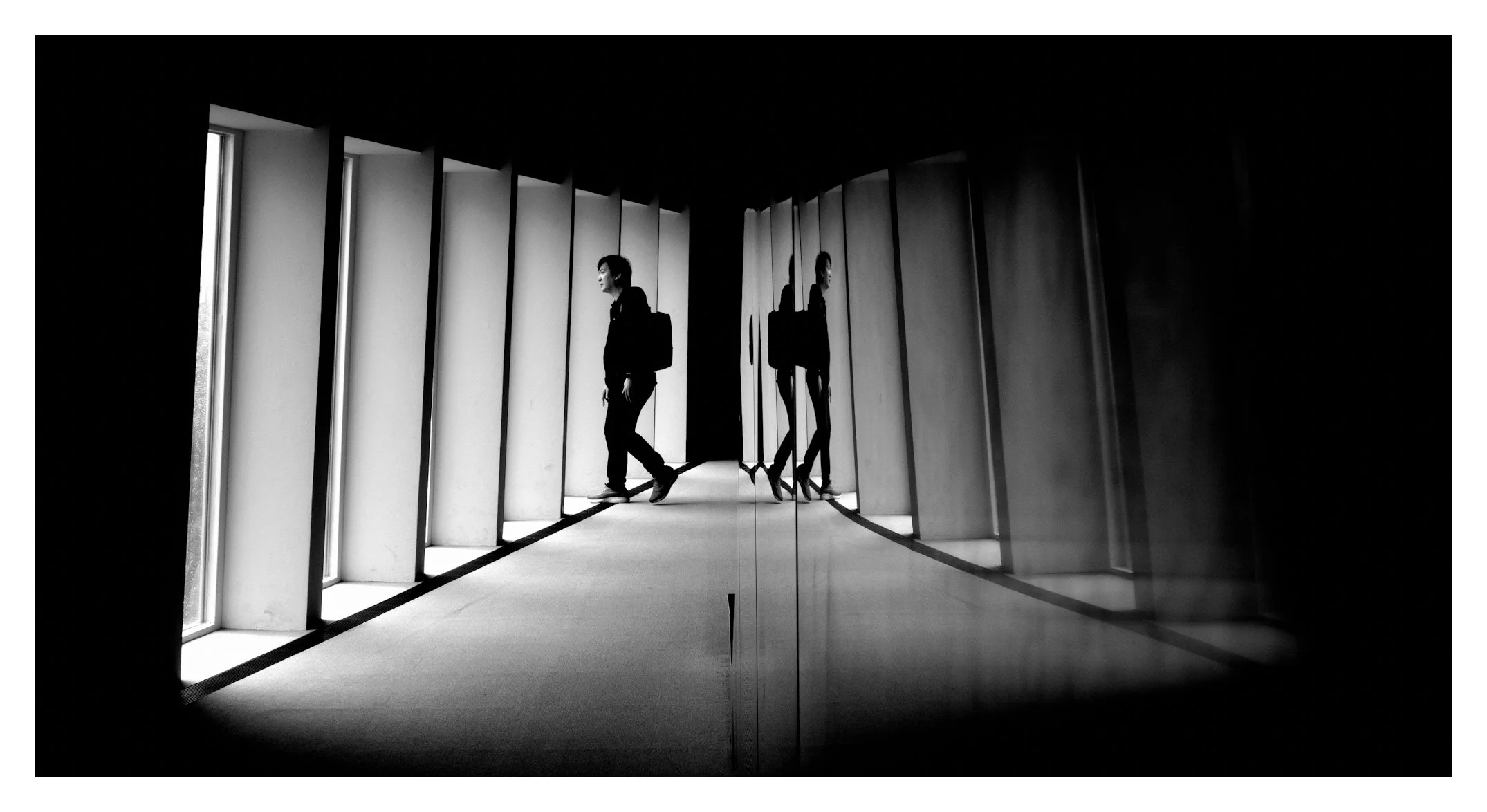
A lone figure walks through a striped corridor of light and shadow, his reflection doubling him in a mirrored wall beside him. A dramatic black-and-white study in geometry, repetition, and the way architecture can turn a single visitor into a whole procession.
Camera Model: Ricoh GR III
Shutter Speed: 1/250 sec
Aperture: f/6.3
ISO: 250
The Critique
This photograph was taken inside the Taichung Green Museumbrary, the newly opened cultural landmark designed by Pritzker Prize-winning architects Kazuyo Sejima and Ryue Nishizawa of SANAA in collaboration with Ricky Liu & Associates — Taiwan’s first combined museum and library, opened in December 2025 on the edge of Taichung Central Park. SANAA’s signature architectural lightness, achieved through layered glass, mesh, and steel panel facades, is on full display here: a corridor of vertical fins alternates deep shadow and bright natural light in a rhythmic sequence that a single walking figure transforms into pure visual music.
The composition draws directly on territory Ray K. Metzker made his life’s work — his cityscapes are dominated by engulfing shadows and a sense of isolation and fragmentation, with figures flattened into silhouette shapes rather than rendered with facial detail, and hard architectural shadows slicing through the frame to abstract the urban landscape into rhythm and pattern. This image achieves exactly that: the man walking through the corridor is reduced entirely to dark silhouette, his identity subsumed into pure gesture and form, while the striped columns behind him create the kind of graphic, almost musical repetition that defined Metzker’s most celebrated urban work.
The mirrored wall running down the center of the frame is the composition’s real masterstroke, doubling the figure and the architecture simultaneously and creating a symmetrical, almost kaleidoscopic effect without any digital manipulation — purely the fortunate byproduct of the building’s own reflective surface. That doubling recalls Metzker’s own fascination with composite and multiple-exposure techniques, though here it emerges naturally from the architecture itself rather than through darkroom manipulation, giving the image a sense of controlled accident that feels genuinely earned.
The strong vertical striping of light and shadow, combined with the deep converging perspective lines of the corridor’s ceiling and floor, creates real depth and rhythm, pulling the eye from the bright, sunlit doorway at the far end back toward the walking figure in the midground. Where the image could be pushed further is in the balance between the mirrored reflection and the “real” figure — the reflection currently reads slightly softer and less resolved than the primary subject, and a marginally different angle might have sharpened that symmetry even further.
How This Image Could Be Improved
• Consider a position that sharpens the mirror symmetry. The reflected figure currently reads a touch softer than the primary subject; a small adjustment in angle could tighten that doubling effect.
• Watch the far bright doorway’s exposure. It’s working well as a compositional anchor, but a touch of highlight recovery there could preserve slightly more detail in the brightest zone.
• Return to this corridor at different times of day. The striped light-and-shadow pattern will shift dramatically with the sun’s angle; multiple visits could build a genuinely compelling series from this single architectural feature.
Becoming a Better Photographer Over Time
• Study architecture that creates natural repetition and rhythm. Corridors, colonnades, and striped facades like this one are gifts for photographers — actively seek out buildings with this kind of structural repetition.
• Practice using silhouette to abstract figures into pure form. Log which of your images benefit from a fully realized, identifiable subject versus a reduced, silhouetted one, and build deliberate control over when each approach serves the composition.
• Learn architectural history before photographing significant new buildings. Knowing this is SANAA’s landmark “museumbrary,” designed around themes of transparency and fluidity, adds context that could inform future compositions of the same space.
Photographers to Study
• Ray K. Metzker — the essential reference for this frame’s use of hard shadow, silhouette, and architectural rhythm to abstract the urban and interior environment.
• Franco Fontana — for his graphic, geometrically rigorous approach to light and shadow in built environments.
• Harry Callahan — for his experimental treatment of urban geometry and layered visual structure.
• Keld Helmer-Petersen — for his disciplined, abstraction-driven approach to architectural and urban form.
• Nathan Lyons — for his interest in juxtaposition and unexpected visual rhythm within everyday environments.
Books Worth Reading
• Ray K. Metzker: City Whispers
• Ray K. Metzker: Composites
• Franco Fontana: Skyline
• Harry Callahan (Aperture monograph)
• Nathan Lyons: Notations in Passing
Videos Worth Watching
• “A Study of Light, Shadows, and Framing: Street Photos by Ray Metzker” — a thorough visual survey of the exact technique this image draws on.
• The Getty’s online exhibition on Ray K. Metzker and the Institute of Design — deeper historical context on his development of shadow, silhouette, and composite technique.
• Ted Forbes, The Art of Photography channel — for broader grounding in mid-century American abstraction and shadow-based street photography.