

Day 215/365 The Comedy of the Streets: Finding High Art in Low Angles
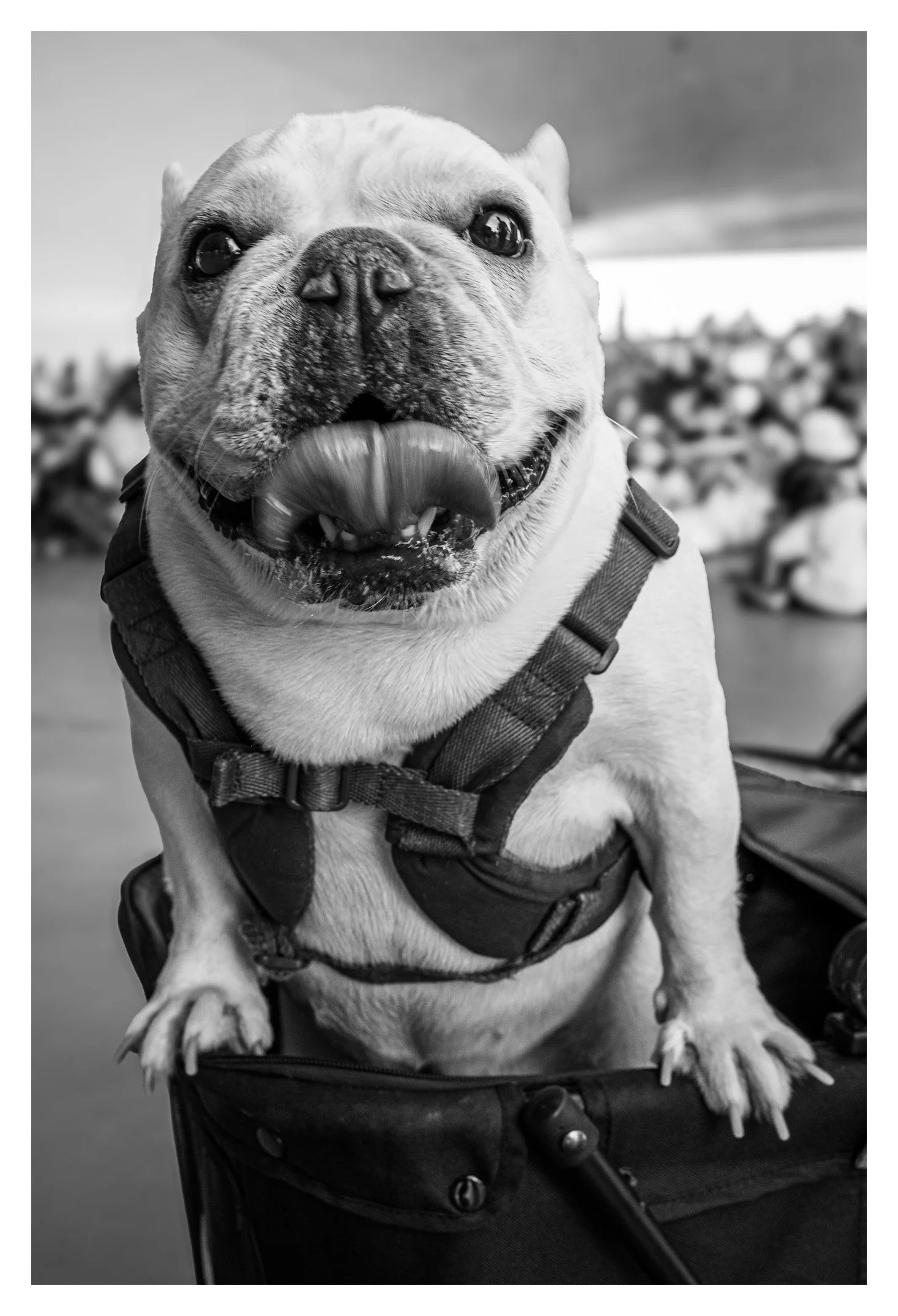
Street photography isn't always about poetic shadows or grand architectural scale; sometimes it’s about absolute, unadulterated joy. You’ll learn why a low-angle perspective can completely transform an ordinary street encounter, and how a simple change in positioning bridges the gap between a snapshot and a deliberate technical masterclass.
Technical Profile
Camera Model: Ricoh GRIII
Shutter Speed: 1/60
Aperture: f4.5
ISO: 200
The Critique: Unpacking the Frame
There is an undeniable energy to this frame. By getting low and meeting this French Bulldog at eye level, you have rejected the passive, top-down perspective that dooms most casual pet photography. Instead, you have granted the subject real presence. The wide-angle lens of the Ricoh GRIII exaggerates the foreground, making the dog's paws feel anchored and immediate as they grip the edge of the stroller, while the wide-open mouth and sprawling tongue inject a delightful sense of comedic timing.
The choice of monochrome is highly effective here. It strips away the distracting, chaotic colors of the crowded Taiwanese background, focusing our attention entirely on texture—the grit of the pavement below, the coarse fabric of the harness, and the soft, wrinkled contours of the dog's face.
However, the technical limitations of the shot are visible upon closer inspection. A shutter speed of 1/60 is dangerously slow for moving subjects, even a dog riding in a stroller. While the center of the face retains acceptable sharpness, there is subtle motion blur in the tongue and paws. Given the bright daylight suggested by the background, shooting at 1/60 means your aperture or ISO could have been reassigned to give you more mechanical safety.
Room for Improvement
Boost the Shutter Speed: For spontaneous street interactions, especially involving animals or fast-moving pedestrians, your baseline shutter speed should be at least 1/250 or 1/500. Do not hesitate to bump the ISO to 400 or 800 on the Ricoh GRIII to achieve this; the added grain is negligible compared to the loss of sharpness from motion blur.
Mind the Highlights: The sky and upper-right background are leaning toward being blown out. In high-contrast environments, utilize the Ricoh's highlight-weighted metering mode to protect those bright areas, then pull the shadows back up during post-processing.
Watch the Frame Edge: The white border adds a nice gallery feel, but ensure the composition inside feels balanced. The black structure of the stroller cut off at the very bottom feels slightly heavy; a fractional tilt upward would capture less of the black nylon bag and more of the environmental context.
Elevating Your Craft: The Long Game
To transform your casual shooting into a cohesive artistic practice, you must start building a personal metadata archive. Create a spreadsheet of your top images each month. Do not just record the settings, but evaluate the relationship between your technical choices and creative success.
Are your best shots consistently tracking at a specific focal length? Are you missing focus because your aperture is too wide? Over time, this data reveals your creative blind spots and sharpens your technical intuition so that adjustments become second nature when you are out on the pavement.
Curated Resources for the Analytical Eye
Photographers to Study
Elliott Erwitt: The absolute master of combining humor, dogs, and street photography. Study his ability to find deep human truths through anthropomorphic irony and low-angle compositions.
Michael Wolf: Specifically his work Tokyo Compression. While his subject matter is claustrophobic rather than joyful, his extreme focus on texture, tight framing, and raw emotion through glass offers brilliant lessons in formatting tight portraits.
Essential Reading
"Think Like a Street Photographer" by Matt Stuart: An exceptional manual that balances the technicalities of being invisible in a crowd with the mindset required to welcome lucky accidents into your frame.
"The Decisive Moment" by Henri Cartier-Bresson: The definitive bible on geometry, timing, and capturing the precise split-second where composition and human emotion align.
Instructional Media
Watch "Matt Stuart on Failure in Street Photography - How I See" on YouTube via Leica Camera. This discussion explores how embracing repetition, consistency, and a positive mindset allows you to turn high-failure street outings into technical triumphs.