

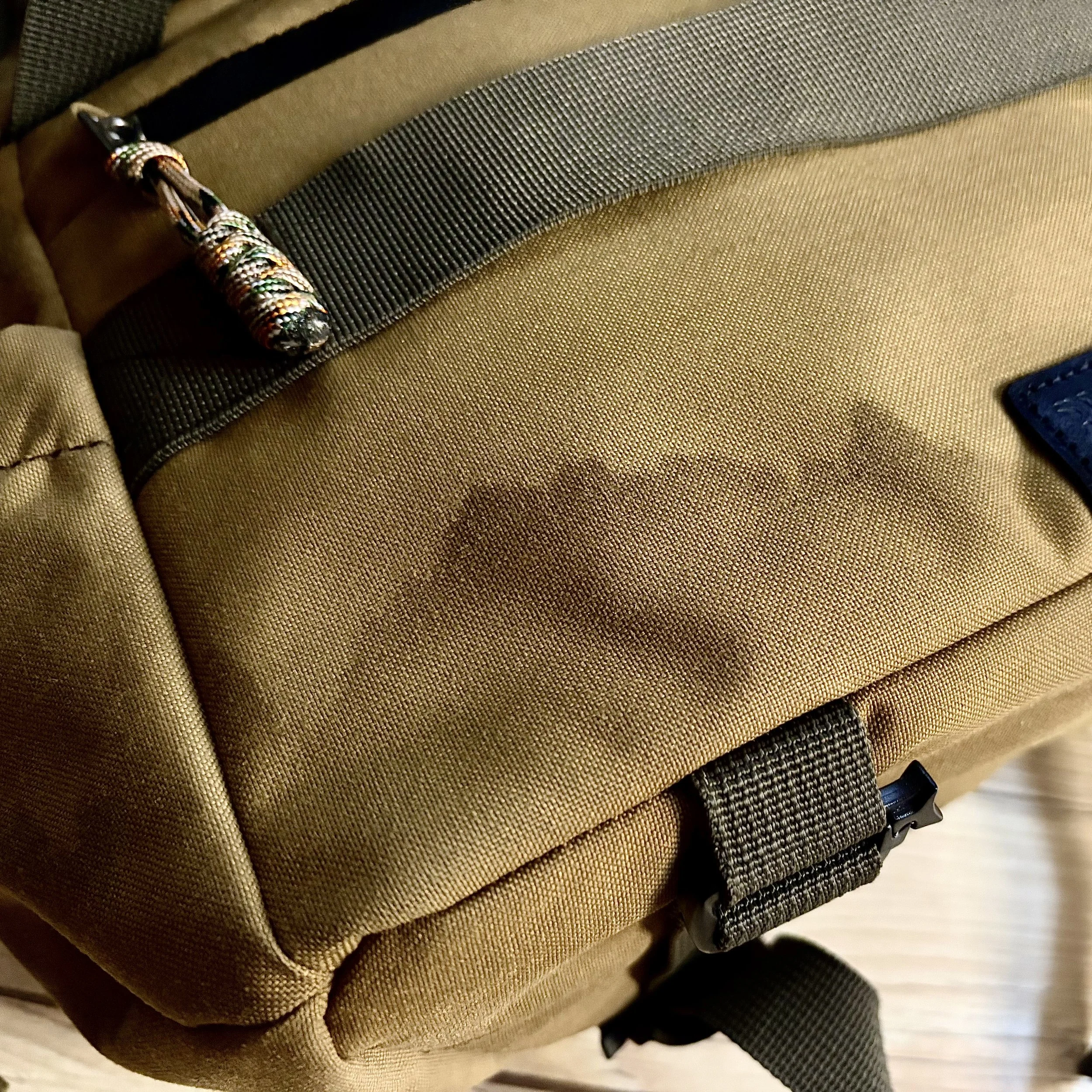
Search for a photograph of this bag wet and you will not find one. Every image online was made indoors, dry, brand new. Mine is under a year old, had never seen rain, and spent forty-five minutes in a Kaohsiung shower under an umbrella. What came out of it changes how you should read every review you have ever watched.
METADATA
• Camera Model: Apple iPhone 17
• Shutter Speed: 1/30 s
• Aperture: f/1.6
• ISO: 640
Main camera, 26 mm equivalent, 0 EV. Made in Lingya District, Kaohsiung.
THE CRITIQUE
DPReview made the Pilot 10L its Gear of the Year. Carryology, Fstoppers, Pack Config and Shotkit have all been through the line. It is a genuinely, thoroughly reviewed bag, and on the specific question of weather the published record amounts to this: one reviewer notes he had not experienced a downpour with it yet, but that it repelled moderate rain without problems. Another writes that the materials are highly water-resistant and that you can expect your expensive camera gear to stay dry during a short downpour — an expectation stated as a promise, with no test behind it.
Nobody has taken one out in real rain, come back, opened it on camera and photographed the inside.
So here is that photograph, or the nearest thing I can offer to it.
First, the conditions, because the whole argument rests on them. The bag is under a year old. Light use, fair weather. No fading at the shoulder, no abrasion at the corners, no salt bloom — none of the wear that eventually defeats any coated fabric. Until yesterday it had never been out in rain. For the purposes of what follows, it was functionally new.
Yesterday it went out for roughly forty-five minutes in Kaohsiung rain, under an umbrella, so only the lower edges caught what the umbrella missed. It was not opened outdoors at any point. Water entered through the fabric or the seams, low down, where the wet sat longest. A card reader and a set of camera batteries came out damp.
This frame, made the following afternoon on a floor in Lingya District, is what remained.
Across the front panel is a stain roughly the size of a spread hand, darker at the rim than in the middle. That rim is a tide line — the edge water leaves as it spreads through a fibre and dries back inward. It crosses the seam without altering its shape. It bears no relationship to the direction of the light. There is nothing equivocal about it.
Now the claim it is being measured against. The Pilot 7L costs USD 179. Wotancraft specify Dualcoat water-repellent waxed 500D nylon canvas and a YKK water-resistant zipper, and describe the zipperless flap as wrapping the left and right edges so the sides are gap-free when closed, preventing rain from entering the main compartment. On waterproofing they are candid — the fabric is water repellent, the bag is not waterproof — and then comes the sentence that matters: the bag has been tested out in the rain for over an hour and the interior still remains dry.
An hour, on their test. Forty-five minutes on mine, with an umbrella overhead and only partial exposure, and the interior was not dry.
When I first looked at this frame I assumed I was seeing a coating at the end of its life. Waxed and coated fabrics do lose repellency to abrasion, UV and time, and in a subtropical climate they lose it faster. That would have been an ordinary story about maintenance, and a dull one. It is not this story. There was no wear to blame. Whatever the canvas did yesterday is what the canvas does.
The gap in the review record is not a conspiracy. It is what the format rewards. Units arrive new and go back. Rain is inconvenient to schedule and unflattering to shoot. A photograph of a stain generates no affiliate revenue. The result is a genre that can tell you precisely how the Fidlock buckle feels under the thumb and nothing at all about the only question that matters to a photographer in southern Taiwan: whether the thing keeps water off a sensor.
Is this a good photograph? Not by the standards of the images it is arguing with. It is dim — ISO 640, f/1.6, a thirtieth of a second, weak directional interior light. Wide open at that distance the depth of field is a couple of centimetres, so the buckle and lower webbing dissolve. Nothing about it is styled and nothing about it flatters the object.
By the standard of whether it carries information a reader cannot get anywhere else, it is the most useful photograph of a Pilot 7L I have seen. Sophie Ristelhueber spent forty years arguing that the mark left behind says more than the event, and that aftermath is not a lesser subject than action. She was photographing war and I am photographing a shoulder bag, but the structure holds. Evidence of what happened outranks the promise of what was supposed to.
A bag at this price, on its first exposure to weather, should not need a plastic liner. Publish the stains.
HOW THIS IMAGE COULD BE IMPROVED
• Get more light on it. At f/1.6 and a thirtieth the phone is scraping. A bright window or a lamp buys a smaller aperture, and a sharp weave is what makes the tide line unarguable at a glance.
• Include a scale reference — a coin, a lens cap, a ruler. The size of the mark is part of the claim.
• Shoot the sequence, not the frame. Whole bag, affected panel in context, then this detail. Three frames make an account; one makes an anecdote.
• Photograph the interior directly behind the stain, and photograph the damp items themselves. Ingress is the story; the exterior mark is only the symptom.
• Photograph the lower seams specifically, close, in raking light. Water through the weave and water through the stitching are different failures, and the second is the more serious finding.
• Keep the timestamped original with its metadata intact. The version published here had its EXIF stripped on export.
ON BECOMING A BETTER PHOTOGRAPHER: LET THE DATA SPEAK
• Keep a folder for photographs that were never meant to be photographs. Damage records, receipts, notes to self. Review it annually. Projects hide there, and they arrive with no performance in them at all.
• Photograph new equipment before you use it. A dry frame of this same panel from this same angle would have doubled the value of the one above. Baselines cost nothing and cannot be made retrospectively.
• Chart ISO and shutter against time of day. Most photographers believe they shoot in better light than they do, and the numbers end that argument quickly.
• Track how often the camera chose the aperture rather than you. On a phone that is nearly always, which is fine until a frame needs depth of field to make its point.
• Log the frames you would reshoot and the single reason why. Three or four failure modes account for most of anyone's misses, and an unnamed pattern is an unfixable one.
• Audit metadata hygiene quarterly. Stripped EXIF, wrong clock, missing location. Tedious, and the archive you own in ten years depends on it entirely.
PHOTOGRAPHERS TO RESEARCH
• Sophie Ristelhueber — the definitive artist of the trace. Photographs aftermath rather than event, and finds the mark more eloquent than the moment.
• Bernd and Hilla Becher — deadpan, frontal, systematic. The argument for flat light and the patient comparative record.
• Taryn Simon — record photography pushed to its limit, where caption and image do inseparable work. Essential on what a picture can and cannot prove.
• Richard Wentworth — the "Making Do and Getting By" series. Decades of unglamorous photographs of objects failing and adapting in public.
• Eugène Atget — a documentarian supplying reference images to painters, who made some of the century's most quietly devastating photographs almost by accident.
BOOKS TO READ
• "Fait" — Sophie Ristelhueber. The Kuwaiti desert after the Gulf War, from the air and the ground. Damage as a subject in its own right.
• "Evidence" — Larry Sultan and Mike Mandel. Institutional record photographs stripped of their captions and reframed as art. Directly relevant to all of the above.
• "Basic Forms of Industrial Buildings" — Bernd and Hilla Becher. The typological method set out plainly.
• "Ways of Seeing" — John Berger. Still the clearest short account of how publicity images teach us to want objects, and why they can never show them used.
• "The Ongoing Moment" — Geoff Dyer. A wandering, argumentative history of photography organised by recurring objects rather than chronology.
VIDEOS TO WATCH
• Sophie Ristelhueber — Documenting Traces of War, TateShots
https://www.youtube.com/watch?v=PBsgm4OBOfE
• Hasselblad Award 2025 — Sophie Ristelhueber in conversation
https://www.youtube.com/watch?v=m_enyWroOwU
• Taryn Simon — Photographs of Secret Sites, TEDGlobal
https://www.youtube.com/watch?v=jKl0tb3VmfQ
• Bernd and Hilla Becher and the Photographic Afterlife of Heavy Industry, The Met
https://www.youtube.com/watch?v=4HueJ8TJ8qM
A NOTE ON WHAT HAPPENS NEXT
I have not written to Wotancraft yet. I will, and this post will be updated with their response. The Pilot carries a three-year warranty and the company has a long record of standing behind its work. One bag is not a pattern and I am not claiming it is.
But I would like to see one reviewer — any reviewer — take a Pilot out in real rain for an hour, come back, open it on camera and photograph what is inside. Until somebody does, the only thing between a photographer and a wet sensor is a sentence on a product page.
Photograph your gear before you use it, and photograph it when it fails. Nobody else is going to.