

Day 315/365 Faceless in the Downpour: One Hook, One Crate, and a Kaohsiung Delivery in the Rain
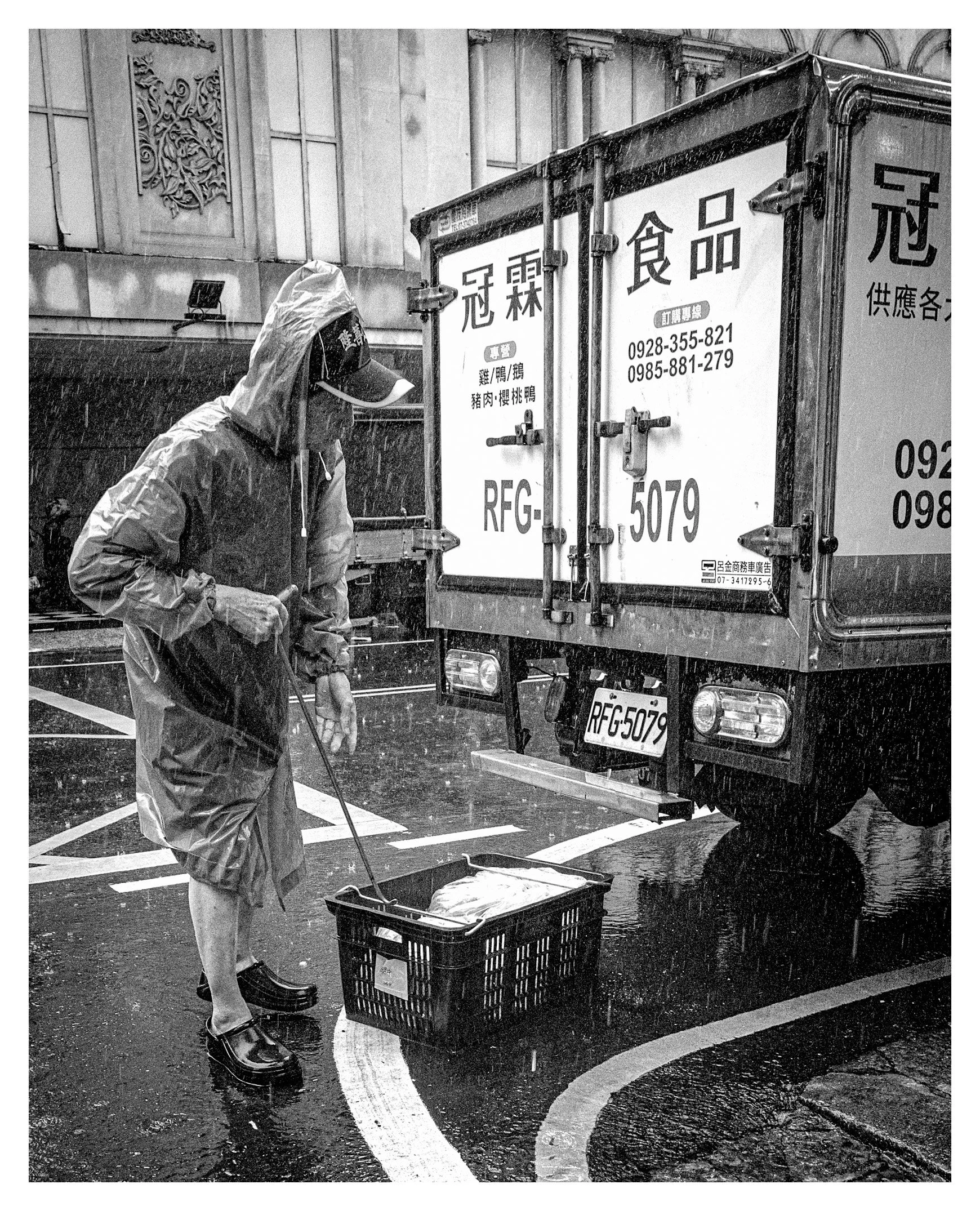
A figure vanishes entirely inside a clear plastic raincoat, dragging a loaded delivery crate across wet pavement with nothing more than a hooked pole, as a food truck idles behind them. What does a photograph gain when it strips its subject down to gesture and tool alone? A look at anonymity, weather, and unglamorous labour.
METADATA
Camera Model: Ricoh GR III
Lens: GR Lens 18.3mm f/2.8 (28mm equivalent)
Shutter Speed: 1/320 sec
Aperture: f/8
ISO: 4000
THE CRITIQUE
There is no face in this photograph, and that absence is the whole point. The figure at the centre of the frame is entirely swallowed by a clear plastic raincoat, hood cinched tight over a duck-billed cap, hands the only visible piece of skin in the entire composition. What remains is not a portrait but a silhouette of labour itself — a posture, a gesture, a tool. In one hand, a simple metal hook on a pole, used to drag a loaded plastic delivery crate across the wet pavement rather than bend and lift it directly. It is about as unglamorous a piece of equipment as photography can find, and that is precisely why it works. There is no theatre in this gesture, no performance for the camera. It is pure, practical economy of motion, the kind of small improvised solution a delivery worker arrives at after enough rainy shifts to know that dragging beats carrying when the ground is this wet and the crate this heavy.
Behind the figure, a refrigerated delivery truck idles with its rear doors open, its panels dense with characters advertising chicken, duck, goose, and pork, along with the phone numbers that keep the whole operation running. That signage does real work in the frame. It doesn't compete with the figure so much as contextualise them — this is not an isolated act of labour but one link in a visible supply chain, a truck's worth of product being moved crate by crate through weather that would keep most people indoors.
The choice to freeze the rain at 1/320 rather than let it smear is a technical decision with real consequence. Individual streaks are legible against the dark ground, near-clinical in their detail — decisive, in the sense Henri Cartier-Bresson meant when he wrote about photography's rare talent for stopping time cleanly rather than gesturing at its passage. Where a slower shutter would have turned this into atmosphere, this exposure turns it into evidence: it was, unambiguously, pouring, and the delivery went on regardless.
There's also something quietly moving in the anonymity itself. Stripped of a face, the figure becomes a kind of everyperson of daily commerce, a stand-in for the countless deliveries that keep a city's food supply moving in weather no one would choose. That instinct — to let ordinary, unglamorous labour carry real weight in a frame without needing a name or an expression attached to it — sits comfortably within a long tradition of Taiwanese documentary photography that has always found its subject in exactly this kind of unremarked-upon daily persistence.
IMPROVEMENT SUGGESTIONS
• The complete facial anonymity is a strong choice, but it's worth shooting a second frame in similar conditions where the hood catches enough light to suggest a sliver of expression. Having both versions gives you the option between the pure everyperson reading this image achieves and a slightly more individuated one.
• ISO 4000 is high for what appears to be daylight, if heavily overcast, conditions. It's worth checking whether the aperture could have opened toward f/4 or f/5.6 to buy back two stops of noise, provided enough separation still existed between the figure and the truck behind them.
• The hook and crate, the most legible piece of action in the frame, sit against dark wet pavement and lose some contrast. A half-step to reposition that connection point against the paler reflection in the puddle below would have given it more graphic clarity.
• The truck's signage, while narratively useful, is dense enough to compete with the figure for attention on the right side of the frame. A slightly tighter crop trimming some of the excess text may sharpen the balance between subject and context without losing the commercial detail that makes the image legible as a supply-chain moment.
BUILDING A BETTER EYE OVER TIME
Improvement in photography is rarely a single leap. It's compiled, image by image, the way sediment builds a shoreline. A few disciplines worth adopting:
• Keep a running log of your EXIF choices against outcomes. Note which apertures and shutter speeds you gravitate toward in different light, and which ones actually served the image versus which were reflexive habit. Patterns will surface that tell you where your instincts are strong and where they're merely comfortable.
• Review contact sheets, not just favourites. The images you almost chose are often more instructive than the ones you did — they reveal the decision points where your eye was calibrating.
• Track a "keeper rate" over months, not days. A rising ratio of publishable frames to total frames shot is one of the few honest metrics of growth in this medium.
• Study one photographer intensively per month rather than skimming many. Depth of study builds vocabulary faster than breadth.
• Seek out critique from people who will disagree with you. Comfortable feedback flatters; honest feedback sharpens.
PHOTOGRAPHERS TO STUDY
• Henri Cartier-Bresson — for the foundational idea that a photograph's power often lies in stopping a single moment with total clarity rather than describing duration.
• Saul Leiter — for turning rain, fog, and obscured visibility into atmosphere rather than obstacle, even if his instinct was toward colour where this frame stays in monochrome.
• Josef Koudelka — for stark, weather-beaten black and white images of isolated figures that carry the emotional weight of exile and displacement.
• Chang Chao-Tang — for five decades spent documenting the ordinary, unglamorous persistence of daily Taiwanese life, often in exactly this kind of unposed, weather-worn moment.
BOOKS TO READ
• "The Decisive Moment" by Henri Cartier-Bresson
• "Early Color" by Saul Leiter
• "Exiles" by Josef Koudelka
• "The Images of Chang Chao-Tang, 1959–2013" by Chang Chao-Tang
VIDEOS TO WATCH
Henri Cartier-Bresson: The Decisive Moment (1973) — a rare 18-minute documentary featuring Cartier-Bresson's own commentary on his iconic images and his philosophy of timing.
https://www.youtube.com/watch?v=14ih3WgeOLs
In No Great Hurry: 13 Lessons in Life with Saul Leiter — official trailer for the documentary on Leiter's quiet, atmospheric approach to weather and obscured visibility.
https://www.youtube.com/watch?v=Rl610p94atw
This Is How I Do Rain Street Photography — a practical walkthrough of shooting technique, exposure, and gear protection for exactly the conditions this image was made in.