

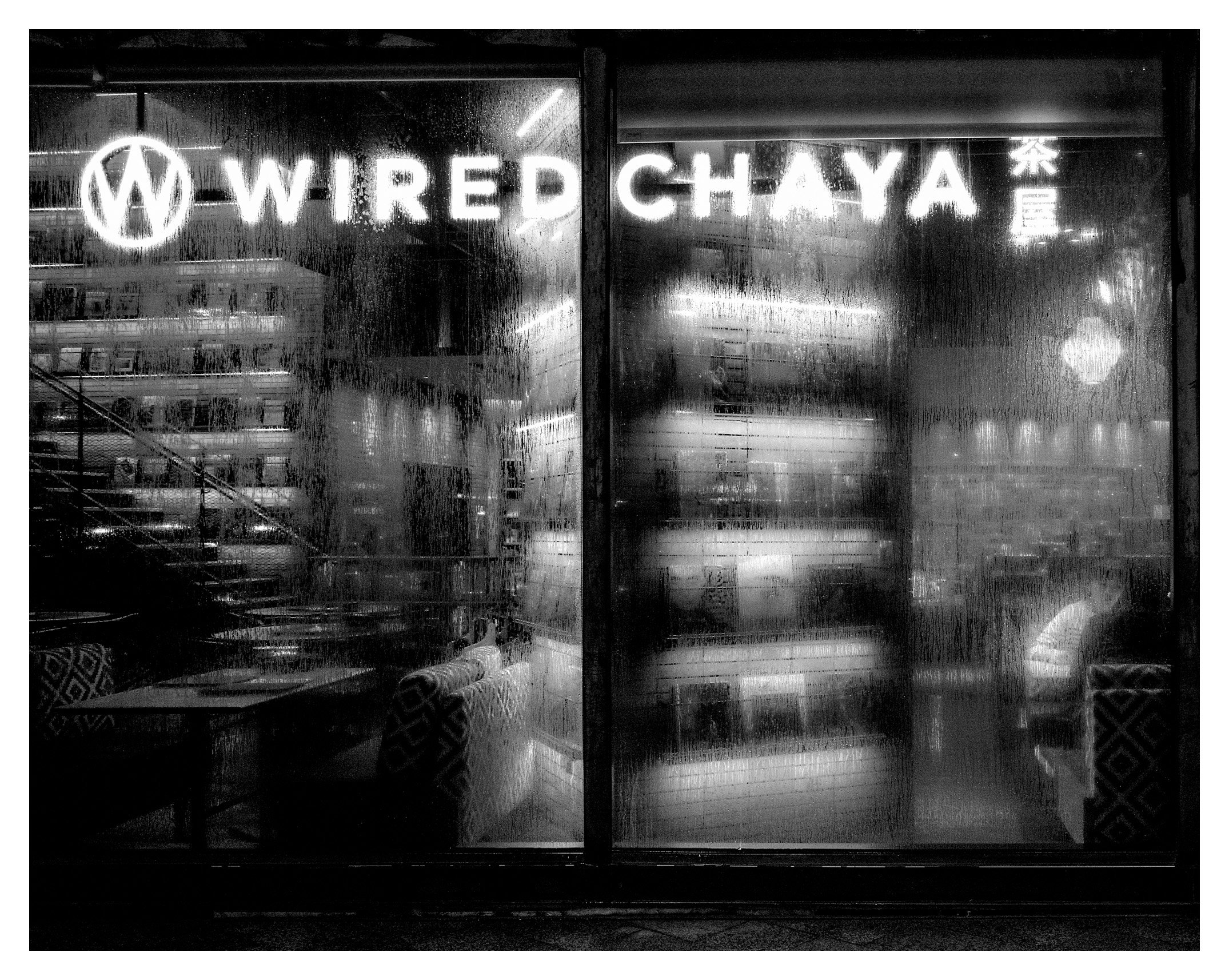
Rain fogs a Kaohsiung storefront into a screen of light and streak, a neon sign holding its shape against a dissolving interior. A close look at what condensation does to composition, why the least legible frame is sometimes the most truthful one, and what it takes to make wet glass work for you rather than against you.
METADATA
• Camera Model: Ricoh GR III
• Shutter Speed: 1/60 sec
• Aperture: f/3.2
• ISO: 2000
THE CRITIQUE
There is a particular kind of photograph that depends entirely on a surface getting in the way. Not the subject obscured by weather as an accident to be tolerated, but weather recruited as the actual material of the picture. This frame belongs to that small, difficult category, and it is worth being precise about why it works before saying anything about how it could work better.
The subject is a storefront at night: WIRED CHAYA, its name lit in bare neon tubing, a circular W logo anchoring the left pane and a single Chinese character for tea glowing at the right edge of the second. Between the photographer and the interior sits a sheet of condensation-run glass, and it is that glass, not the shop, that the picture is actually about. Water has beaded and streaked down the pane in near-vertical rivulets, turning what should be a clear view into something closer to a wet lithograph. Behind it, softened almost to abstraction, a staircase, patterned banquette cushions, shelving, and at the far right a figure caught mid-motion, reduced to a dark vertical smear against the light.
The compositional logic here is a study in selective clarity. Everything the condensation cannot reach — the neon lettering itself, mounted just proud of the glass or bright enough to punch through the water entirely — stays crisp. Everything behind the glass dissolves in proportion to how far it sits from that light source and how much streaked water intervenes. The result is a frame with exactly two registers: signage that reads instantly, and a world behind it that has to be worked for. That is not a technical limitation. It is the actual subject of the photograph, which is something like: what a rain-soaked city looks like when you stop trying to see through the weather and start looking at it instead.
The vertical mullion dividing WIRED from CHAYA is doing more compositional work than it first appears to. It splits the frame close to centre, and ordinarily that is a fault — a picture cut in half asks the eye to choose a side and rarely rewards the choice either way. Here it survives because the two halves are not competing for the same kind of attention. The left pane is architecture and word-as-object: the W-in-a-circle, bold sans serif, a strong graphic anchor low in the frame. The right pane is deeper and busier, more reflection than sign, with the standing figure giving it a second, quieter point of interest. The picture reads left to right as a movement from symbol to scene, which is a more sophisticated use of a centred division than most photographers manage on purpose, let alone by instinct in the rain.
Where it comes apart slightly is in the middle distance. The staircase and the shelving units behind the left pane are legible enough to register as information without being legible enough to reward close looking, which leaves that section of the frame feeling like unfinished business rather than deliberate softness. A photograph that commits to obscured depth should commit fully — either let the interior go further toward abstraction, so the streaks and light-bleed become the entire content of that zone, or find an angle where one element behind the glass (a single chair, a single hanging lamp) survives clearly enough to anchor the eye. What exists now sits in the gap between those two decisions.
The exposure is worth noting on its own terms. At f/3.2, 1/60 and ISO 2000, this is a lens working close to its comfortable limits in genuinely difficult light — bright point sources against a mostly dark, wet, reflective surface, handheld, at night. The noise is present but fine-grained rather than blotchy, and it sits well against the black-and-white conversion, reading as texture rather than as a flaw. The shutter speed is slow enough that any residual motion in the reflected figure has a faint blur to it, which if anything strengthens the frame: a static photograph of streaked glass would be handsome; one with a single soft trace of movement inside it is alive.
There is a lineage here worth naming plainly. Photographers have used wet or fogged glass as a compositional device for a century, precisely because it does something no lens correction ever could: it turns a transparent barrier into an active, textured surface that the eye has to negotiate rather than see past. Handled well, it produces exactly what this frame produces at its best moments — a picture that feels less like a record of a place and more like a record of looking at a place under difficult conditions, which is a more honest account of what night photography in the rain actually is.
HOW THIS IMAGE COULD BE IMPROVED
• Commit further to one register in the mid-depth zone. Either let the staircase and shelving dissolve entirely into light and streak, or reposition slightly so one element behind the glass stays sharp enough to anchor the eye there deliberately.
• Try the same frame from a few steps left or right. The vertical mullion currently sits close to centre; a small lateral shift could push it toward a third-line division and relieve the slight tension of the current split without losing either pane.
• Bracket the exposure down a third to a half stop. The neon is close to clipping in the brightest strokes of the lettering; a touch more restraint would preserve texture in the tubes themselves rather than letting them burn to flat white.
• Return to the same spot on a drier night and shoot a paired frame. A clear-glass version of this exact composition, run alongside the fogged one, would let the condensation's contribution to the picture be shown rather than only asserted.
• Consider a longer exposure on a support to let the standing figure record with more deliberate blur. Right now the motion trace is a fortunate accident; done on purpose it becomes the second subject of the frame rather than a footnote to the first.
ON BECOMING A BETTER PHOTOGRAPHER: LET THE DATA SPEAK
• Build a weather log alongside your shooting log. Cross-reference frames against rain, humidity and temperature at the time, and you will start to see which conditions you actually seek out versus which you only shoot when caught in them.
• Revisit the same storefronts, corners and windows across seasons. A location shot once is an observation. The same location shot in sun, rain and fog across a year is a study in how weather rewrites a place, and it costs nothing but repeated visits.
• Track your keeper rate by ISO band. Most photographers have a noise ceiling they will not admit to. Knowing yours precisely, rather than guessing at it, changes how confidently you shoot into difficult light.
• Separate "obscured on purpose" from "obscured by accident" in your editing folders. Over time this reveals whether you are developing a genuine visual language around difficult conditions or simply keeping frames you got lucky with.
• Note how often your strongest frames include one small, uncontrolled element — a blur, a reflection, a stray figure. Photographers who trust the frame enough to leave room for accident tend to improve faster than those who try to control every variable.
PHOTOGRAPHERS TO RESEARCH
• Todd Hido — night, glass, and the atmosphere of houses and windows seen from outside. The clearest contemporary reference for what condensation and glare can do to a composition.
• Brassaï — Paris by Night made the wet, lit city street into a genre of its own, and his handling of light bleeding through darkness still holds up as a masterclass.
• Issei Suda — Japanese street work that finds the uncanny inside completely ordinary urban scenes, often through framing devices that partially obscure rather than fully reveal.
• Bill Brandt — a photographer who treated shadow and reflection as active compositional elements rather than problems to be lit around.
• Anders Petersen — intimate, textured black-and-white work made from inside bars and cafés at night, where glass, smoke and low light all do similar obscuring work to the condensation here.
BOOKS TO READ
• "House Hunting" — Todd Hido. Suburban houses at night, lit windows, and a career-defining use of atmosphere as subject.
• "Paris de Nuit" — Brassaï. The founding document of night street photography, still unmatched for its handling of wet pavement and gaslight.
• "Fūshi Kaden" — Issei Suda. Suda's debut, and the clearest introduction to his eye for the theatre hiding inside ordinary streets.
• "Shadow of Light" — Bill Brandt. A career retrospective built entirely around the relationship between dark and lit space.
• "Café Lehmitz" — Anders Petersen. Essential for anyone interested in what happens to a photograph when the room itself becomes a character.
VIDEOS TO WATCH
• Todd Hido's Secret To Atmospheric Photography
https://www.youtube.com/watch?v=QxyJVLW74CE
• The Secret Paris of the 1930s — Brassaï, Master of the Night
https://www.youtube.com/watch?v=NFQulGTYf3Y
• Surreal, Mysterious and Eerie Photos of 70s/80s Japan — Issei Suda
https://www.youtube.com/watch?v=osjSSJVCRSY
• Bill Brandt, Shadow and Light