

What happens when the technical precision of a fleeting moment collides with the underlying narrative of a scene? You'll learn why split-second timing alone isn't enough to sustain an image, and how the dialogue between subject and background alters everything.
EXIF Data
Leica D-Lux 8
1/500s
f/5.6
ISO 200
The Critique: Decoding image.png
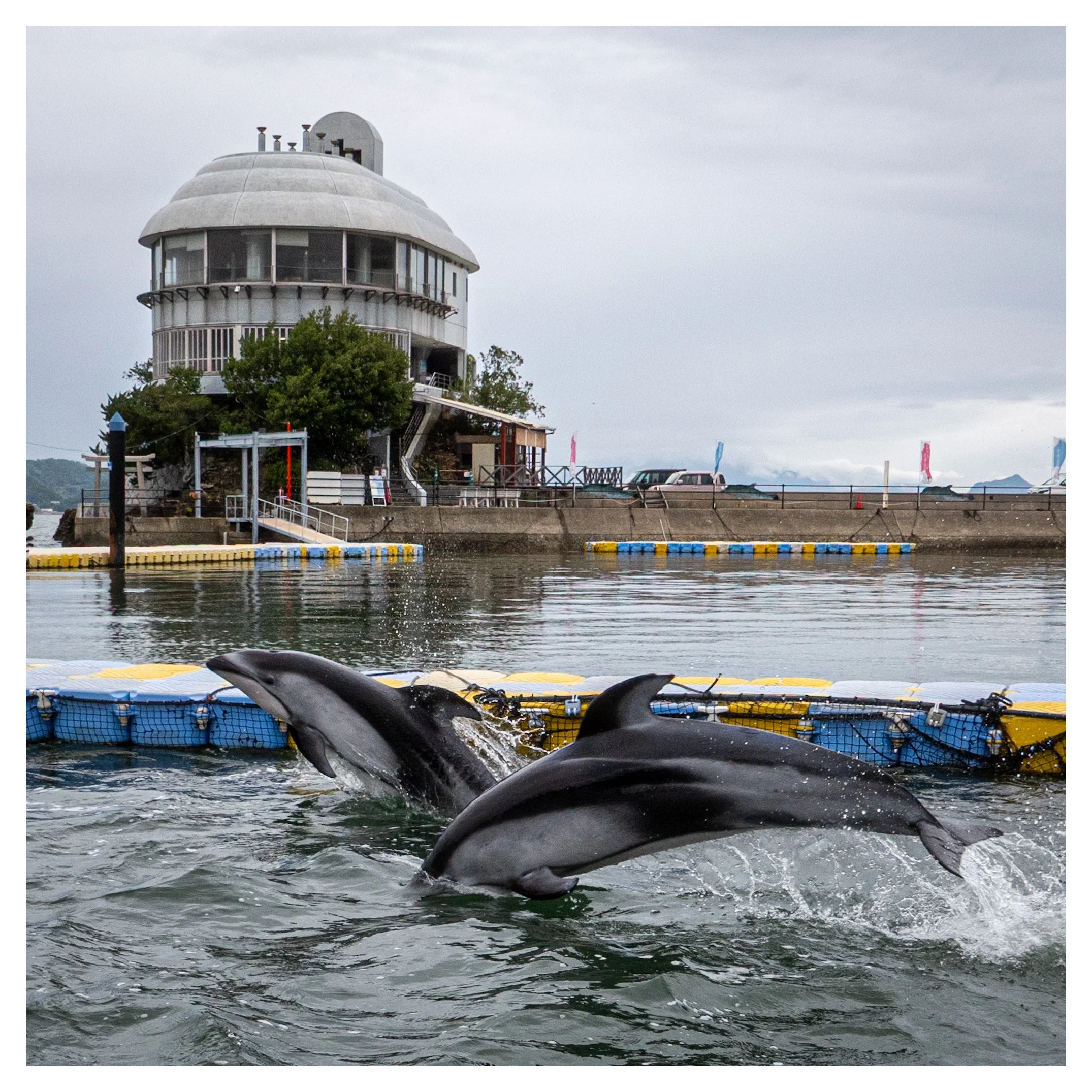
In image.png, there is an immediate, muscular kinetic energy that captures the eye. The dual arc of the dolphins leaping from the water provides a striking geometric symmetry. At 1/500s, the camera has frozen the physical mechanics of the leap beautifully—the water droplets hanging mid-air like shattered glass, the slick, high-contrast sheen of the mammals' skin, and the clean separation from the immediate surface of the water. The choice of an f/5.6 aperture keeps the main subjects bitingly sharp while allowing the background to remain legible, establishing a specific sense of place.
However, as an art piece, the image exists in a state of narrative tension.
The lower third of the frame is dynamic, organic, and wild. The upper two-thirds, dominated by the brutalist, dome-like architecture on the pier and the yellow and blue floating barriers, introduce a heavy, industrial constraint. The barriers slice directly through the center of the image, bisecting the frame and creating a visual barrier that traps the leaping dolphins within the lower foreground. The gray, overcast sky flattens the light, depriving the background building of dimensional shadow and leaving it as a massive, somewhat distracting tonal anchor at the top-left.
Strategic Adjustments for a Stronger Frame
Isolate the Narrative: If the intent is to celebrate the raw, documentary beauty of nature, a lower shooting angle closer to the water's surface would push the dolphins up against the sky, removing the distracting elements of the pier, cars, and barriers entirely.
Embrace the Irony: Alternatively, if the goal is to lean into the environmental juxtaposition—the contrast between the free-flowing movement of nature and the rigid, manufactured lines of human infrastructure—you should lean into it completely. Moving slightly to the right to frame the peak of the dolphins' jump directly beneath or alongside the circular lines of the domed building would create a deliberate, surreal dialogue between the two shapes.
Tonal Control: In processing, introducing a deeper gradient or shifting the contrast in the background can prevent the overcast sky from bleeding into the structure, ensuring the eye goes exactly where you intend.
The Growth Path: Data-Driven Evolution
To evolve from capturing striking moments to building a cohesive photographic voice, you must move beyond looking at your images in isolation. You need to look at them as a data set.
Compiling Your Visual Metadata
Start a structural audit of your work over the last six months. Create a private catalog or spreadsheet to track the specific traits of every image you consider successful. Do not just look at the technical metadata; categorize the visual behavior:
Technical Metrics: What focal lengths, shutter speeds, and apertures do you favor when a shot connects?
Environmental Variables: What are the lighting conditions? Overcast, harsh midday sun, or golden hour?
Compositional Tendencies: Are your strongest frames tightly cropped layers, wide-angle environmental views, or split-second action?
By analyzing these patterns, you will uncover your implicit biases as a shooter. If the data shows you consistently shoot in flat light but struggle with background clutter, it tells you exactly what to train next: the discipline of patience, waiting for the clean background before pressing the shutter.
Historical & Contemporary Research
To expand your visual literacy and see how masters of the medium handle environment, geometry, and subject matter, spend time analyzing these specific resources.
Photographers to Study
Fan Ho: The undisputed master of utilizing geometry, dramatic natural light, and deep shadows to transform everyday maritime and urban environments into poetic, cinematic masterworks.
Martin Parr: For a completely opposite approach, look at Parr's satirical, high-contrast documentary work. He excels at using bright colors and seemingly mundane, cluttered backdrops to make sharp social commentary.
Essential Reading
Bystander: A History of Street Photography by Colin Westerbeck and Joel Meyerowitz. This text acts as an academic encyclopedia on how the medium has evolved, tracing how photographers have navigated the balance between candid moments and their environments over decades.
Thoughts on Street Photography — Dive into essays exploring the deeper philosophy, observation, and wisdom required to find meaning within chaotic, candid frames.
Curated Video Lectures
The Art of Photography: Fan Ho — A deep dive by Ted Forbes into how Ho organized chaotic visual environments into perfectly balanced, geometric frames. Watch on YouTube: Fan Ho - The Art of Photography.
The Art of Seeing: Photography Lessons from Martin Parr — This analysis explores how to move past technical perfection to use your unique photographic voice as a purposeful tool. Watch on YouTube: Lessons from Martin Parr's Global Warning.