

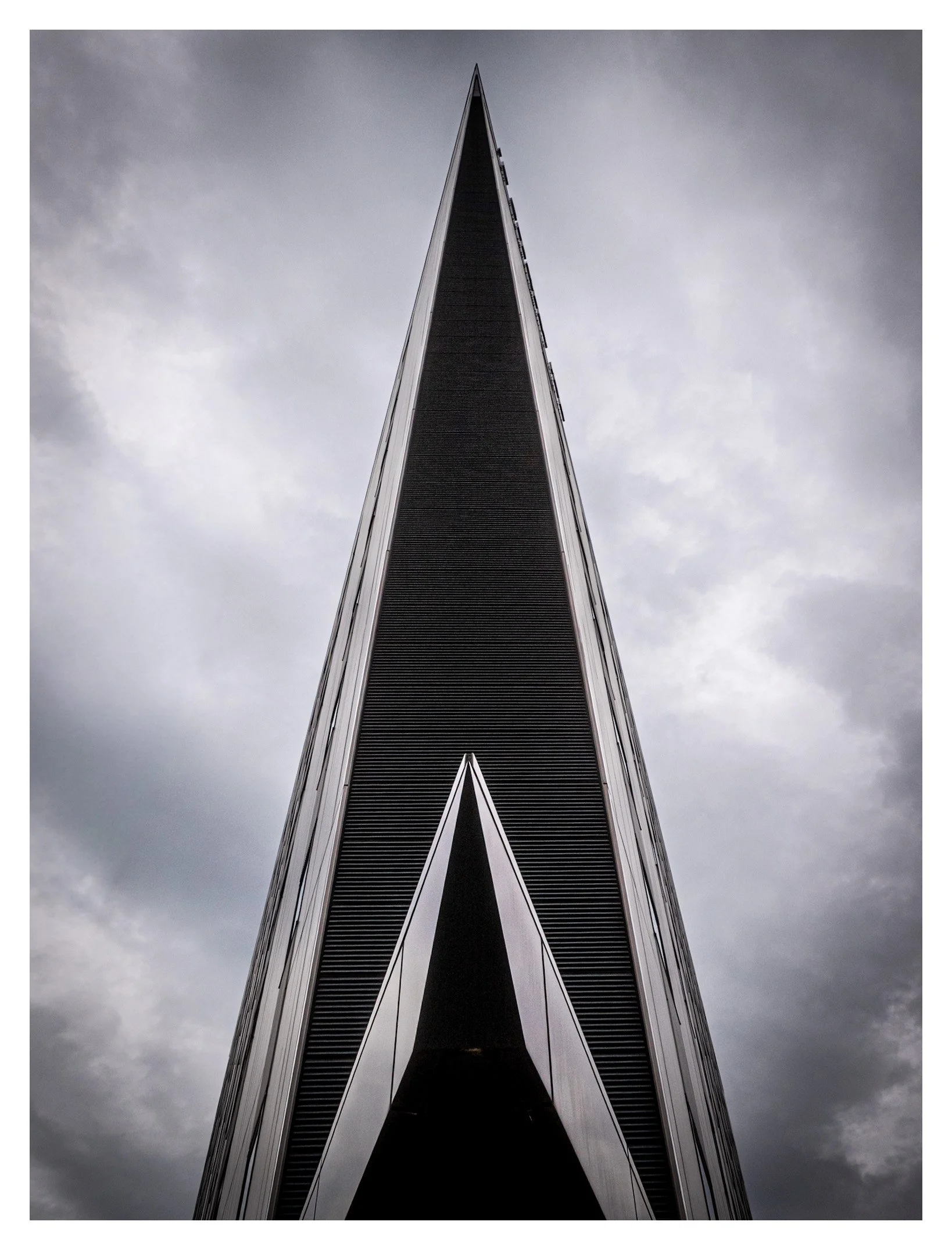
What happens when you point a premium compact at the Japanese sky on a moody afternoon? You’ll learn why perfect symmetry and dramatic storm clouds can turn a standard building facade into a striking, near-abstract sculptural statement.
Image Metadata
Camera Model: Leica D-Lux 8
Shutter Speed: 1/400
Aperture: f/5.6
ISO: 200
The Critique: Framing the Void
There is an arresting, aggressive embrace of verticality. By looking straight up, you have stripped the architecture of its mundane context—there are no streets, no tiny human figures, and no distracting urban clutter. Instead, you have transformed a functional building into a sharp, monochromatic obsidian arrowhead piercing a restless sky.
The choice of f/5.6 on the 4/3-inch sensor keeps the repetitive, micro-textured horizontal louvers razor-sharp throughout the frame, creating a superb graphic contrast against the soft, roiling texture of the overcast clouds. The exposure balancing is handled exceptionally well; the metallic, reflective edges of the lower inverted chevron retain their highlight detail without blowing out, framing the deep, cavernous shadow underneath beautifully.
Points for Improvement
The Symmetrical Obsession: The image lives and dies by its symmetry, but it is just a fraction of a degree off-center. Look closely at the apex at the very top—it leans ever so slightly to the right, and the left structural edge has a tiny bit more breathing room than the right. When executing a hyper-graphic shot like this, precise alignment is everything. Use a geometric grid in post-processing to force a perfect vertical axis.
The Inverted Apex Crop: The dark chevron opening at the bottom is clipped. Allowing just a fraction more room at the base of the frame to anchor that lower "V" shape would give the entire structure a more stable, powerful psychological foundation.
Developing Your Eye: Compiling Image Data
To grow as a photographer, you must stop viewing your images as isolated events and start looking at them as a continuous dataset.
Every three months, export the metadata of your top 50 favorite images. Analyze the patterns. Are you relying heavily on a specific focal length? Are you consistently shooting at wide-open apertures out of habit, or stopping down when the graphic geometry demands it?
By cataloging your shutter speeds, apertures, and even the time of day, you can diagnose your creative comfort zones. If you realize 80% of your work is shot at eye-level with a medium focal length, force yourself onto the streets with a mandate to only shoot extreme low-angle perspectives or compressed, distant details.
Research and Study
Masters to Research
Fan Ho: For an absolute masterclass in geometric composition, dramatic shadows, and how to slash a frame using light and stark structural angles.
Michael Wolf: Specifically his Architecture of Density series. Study how he eliminates the horizon and the sky entirely to compress urban landscapes into mesmerizing, repetitive abstract patterns.
Books to Read
"Thoughts on Photography" by Fan Ho: A profound collection of essays and theory on the philosophy of framing, patience, and visual intent.
"Think Like a Street Photographer" by Matt Stuart: Excellent for cultivating a quick, observational eye that spots unexpected juxtapositions and geometry in daily life.
Videos to Watch
The Secret to Fan Ho's Street Photography Geometry – An insightful deep dive into how Ho utilized early architectural planning and light to frame his subjects.
Abstracting the City: A Guide to Architectural Composition – A video essay exploring how to remove context from urban structures to create pure graphic art.