

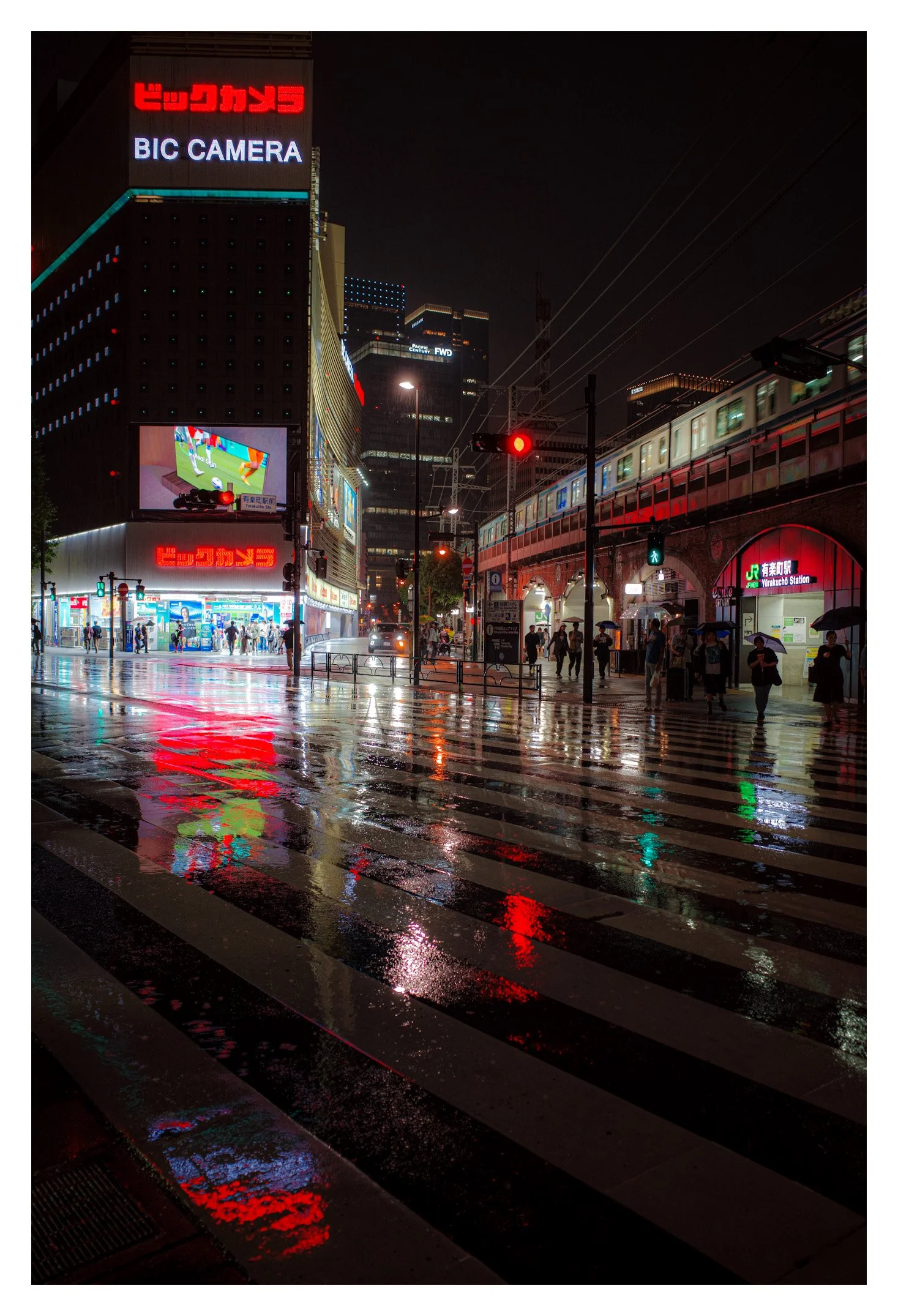
Rain transforms Tokyo's Yurakucho district into a shimmering playground of light, but capturing this complex environment requires more than luck. Discover how careful geometry and analytical metric compilation can elevate your street photography from a simple snapshot to a calculated visual masterpiece.
EXIF Data
Camera Model: Ricoh GRIII
Shutter Speed: 1/25
Aperture: f2.8
ISO: 200
This image presents a masterclass in urban texturing, finding its rhythm in the wet, post-rain environment outside the Bic Camera in Yūrakuchō, Tokyo. The strong diagonal composition created by the pedestrian crossing anchors the lower half of the frame beautifully, acting as a canvas for the vibrant, bleeding red and green neon reflections. The inclusion of the moving train on the elevated track provides a brilliant narrative counterpoint to the static, looming presence of the commercial architecture.
However, at a shutter speed of 1/25, handheld street shooting introduces a delicate tension between deliberate motion blur and unintentional camera shake. While the motion of the train is well-rendered, a slightly faster shutter speed or absolute stabilization against a fixed surface would tighten the structural lines of the buildings and the text on the signage, sharpening the overall impact of the frame.
Refining Your Frame: Recommendations for Growth
To push the boundaries of images like "image.png," look closer at the geometry of human presence. The figures near the station entrance are somewhat swallowed by the deep shadows under the arches. Waiting for a singular subject to break into the light—perhaps highlighted by the glow of the station sign or silhouetted cleanly against a reflection—would provide a stronger focal point for the eye to rest upon.
The Analytical Path: Compiling Image Data
True progression in photography happens when you shift from intuitive shooting to systematic analysis. Treat your catalog as a dataset.
Compile a structured spreadsheet log of your work, monitoring specific variables across your top images:
Technical Metrics: Track focal length, shutter speed limits, and ISO performance to identify your gear's sweet spots in low light.
Environmental Data: Log weather conditions (e.g., wet asphalt vs. dry daylight) alongside location types to see where your aesthetic thrives.
Compositional Tags: Document the structural patterns you rely on—such as strong leading diagonals, low-angle perspectives, or color-blocked frames.
By auditing this data every hundred frames, you will bypass creative ruts and unearth the exact mathematical and environmental formulas behind your most successful visual expressions.
Curated Resources for Technical and Aesthetic Study
Photographers to Research
Fan Ho: Study his unparalleled mastery of geometric shadows, scale, and the precise placement of human figures within massive urban structures.
Michael Wolf: Specifically examine his series architectural work to understand how to compress urban spaces and find rhythm in dense commercial facades.
Essential Reading
Bystander: A History of Street Photography by Colin Westerbeck and Joel Meyerowitz. This text offers an indispensable, comprehensive look at the evolution of the medium, tracing the shifts in philosophy and technique from its inception to the modern era.
Thoughts on Street Photography – An insightful exploration of structural theory, observation, and the underlying philosophy of candid execution in public spaces.
Educational Video Lectures
"The City as Canvas: Navigating Urban Spaces"
An in-depth look at capturing the intersections of architecture and human movement.
"Mastering the Decisive Moment in Low Light"
A technical guide detailing exposure balancing, slow-shutter stabilization, and finding color harmony in night streetscapes.