

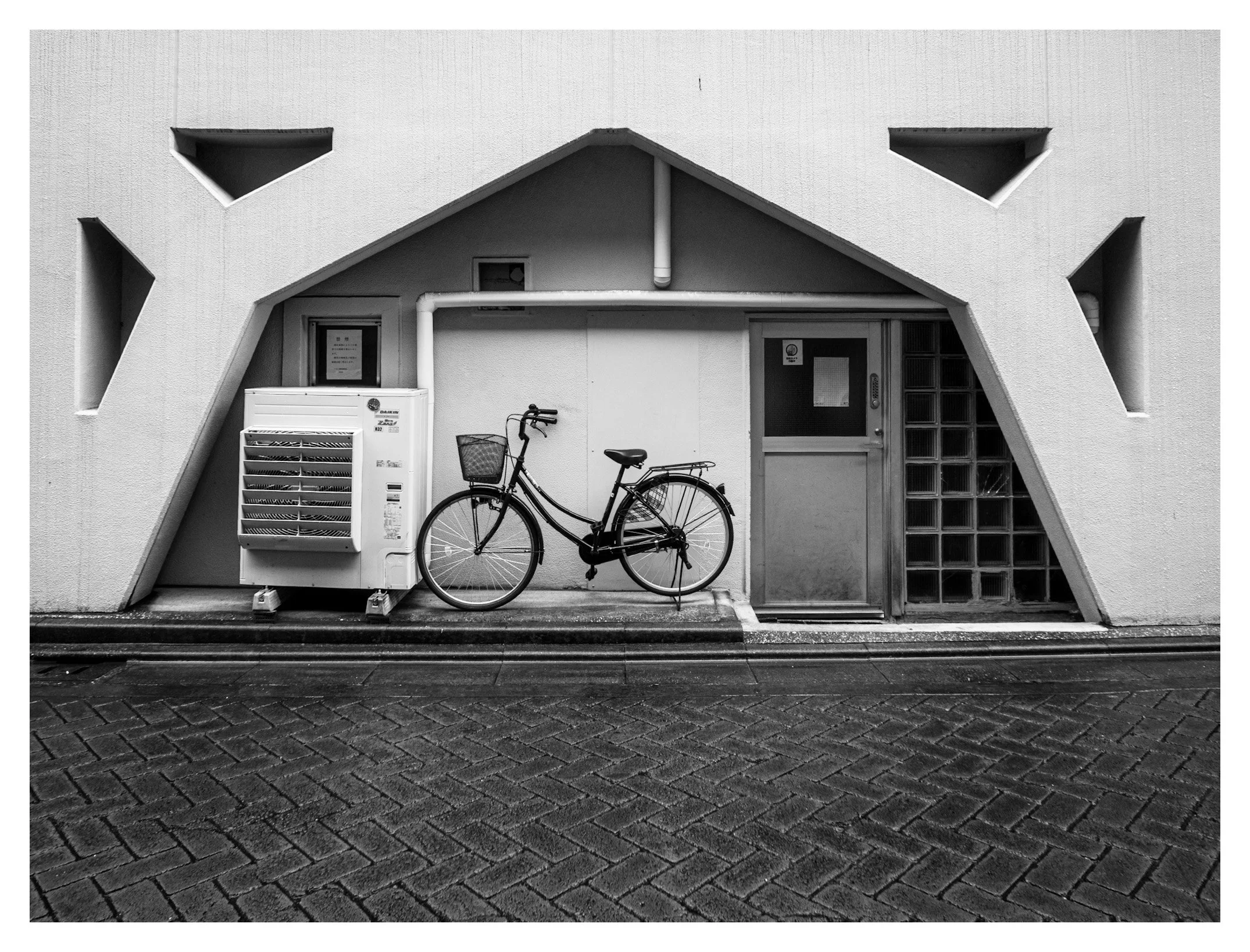
You’ll learn why a single, parked bicycle can transform a rigid architectural facade into a compelling narrative of urban solitude. This critique dissects the interplay of geometric framing, stark monochrome tones, and everyday Japanese design elements captured through the lens.
EXIF Data
Camera Model: Leica D-Lux 8
Shutter Speed: 1/125
Aperture: f/5.6
ISO: 200
The Critique: Finding Balance in the Concrete
There is a profound, quiet rhythm in this frame that speaks beautifully to the vernacular landscape of Tokyo. You have captured a moment of stillness that relies heavily on architectural geometry, using a bold, stylized structural cutout as an organic frame within a frame.
The composition thrives on its strong sense of balance, yet avoids the sterile trap of perfect symmetry. On the left, the heavy, industrial block of the air conditioning unit anchors the frame, mirrored on the right by the delicate, repetitive grid of the glass-block window pane. Nestled perfectly between them—and resting right under the peak of the architectural awning—is the bicycle. It acts as the human anchor in an otherwise inanimate scene, a calling card of an unseen resident.
Your use of high-contrast black and white is highly effective here. It strips away the visual distraction of Tokyo’s colorful signage, forcing the viewer to focus entirely on texture, shape, and tone. The rich, interlocking herringbone pattern of the brick street in the foreground provides a tactile counterpoint to the flat, smooth texture of the concrete building facade.
Technical Enhancements and Fine-Tuning
While the image is graphically striking, a few micro-adjustments could elevate the impact of the final print:
Correcting Spatial Discrepancies: The vertical line of the main building structure on the far right leans slightly inward. In architectural and street photography, maintaining perfectly parallel vertical lines keeps the geometry feeling intentional and solid. A minor perspective transformation in post-processing will straighten this out.
Managing Dynamic Range: The interior views through the triangular window cutouts on the upper left and right are completely lost to deep shadow. While true blacks are excellent for graphic contrast, lifting the shadows just a fraction in those cutouts might reveal faint, subtle textures that add a layer of environmental depth.
Refining the Lower Boundary: The very bottom edge of the frame contains a thin white border that cuts through the herringbone bricks unevenly. Standardizing your border margins ensures that the graphic weight of the pavement isn't abruptly truncated.
Developing Mastery: Building Your Photographic Archive
To evolve from capturing great individual frames to producing cohesive, museum-quality bodies of work, you must begin treating your metadata as a diagnostic tool.
The Analytical Metadata Journal
Create a private digital database or use spreadsheet tracking for every image you select for your portfolio. For each file, catalog the technical specs alongside qualitative notes: the time of day, the specific neighborhood, the weather conditions, and your emotional intent when pressing the shutter.
Over six months, analyze this data to look for patterns. You might discover that your sharpest street work happens exclusively when shooting at f/5.6 on overcast days, or that you tend to underexpose when rushed in high-traffic areas. By isolating these trends, you transform accidental successes into repeatable, deliberate techniques.
Curated Research for the Photographically Curious
To deepen your understanding of street geometry, urban isolation, and the unique visual vernacular of East Asia, I recommend studying the following materials:
Photographers to Analyze
Michael Wolf: His seminal series Tokyo Compression offers a masterclass in claustrophobic urban portraiture, showing how the constraints of a city shape the human experience within its transit systems.
Fan Ho: Regarded as a master of light and shadow, his mid-century street work in Hong Kong demonstrates how to use grand architectural geometry and cutting diagonals to frame solitary figures.
Books to Read
Thoughts on Street Photography by Fan Ho: An insightful dive into the philosophy, patience, and compositional theories behind capturing the classic urban landscape.
Tokyo Compression by Michael Wolf: Essential reading for any photographer shooting in Japan, illustrating how a rigid, repetitive environment can be turned into a profound narrative on modern globalism and urban density.
Educational Videos to Watch
The Genius of Fan Ho - Master of Composition: Discover how the legendary photographer utilized shadows, scale, and patience to turn chaotic city streets into poetic, geometric art. Watch the analysis on YouTube: https://www.youtube.com/watch?v=3M_k_LzE8ks
Michael Wolf's Life in Cities - Retrospective: An exploration of how Wolf documented the structural density, architecture, and vernacular artifacts of major Asian metropolises. View the documentary feature on YouTube: https://www.youtube.com/watch?v=xvE6_k_p4gM