

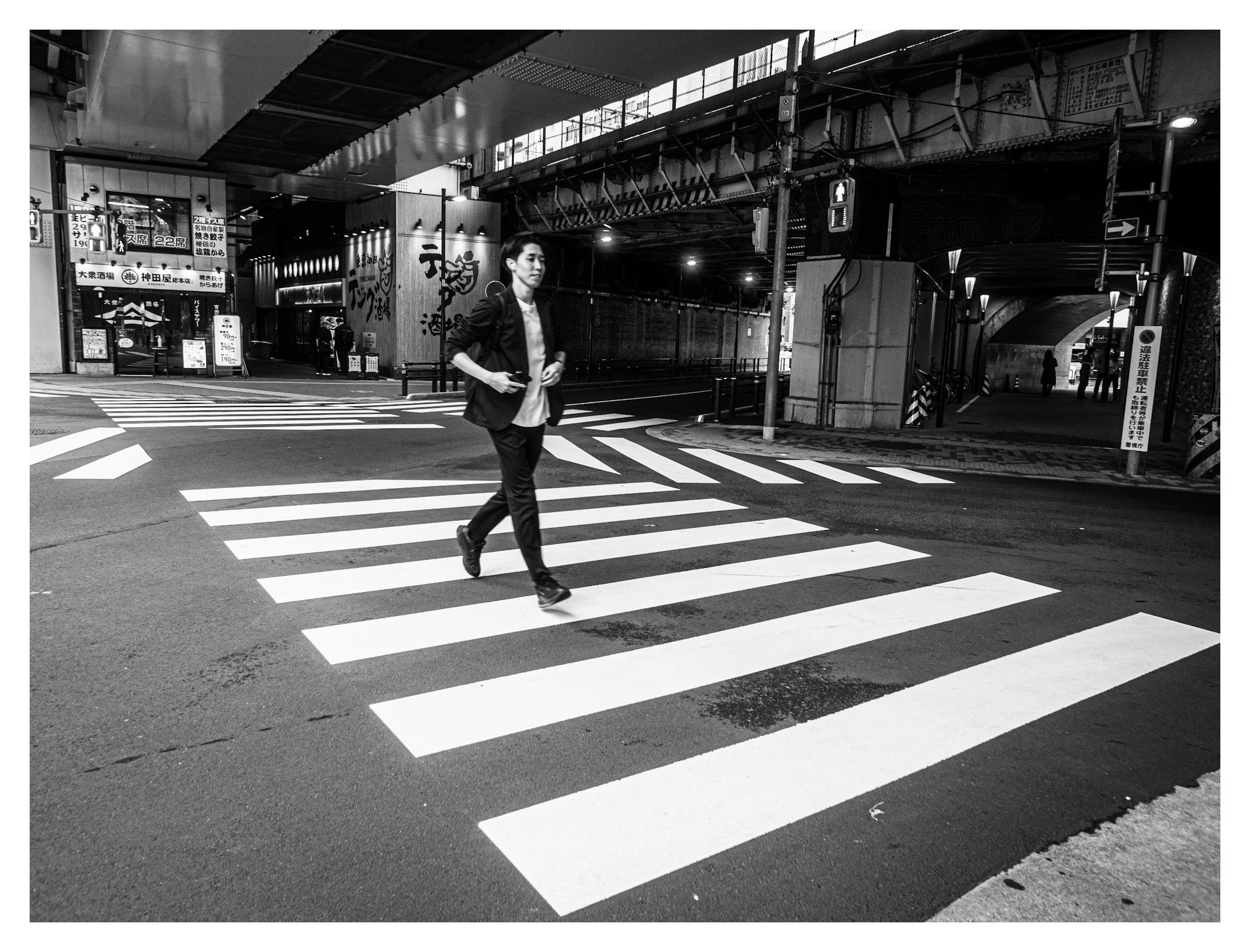
Capturing the perfect slice of urban life requires more than just pointing and shooting. Discover how a split-second decision under Tokyo's tracks highlights a critical choice every street photographer faces, and learn why tracking your camera data might just unlock your next creative breakthrough.
EXIF Data
Camera Model Leica D-Lux 8
Shutter Speed 1/125s
Aperture f/3.2
ISO 200
The Critique: A Study in Urban Geometry
Your image presents an engaging intersection of human movement and rigid urban infrastructure underneath what appears to be Tokyo’s elevated railway tracks. The high-contrast, black-and-white treatment accentuates the strong graphic patterns of the zebra crossing, creating a compelling leading line that guides the eye directly toward the central subject.
Capturing a lone pedestrian mid-stride evokes a classic street photography trope, offering a sense of isolated narrative within a bustling metropolis. The diagonal lines of the street markings against the dark background underpinnings add a gritty, cinematic atmosphere to the frame.
Refine Your Craft: Areas for Improvement
While the composition is graphically striking, a few technical and intentional adjustments could elevate this photograph from a snapshot into a powerful documentary piece:
Freeze the Motion
At 1/125s, a walking subject can still exhibit slight motion blur, especially in the limbs. Bumping the shutter speed to 1/250s or 1/500s would pin down the subject with razor-sharp precision.
Separate the Subject
The subject’s dark clothing partially blends into the dark shadows of the background architecture. Waiting for a moment where the subject passes against a lighter background element—or choosing a subject with contrasting attire—would create better separation.
Mind the Highlights
The bright sky peeking through the upper center and the lit-up storefront signs on the left are somewhat distracting. Cropping tighter or adjusting your angle to eliminate these hot spots would keep the viewer's focus locked onto the main action.
Moving Forward: Data and Visual Literacy
Harnessing Data to Predict the Shot
To grow as a photographer, look beyond the single image and begin compiling an analytics spreadsheet of your work. Track parameters such as focal length, time of day, keeper rate, and lighting conditions. Over time, this data will reveal your behavioral patterns. You will discover whether you find success in low-light environments or harsh midday sun, allowing you to intentionally seek out situations where your technical execution peaks.
Masters of the Frame to Research
To expand your visual vocabulary, study the masters who defined the geometry of the streets:
Daido Moriyama: Look at his raw, high-contrast, and grainy depictions of Tokyo to understand how to lean into a more chaotic, emotional atmosphere.
Fan Ho: Observe his legendary use of geometric shadows, scale, and single subjects in urban spaces to see how architecture can frame humanity.
Essential Reading
For a Language to Come by Takuma Nakahira: A masterful exploration of post-war Japanese urban landscapes that challenges conventional framing.
Bystander: A History of Street Photography by Colin Westerbeck and Joel Meyerowitz: An academic yet accessible reference that tracks the evolution of candid street portraiture.
Educational Video Resources
The Decisive Moment: Delve into the philosophies of Henri Cartier-Bresson regarding timing and geometry in public spaces: Henri Cartier-Bresson: The Decisive Moment
Chasing the Light: A deep dive into utilizing harsh urban shadows and contrast effectively: Street Photography Composition and Light Mastery