

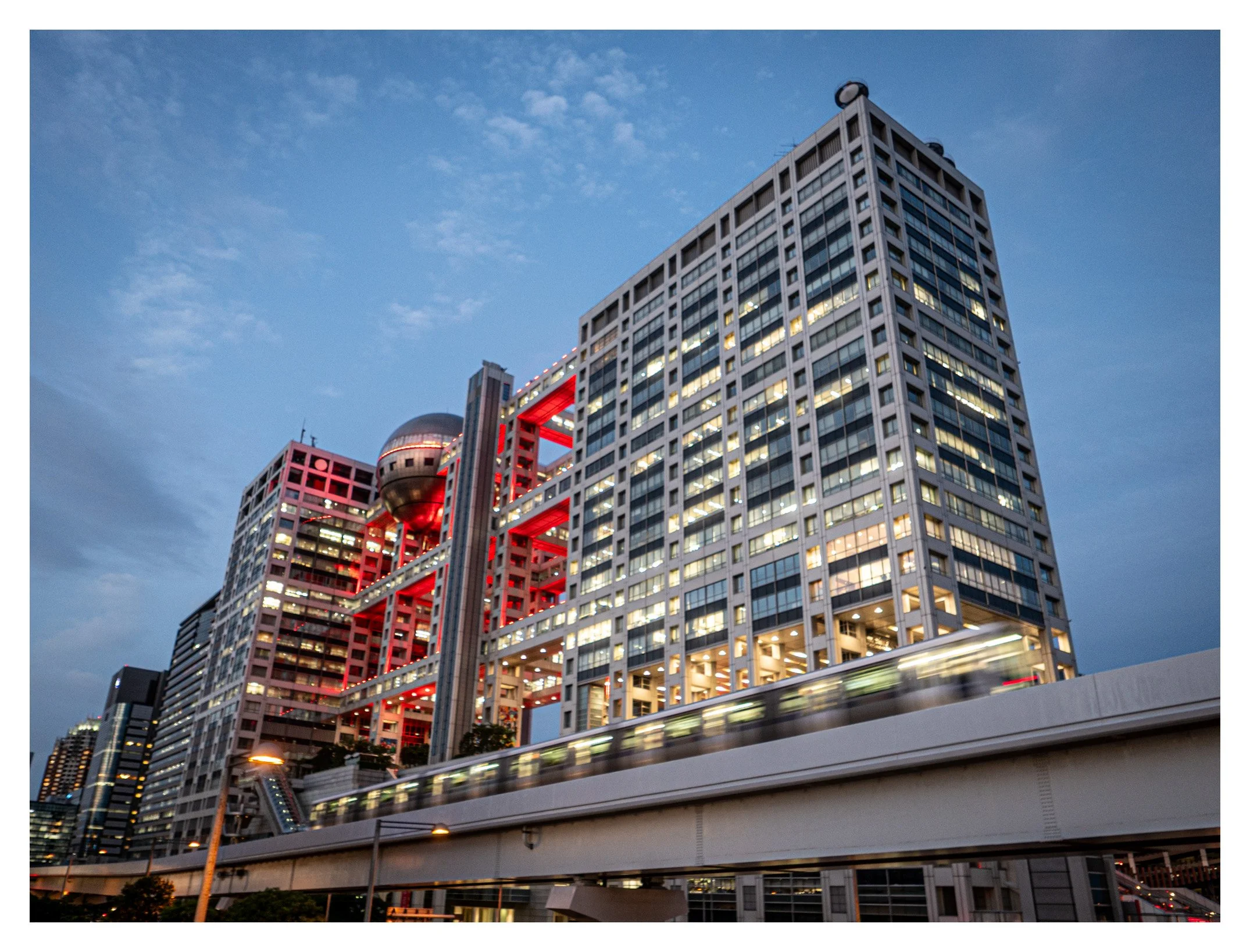
Capturing Kenzo Tange’s iconic Fuji Television building requires more than just pointing a lens at its futuristic lattice. You’ll learn why embracing deliberate motion blur and challenging conventional framing can transform a standard architectural record into a cinematic study of urban velocity.
Image Metadata
Camera Model: Leica D-Lux 8
Shutter Speed: 1/15
Aperture: f/2
ISO: 200
Location: Tokyo, Japan
The Critique: A Dialogue Between Structure and Speed
There is a striking juxtaposition at play in this frame. By positioning yourself below the elevated tracks of the Yurikamome line in Odaiba, you have managed to capture the colossal, grid-like geometry of Kenzo Tange’s Fuji Television building while slicing through the foreground with the kinetic energy of a passing train.
Choosing a shutter speed of 1/15 of a second was an excellent, painterly instinct. It stretches the train into a streak of translucent light, offering a beautiful counterweight to the rigid, hyper-stable Metabolism architecture looming behind it. The warm glow of the interior office lights and the deep crimson illumination glowing from the building's central structural voids inject a distinct cyberpunk aesthetic into the twilight sky.
However, the image wrestles slightly with its framing and perspective. The wide-angle lens, combined with a low-angle tilt, has caused a dramatic vertical convergence—meaning the building appears to be leaning backward. While this can sometimes feel grand, here it truncates the top of the structure’s prominent spherical observation deck, robbing the architecture of its most iconic signature.
Technical Adjustments for a Refined Frame
Correcting Vertical Distortion: When shooting massive structures from below, your vertical lines will naturally converge. To retain the true grandeur of the architecture, step back if physical space allows and keep the camera sensor perfectly parallel to the building facade. Alternatively, you can use built-in perspective correction tools in post-processing to pull those vertical lines back into alignment.
Give the Subject Breathing Room: Avoid clipping structural elements. The spherical dome of the Fuji TV building is the crown jewel of the design. Composing slightly wider to include the entire curve of the sphere against the sky would establish a much stronger visual anchor.
Controlling Exposure Wide Open: Shooting at f/2 allowed you to keep your ISO at a clean 200 during twilight, but a wide-open aperture can sometimes introduce minor softness at the edges of an architectural frame. If you use a tripod, stopping down to f/5.6 or f/8 while extending your shutter speed would sharpen the concrete details while maintaining that gorgeous motion blur on the tracks.
Elevating Your Craft: The Power of Metadata Logging
To evolve from a photographer who takes good images to a master who executes a precise vision, you must look at your archive as a textbook.
Start maintaining a systematic shooting log. Group your images by environment (e.g., Urban Twilight, High-Contrast Street, Architectural Abstracts). For every session, look closely at the relationship between your shutter speed and the velocity of your subjects. By tracking how a 1/15-second exposure behaves compared to a 1/4-second or 1/30-second exposure in the city, you will build an intuitive mental catalog. Over time, you will no longer have to guess how much blur a train or a pedestrian will yield; you will know exactly which setting creates the precise texture you desire before you ever lift the camera to your eye.
Masters to Study and Inspiration for the Road
Photographers to Research
Michael Wolf: Look closely at his Tokyo Compression series to observe how he handles dense, claustrophobic urban geometry, framing infrastructure not just as buildings, but as a commentary on modern life.
Fan Ho: A master of mid-century urban composition. His use of dramatic scale, slicing geometric shadows, and patience in waiting for the perfect human element to enter a massive architectural frame is foundational reading for any street or city photographer.
Books to Read
Uncommon Places by Stephen Shore: An absolute masterclass in using large-format-style precision to frame the built environment. Shore will teach you how to look at ordinary infrastructure with a structural, beautifully balanced eye.
Thoughts on Design by Paul Rand: Though rooted in graphic design, this essay collection is crucial for photographers. It strips visual communication down to its core principles—form, contrast, and geometry—which will fundamentally alter how you arrange elements within a viewfinder.
Videos to Watch
To understand the soul of the very monument you photographed, watch this short exploration of Tokyo's unique Metabolist structures, featuring the Fuji Broadcasting Center: 4K Tokyo: The City Of Metabolist Architecture.
To discover how architectural forms can evoke deep human emotion and push the boundaries of technology, explore the life philosophy of the building's legendary creator: Kenzo Tange: Life and Works.