

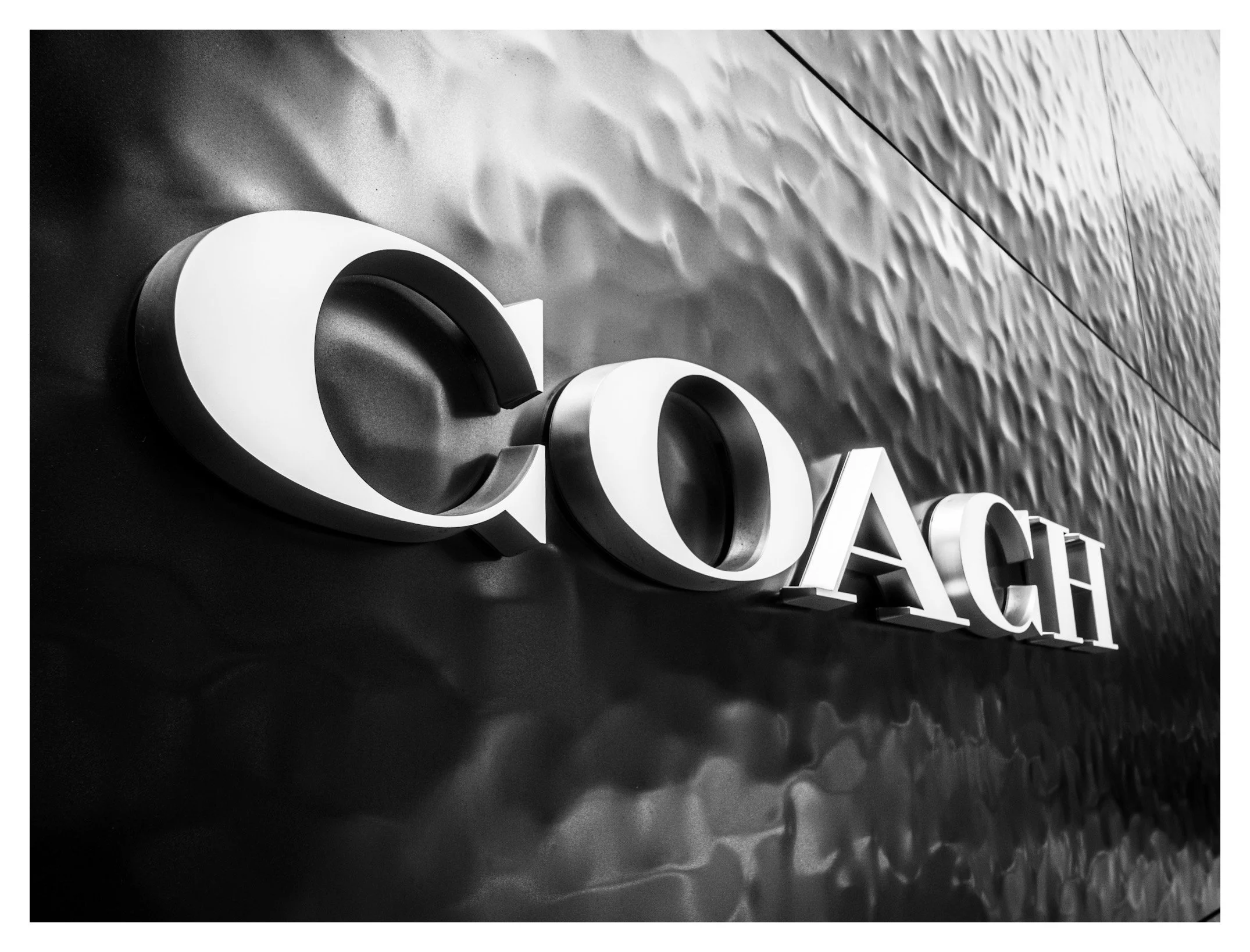
You will learn why a slight shift in perspective can transform everyday commercial typography into a dramatic graphic narrative. Discover how the subtle interplay of shadow and metallic distortion alters our perception of standard branding.
EXIF Data
Camera Model: Leica D-Lux8
Shutter Speed: 1/320
Aperture: f5.6
ISO: 200
This image presents a compelling study in high-contrast abstraction, lifting a familiar commercial logo out of its standard corporate context and treating it as a sculptured form. Captured in Ginza, Tokyo, the frame succeeds primarily because of its focus on texture and its tight, angled composition.
The immediate point of tension is the relationship between the clean, crisp geometry of the lettering and the fluid, organic undulations of the metallic facade behind it. By opting for a black and white rendering, you have stripped away the distracting variables of color, allowing the viewer to focus entirely on form, tonal gradation, and structural cadence. The diagonal sweep of the word creates a sense of dynamic movement across the frame, while the dramatic falloff of light creates a gradient that pulls the eye from left to right.
The specular highlights dancing across the hammered surface mimic the appearance of rippling water, which provides an excellent foil to the rigid, sharp-edged serifs of the sign. It is a masterful realization of the urban landscape as a canvas of abstract patterns.
Refining the Frame: Room for Growth
While the image has immense graphic impact, a few subtle adjustments during capture could elevate its artistic depth:
Mind the Highlights: The faces of the letters 'C' and 'O' are pushed right to the edge of overexposure. In high-contrast street photography, losing detail in the whites can make the shapes feel detached. Bringing down the exposure by a third of a stop would preserve the fine metal grain on the lettering itself.
Edge Awareness: The letter 'H' at the far right of the frame is fighting for breathing room against the fading depth of field. Giving the composition just a fraction more space on the right edge would allow the final letter to resolve completely without feeling clipped by the frame line.
Micro-Contrast Control: The transition between the deep shadows beneath the 'C' and the bright surface of the letter is incredibly abrupt. Utilizing a subtle fill light or repositioning your angle slightly to catch a secondary reflection would bridge that extreme contrast gap and add dimensionality.
Becoming a Critical Archivist: The Metadata Method
To evolve as a visual storyteller, you must stop treating images as isolated occurrences and start analyzing them as data sets.
Create a personal archive spreadsheet. For every successful frame, catalog the camera model, focal length, shutter speed, aperture, and ISO, alongside qualitative tags like "High Contrast," "Abstract," "Geometric," or "Commercial."
Over six months, patterns will emerge. You might discover that your most visually arresting images are consistently shot at f5.6 or that you lean heavily on a specific focal length when shooting in compressed urban environments. Recognizing these technical habits allows you to consciously break them, pushing yourself out of your comfort zone to find new creative methodologies.
Curated Resources for Further Study
Photographers to Research
Fan Ho: For an absolute masterclass in how to use geometric shapes, stark shadows, and high contrast within urban settings to build a sense of scale and drama.
Michael Wolf: Specifically his architectural studies, to observe how compression and framing can turn massive physical structures into repetitive, abstract patterns.
Books to Read
"The Decisive Moment" by Henri Cartier-Bresson: The foundational text on structural arrangement and training your eye to recognize when geometry and time align perfectly.
"Uncommon Places" by Stephen Shore: Though primarily known for his color work, Shore’s structural precision and meticulous attention to the mundane elements of commercial landscapes offer brilliant lessons in composition.
Videos to Watch
To understand how to embrace high-contrast street photography and see the city through a graphic lens, watch The Art of Photography: Street Photography Composition.
For an examination of minimalism and texture within an urban environment, view Sean Tucker: Finding Light in the Darkness.