

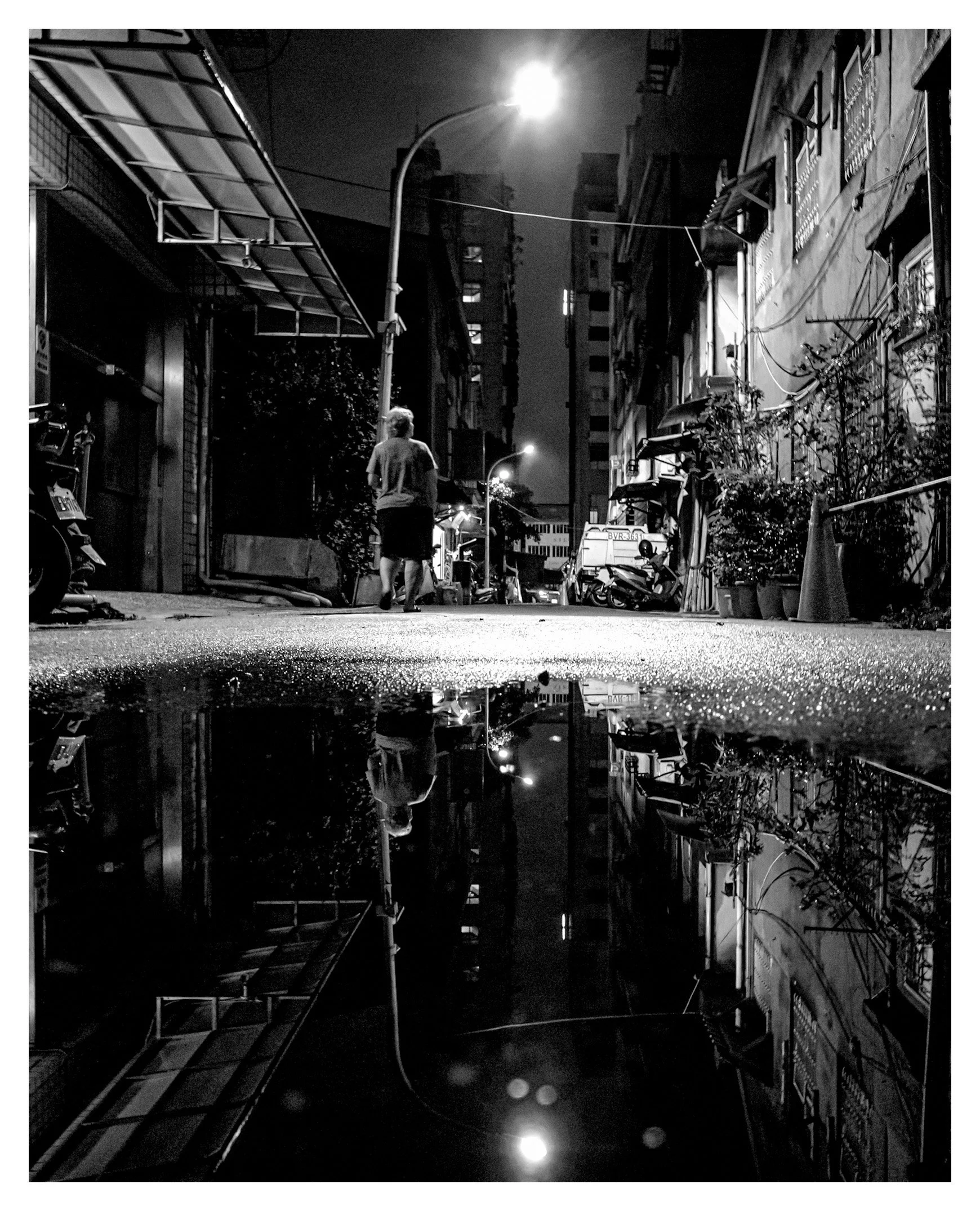
Rain creates a canvas on the asphalt, turning a simple walk into an exercise in symmetry. You’ll learn why a high-grain, high-ISO approach captures the raw pulse of the city, and how shifting your perspective can completely redefine the emotional weight of your street photography.
EXIF Data
Camera Model: Ricoh GRIII
Shutter Speed: 1/30
Aperture: f5.6
ISO: 6400
The image is a compelling study of urban isolation and structural geometry, utilizing the damp streets of Kaohsiung to build a classic split-composition. By positioning the camera close to a roadside puddle, you have created a near-perfect Rorschach inkblot of urban life. The vertical lines of the architecture lock the frame into a tight, deliberate corridor, guiding the viewer's eye forcefully down the center toward the solitary subject walking away.
The choice of monochrome is highly effective here. It strips away the competing neon and fluorescent distractions typical of Taiwanese nightscapes, forcing the viewer to confront raw form, contrast, and texture. The asphalt surface creates a beautifully textured horizon line that slices the image in half, separating the physical world from its liquid mirror.
Areas for Improvement
Tame the Highlights: The street lamp at the top center of the frame is severely blown out, creating a heavy lens flare that pulls attention away from the human subject. While night street photography inherently deals with harsh light sources, closing down the aperture slightly or adjusting your position to mask the bulb behind a roofline would retain the dramatic light falloff without the blinding hotspot.
Embrace Ambient Depth: Shooting at f5.6 at night provides decent depth of field, but it forces your ISO up to 6400, introducing significant digital noise. While the grain works in favor of a gritty, documentary aesthetic, a wider aperture like f2.8 or f4 would lower the required ISO, clean up the shadow details in the alleyways, and isolate the subject more cleanly from the deep background.
The Decisive Moment: The subject is caught mid-stride, which gives a sense of motion. However, waiting another second for the subject to move slightly further down the alley—framed perfectly between the mid-ground street lamps—would have heightened the silhouette effect and made the human element feel more intentional within the grand architectural scale.
Becoming a Better Photographer Over Time: The Data Approach
To truly evolve as a photographer, you must treat your catalog as a living archive. Instead of merely looking at your photos, look at the data behind them. Compiling metadata allows you to spot technical habits and creative ruts that are otherwise invisible.
How to Compile and Analyze Your Metadata
Focal Length and Aperture Audits: Periodically filter your best images to see which focal lengths and apertures you default to. If you notice 90% of your favorite street frames are shot at a wide-open f2.8, challenge yourself to shoot a week at f8 to force a shift toward environmental storytelling where everything is sharp.
The Keeper-Rate Formula: Calculate your keeper rate across different lighting conditions. Divide your final edited selections by the total number of frames shot during a specific session. If your night street photography keeper rate drops drastically when shutter speeds hit 1/30 or slower, it is a data-driven signal to invest time in mastering steadier hand-holding techniques or adjusting your auto-ISO minimum shutter speed thresholds.
Time-of-Day Tracking: Log the timestamps of your successful images. You might find that your eye for composition peaks during the blue hour or late at night rather than midday. Use this data to optimize your shooting schedule, focusing your energy when your creative instincts are statistically sharpest.
Masters to Study, Books to Read, and Media to Watch
Expanding your visual vocabulary requires stepping outside your comfort zone and studying how master photographers manipulate light, frame geometry, and narrative.
Photographers to Research
Chien-Chi Chang: A master of documentary photography whose work in Taiwan explores deep themes of alienation, mental health, and structural confinement. His book The Chain is a masterclass in using framing to evoke psychological tension.
Fan Ho: For those working with reflections, shadows, and clean urban geometry, Fan Ho’s 1950s street work in Hong Kong is the ultimate blueprint. He understood how to use single light sources to turn mundane streets into cinematic stages.
Michael Wolf: His series Tokyo Compression provides an intense look at urban density and architectural claustrophobia. His work will challenge you to look at how buildings and tight spaces shape the human experience.
Essential Reading
"The Decisive Moment" by Henri Cartier-Bresson: The definitive text on street photography logic, geometry, and timing. It teaches you how to align the brain, the eye, and the heart along the same line of sight.
"Bystander: A History of Street Photography" by Colin Westerbeck and Joel Meyerowitz: An encyclopedic look at the evolution of the genre. It provides vital context on how street photography shifted from formal portraiture to candid, modern observation.
Videos to Watch
The Genius of Fan Ho's Street Photography Geometry: This analysis breaks down how to read urban spaces like an architect and wait for the perfect light to carve out your frame.
Mastering Low Light: Exposure Strategies for the Night Street: A deep dive into balancing fast shutter speeds with high ISO noise, showing you how to maintain crisp subjects when the sun goes down.