

Day 235/365 The Razor and the Quilt: Sharp Geometry on a Kaohsiung Sidewalk
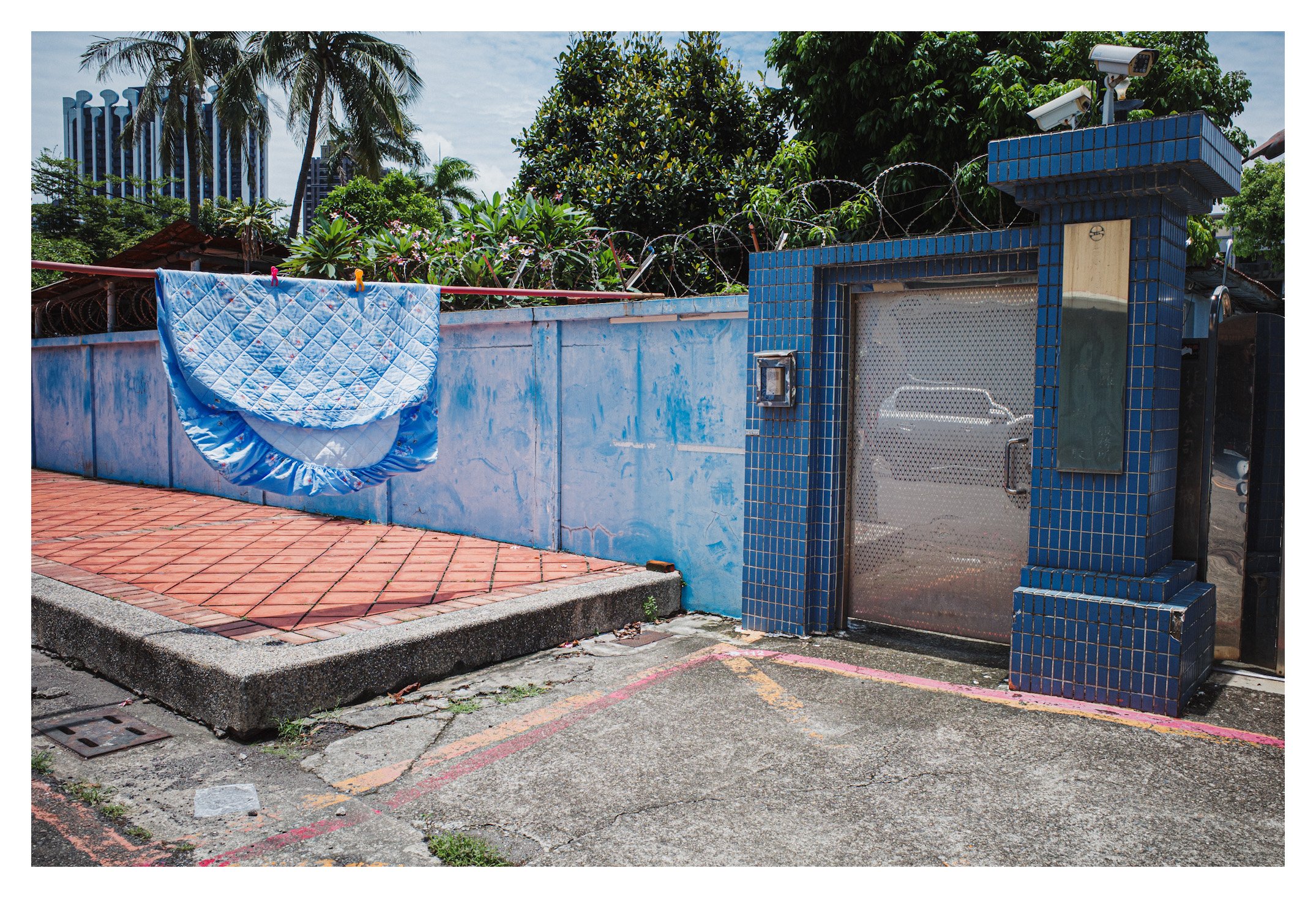
An everyday stroll in Southern Taiwan reveals a striking visual battleground between domestic life and heavy security. Discover how a simple household chore colliding with razor wire can teach you the ultimate lesson in framing, tension, and managing dead space in street photography.
EXIF Data
Camera Model: Ricoh GRIII
Shutter Speed: 1/1250
Aperture: f4.5
ISO: 200
There is an arresting friction at the heart of this photograph. As a street photographer, your eye was clearly drawn to a classic urban contradiction: the soft, vulnerable, domestic act of drying a quilted blanket juxtaposed against the aggressive, institutional hostility of a fortified gate.
The color palette is undeniably compelling. The weathered blue of the wall anchors the frame, while the bright red diamond pattern of the raised sidewalk injects a powerful geometric element. By opting for an exposure of 1/1250s at f4.5, you captured the intense, harsh daylight of Kaohsiung with absolute clarity, bringing out the peeling textures of the concrete and the glinting metal of the razor wire. The blanket's shadow acts as a solid, graphic anchor on the red pavement.
However, a great street photograph requires more than a strong contrast of themes; it demands ruthless editing within the frame.
Refinement: Ruthless Framing and Dead Space
To elevate this image from a well-observed moment to a museum-grade composition, several adjustments could be made to the framing and positioning.
Eliminate Architectural Distractions: In the upper-left quadrant, a modern, scalloped skyscraper peers over the palm trees. This background element pulls the viewer's attention away from the intimate, localized tension between the blanket and the gate. Cropping slightly from the left or shifting your physical position to hide that building behind the foliage would keep the narrative contained within the immediate street corner.
Minimize the Foreground Asphalt: The lower third of the frame consists of cracked grey asphalt with a faint pink line. This area contains very little visual information and dilutes the impact of the brilliant red diamond sidewalk. Stepping closer to the raised curb or dropping your camera to a lower, more dramatic angle would compress this dead space, allowing the geometric lines of the red pavement to dominate the lower third of the image.
Wait for the Shadow's Peak: The harsh midday sun works well for texture, but waiting for a slightly different time of day when the sun casts a longer, more dramatic diagonal shadow from the blanket across the red tiles would create a dynamic leading line, guiding the viewer's eye straight toward the fortified blue pillar.
The Analytical Photographer: Data-Driven Growth
To evolve your craft systematically over time, you must look past individual images and begin analyzing the underlying data of your catalog. Casual shooting builds intuition, but structured data compilation builds mastery.
Create a spreadsheet or use data tracking structures (like those found in books_database_2.numbers) to log the metadata and compositional DNA of your successful photographs.
Track Exposure Habits: Map your focal lengths and apertures. If your data shows that 80% of your street work is shot at mid-range apertures like f4.5 or f5.6, challenge yourself to spend a full month shooting exclusively at f2.8 to explore isolation, or at f11 using hyperfocal distance.
Log Compositional Templates: Categorize your images by their structural style—such as "Layered/Complex," "Juxtaposition," "Graphic/Minimalist," or "Leading Lines." Over six months, a clear pattern will emerge. If you notice a heavy reliance on a single template, it is a signal to break your routine and force yourself into unfamiliar visual territory.
Curated Inspirations for the Serious Eye
To expand your visual vocabulary, study how other masters handle the complex relationship between color, structural geometry, and human environments.
Photographers to Research
Fan Ho: A legendary master of light, shadow, and geometric framing. His work demonstrates how to use stark, graphic lines in urban spaces to create a sense of scale and drama.
Shen Chao-Liang: Essential research for understanding the intersection of color, local infrastructure, and cultural landscapes within Taiwan. His environmental structures showcase the deep character of regional spaces.
Books to Read
The Decisive Moment by Henri Cartier-Bresson: The absolute bible of photographic composition. It will teach you how geometry, timing, and human elements must align perfectly within the frame.
The Suffering of Light by Alex Webb: A masterclass in complex, multi-layered color street photography. Webb’s work is highly instructive on how to manage multiple points of interest and deep shadows without cluttering the frame.
Videos to Study
William Eggleston - The King of Color: A deep dive into how ordinary, mundane structures and everyday objects become extraordinary through precise color relationships and deliberate framing. Watch on YouTube: https://www.youtube.com/watch?v=3j2uW901239
Garry Winogrand - All Things are Photographable: An exploration of one of street photography's most energetic figures, focusing on how to embrace the chaos of the street while maintaining a rigorous command over the edges of your frame. Watch on YouTube: https://www.youtube.com/watch?v=13F8E120-E2E6-44BC-AF17-ECD126EB2F0r