

Day 236/365 Low to the Ground: Finding Cinema in a Kaohsiung Downpour
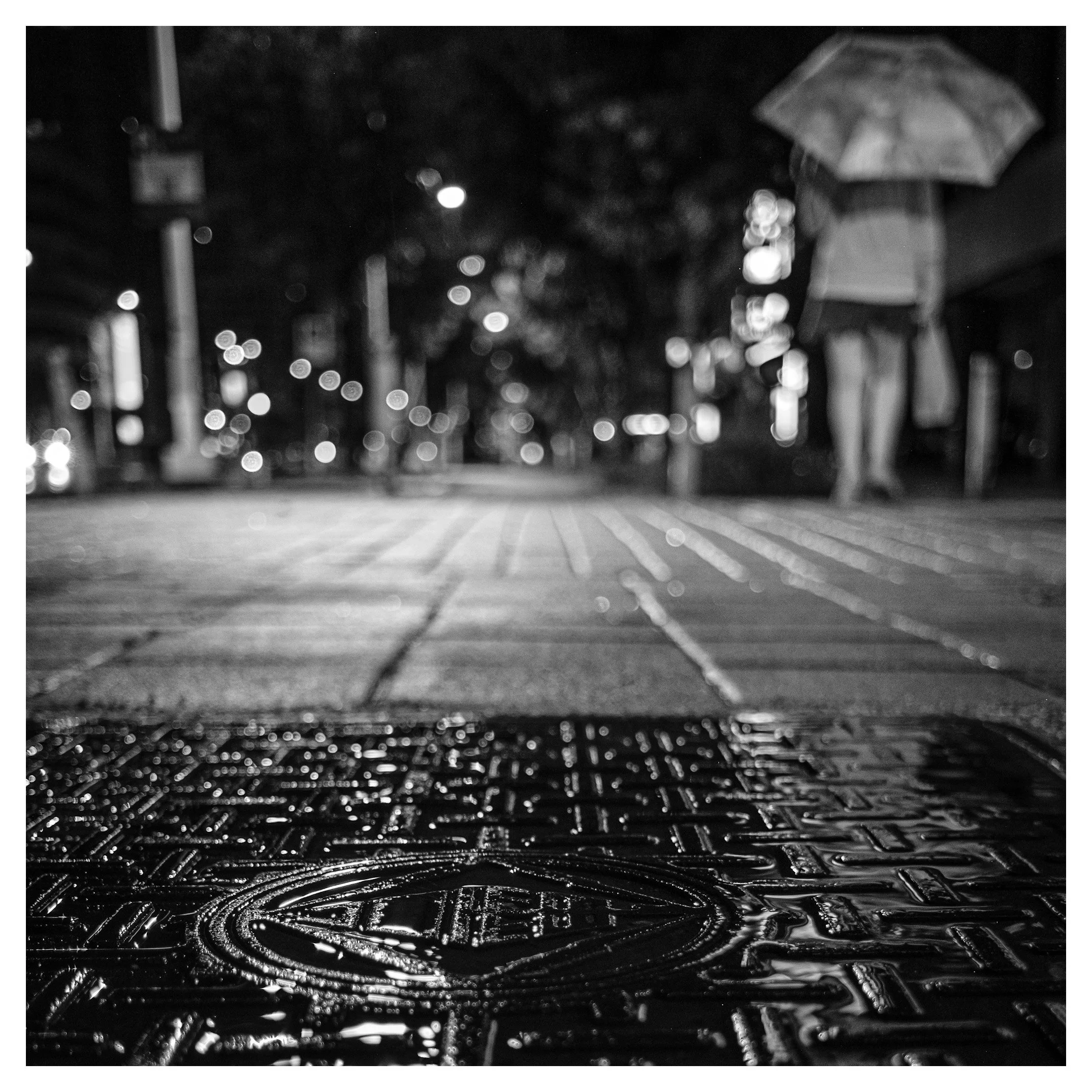
What happens when you drop your lens to the very pavement of a rain-slicked city? This look at a late-night street frame reveals how technical constraints and deliberate low-angle geometry can turn a common storm into a masterclass in cinematic atmosphere. You’ll learn why a shift in perspective changes everything.
Camera Metadata
Camera Model: Fujifilm X-Pro2
Shutter Speed: 1/60
Aperture: f2
ISO: 800
The Critique: Theo Marr on Atmosphere and Geometry
There is a distinct, dark romance to a city slicked by storm, and this image captures that mood with an exceptional sense of presence. By dropping the camera completely down to the ground plane, you have transformed a common street feature—the geometric pattern of a wet manhole cover—into a tactile, highly textured anchor for the entire composition. The way the water pools within those grooves, catching the ambient street light, creates a beautiful, high-contrast playground in the lower third of the frame.
The square crop serves this composition well. It balances the dense, crisp geometry at the bottom against the soft, impressionistic background, where a solitary figure under an umbrella steps into the night. The circular bokeh balls drifting through the mid-ground perfectly evoke the feeling of a humid, rain-soaked evening. It is an image filled with mystery and cinematic potential.
Refining the Frame: Room for Growth
The Trap of Foreground Focus: Right now, your critical sharp focus rests entirely on the immediate foreground metalwork. While the texture is stunning, it leaves your primary human element completely lost to the blur. Consider shifting your focus plane slightly further back into the mid-ground pavement. This maintains a soft, atmospheric foreground fall-off while giving the silhouette of the walking figure just enough edge definition to heighten the storytelling tension.
Shutter Speed vs. Low-Angle Stability: Shooting at 1/60th of a second at f2 while crouched or holding a camera near the wet ground is a recipe for subtle micro-shake. To keep those geometric lines tack-sharp without raising your ISO too high, try anchoring the base of your camera against a small, packable rubber wedge or a pocket beanbag on the pavement to ensure absolute stability.
Shadow Density: The image leans heavily into deep, blocked-out blacks. While this adds drama, bringing up the shadows by just a fraction of a stop in post-processing could reveal a whisper of texture in the darkest corners, keeping the frame from feeling overly compressed.
Becoming a Better Photographer Over Time: The Data Approach
To evolve from a shooter who captures great individual frames into an artist with a cohesive vision, you need to treat your body of work as a living database.
Stop looking at your photos as isolated files. Every quarter, export the EXIF data of your top fifty images into a structured tracking system. Analyze the patterns that emerge. Are you consistently shooting wide open at f2 because it is a comfortable habit, or does the narrative actually demand it? Are you limiting your shutter speeds to 1/60th when a faster speed might crisp up your street work?
By compiling data on your focal lengths, apertures, lighting conditions, and even the weather conditions of your successful shoots, you strip away guesswork. You will quickly see your technical blind spots and identify the exact environments where your creative voice thrives.
Curated Recommendations for Study
Photographers to Research
Chien-Chi Chang: A master of documentary narratives who brilliant navigates alienation, tight environments, and deep cultural landscapes. Studying his work will show you how to anchor human geometry within highly specific atmospheric contexts.
Fan Ho: For an absolute masterclass in monochrome street work, look closely at how he utilized dramatic directional light, clean lines, and geometric frames to isolate figures within the public square.
Books to Read
Thoughts on Landscape by Frank Gohlke: A deeply contemplative book that will expand how you conceptualize space, structures, and the silent dialogue between the built environment and the camera lens.
Bystander: A History of Street Photography by Colin Westerbeck and Joel Meyerowitz: This is the definitive reference work that charts the historical evolution, philosophical shifts, and technical milestones of shooting in the streets.
Videos to Watch
Magnum Photos Contact Sheets: To understand how classic masters built their narratives, managed variables, and organized chaos within a scene, watch this breakdown on YouTube: https://www.youtube.com/watch?v=chK6g4hToxE.
In Sight - Street Photography Documentary: For a modern perspective on finding creative rhythm, handling challenging low-light environments, and building a visual voice on the move, watch this documentary on YouTube: https://www.youtube.com/watch?v=k386521584X.