

Day 237/365 Motion in the Rain: Capturing Kaohsiung's Fluid Streets
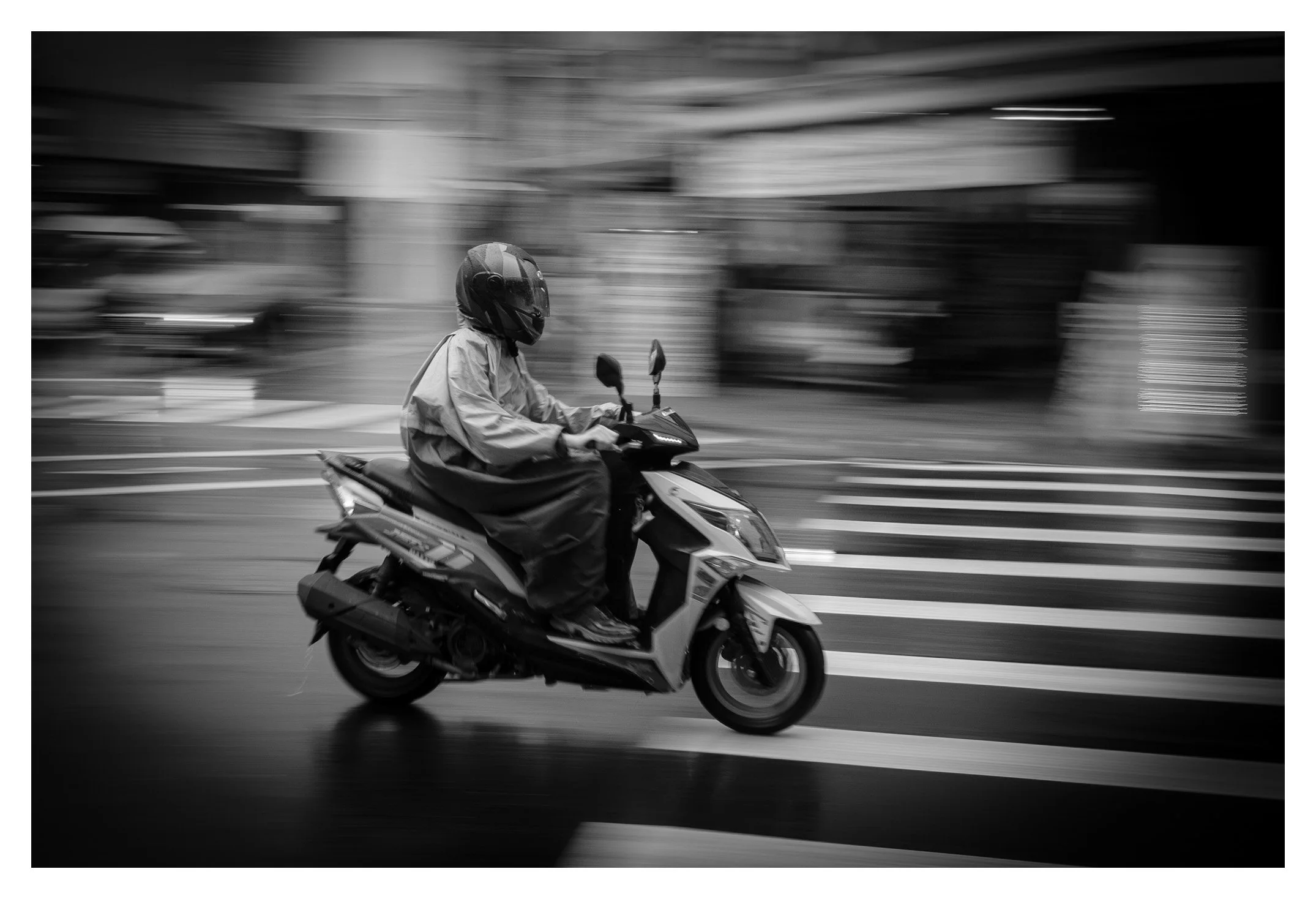
A masterclass in street panning captures a lone scooterist slicing through a rainy evening. You'll learn why a borderline exposure choice breathes life into the frame, how to analyze your metadata trends over time, and which legendary monographs will reshape your understanding of visual grit.
Image Metadata
Camera Model: Fujifilm X-Pro2
Shutter Speed: 1/30
Aperture: f7.1
ISO: 400
Greetings. I am Theo Marr. When analyzing street photography, I look for work that transcends the mere documentation of a public space and instead captures its energy, its friction, and its pulse. Let us dismantle this frame together.
This photograph, captured on the slick asphalt of Kaohsiung, strikes at the very heart of street photography's relationship with movement. Street portraiture in adverse weather demands an intuitive understanding of pace, and here, the motion blur of your panning shot works beautifully. The background streaking creates a cinematic canvas, while the distinct geometry of the pedestrian crosswalk anchors the lower third of the composition.
The choice of monochrome is highly effective. By removing color, the image focuses entirely on tone, texture, and velocity. The reflection of headlights and streetlamp glare on the wet surface adds a layer of atmospheric depth, transforming a mundane commute into a moody, narrative-driven slice of life.
Room for Improvement
While the intentional blur establishes a marvelous sense of speed, the technical execution of the pan leaves room for refinement:
Critical Sharpness: In a successful motion pan, the subject's core—ideally the helmet or the front cowl of the scooter—needs a sharper point of contact to contrast against the extreme background blur. At 1/30 of a second, any vertical camera shake soft-focuses the entire subject. Track smoothly on a perfectly parallel plane with the rider to tighten that focal point.
Framing and Spacing: The rider is positioned centrally, slightly leaning toward the left. In street photography, subjects should ideally have "room to ride" into the frame. Capturing the scooter a fraction of a second earlier would place it on the right side of the frame, allowing the viewer's eye to follow the trajectory of travel across the crosswalk.
Elevating Your Craft: The Power of Metadata Compilation
To progress from capturing isolated moments to understanding your innate stylistic voice, you must treat your image catalog as a database. Compiling data from your photo library helps decode your habits and uncovers hidden patterns in your work:
Track Your Focal Lengths: Filter your catalog to see if you favor a tight, environmental frame or an intimate close-up. If you notice a high concentration of shots at a specific focal range, force yourself to spend a month shooting at the opposite extreme to challenge your spatial awareness.
Correlate Shutter Speeds with Success Rates: For kinetic street photography, log your keeper rate across different slow shutter speeds (e.g., 1/15, 1/30, 1/60). Finding your personal threshold for sharp motion pans will take the guesswork out of camera settings in fast-moving environments.
Monitor Aperture Trends: Analyze whether you lean heavily on wide-open apertures or deeply compressed depths of field. Street photography thrives on contextual backgrounds; tracking this metadata ensures you aren't using background separation as a crutch to avoid complex compositions.
Masters of the Medium: Research and Inspiration
To broaden your visual vocabulary, study these seminal artists and resources that explore the boundaries of grit, geometry, and street subcultures:
Photographers to Study
Chien-Chi Chang: A masterful documentarian whose book The Chain presents an unforgettable look at alienation and environmental portraiture. His work provides an exceptional education in framing human subjects within structured environments.
Daido Moriyama: The definitive voice of Japanese street photography. His provocative, high-contrast, and grainy monochrome style demonstrates how breaking traditional technical rules can create an incredibly visceral mood.
Michael Wolf: Famous for his series Tokyo Compression, Wolf’s work is essential reading for understanding how to capture the claustrophobia, density, and daily rhythm of modern Asian urban landscapes.
Books to Read
Bystander: A History of Street Photography by Colin Westerbeck and Joel Meyerowitz. This is the definitive academic reference on how the genre has evolved, tracing the lineage of candid observation from its inception.
Thoughts on Street Photography: A compilation of insightful essays and philosophies that moves past camera settings to explore the deeper psychological motivations behind public photography.
Videos to Watch
Watch The Quick Review of Fujifilm X-Pro2 to see how this specific camera body handles environmental shooting and street-level imagery in dynamic field scenarios.
Study The Genius of Daido Moriyama to dive deep into how raw, unpolished imagery can evoke powerful emotional responses far beyond technically perfect exposures.