

Day 238/365 Escaping the Grid: Finding the Cinematic Soul in Kaohsiung's Concrete
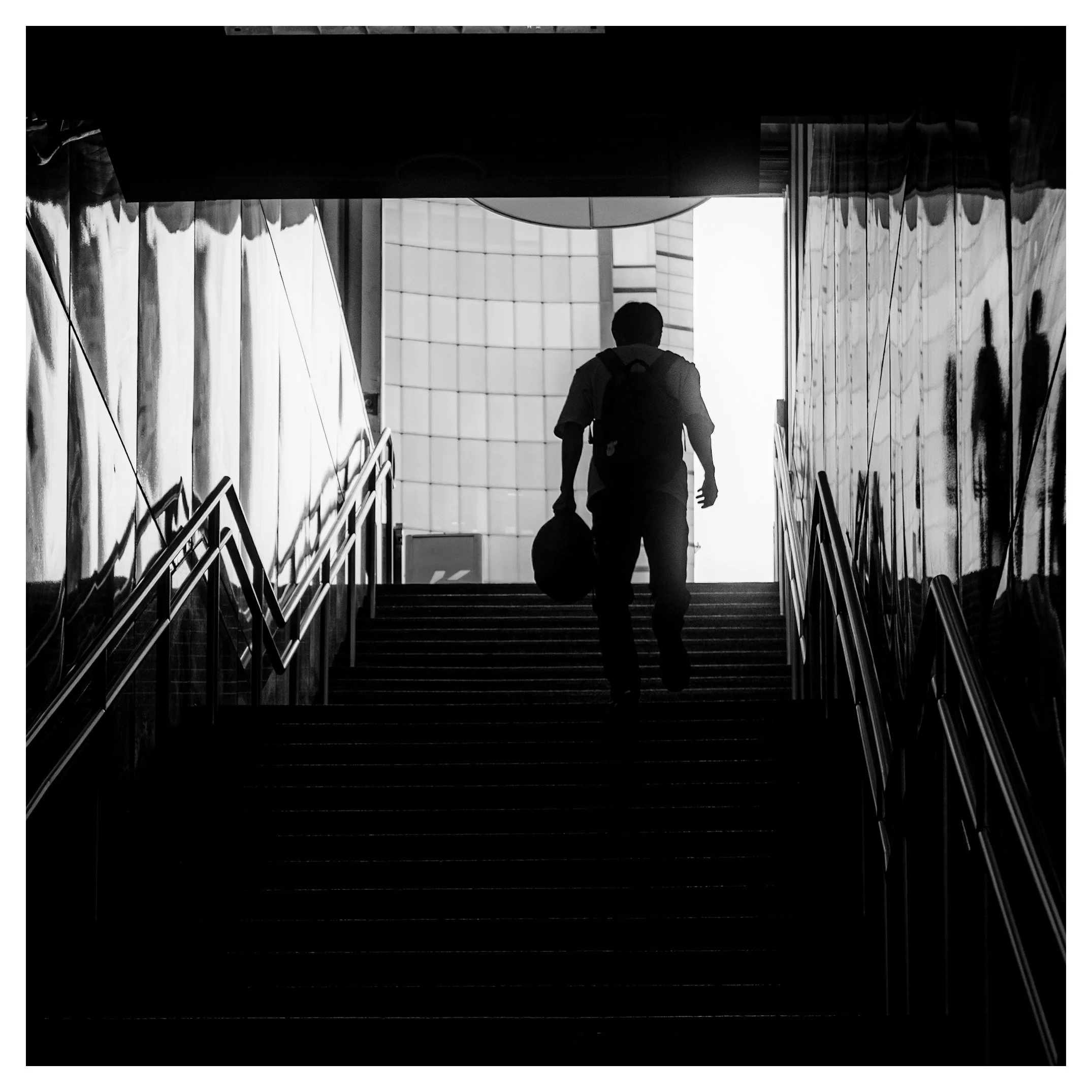
A solitary figure breaks through the crushing geometric symmetry of an underground transit exit, stepping into the blinding light of the city above. You will discover how subtle shifts in shutter mechanics, deliberate highlight preservation, and an aggressive data-driven editing archive can turn a brief urban encounter into a permanent psychological study.
EXIF Data
Camera Model: Leica D-Lux 8
Shutter Speed: 1/125
Aperture: f/4.5
ISO: 200
Street photography at its highest level is not merely about documentation; it is about tracking isolation. In this frame, the stark, high-contrast silhouette climbing the stairs evokes an immediate cinematic gravity. The deep, ink-black shadows of the foreground build a classic tonal gradient that pushes the eye naturally upward toward the brilliant, geometric grid of the Sanduo architecture.
The compositional strength lies in the flanking panels. The polished, reflective surfaces on either side act as visual echoes, capturing distorted, ghostly impressions of urban life that perfectly bracket the central subject. It is a sophisticated nod to the tension between the individual and the imposing structure of the modern city.
Theo Marr’s Critiques and Refinements
Even a compelling frame can be sharpened into a masterpiece. To elevate this specific image from a strong street grab to an archival-grade print, consider these precise physical and technical adjustments:
Pin the Silhouette with Shutter Velocity: A shutter speed of 1/125 is a dangerous baseline on the street if either you or your subject is in motion. While the figure's core is stable, a fraction of softness creeps into the edges of the limbs and the bag. Pushing to 1/250 or 1/500 would solidify the boundary lines of the silhouette, rendering those edges with razor-sharp graphic finality.
Expose for the Escape Route: The exit portal is completely blown out, turning what could be a textured, complex background into a wall of pure white. By pulling your exposure down slightly to preserve the faint architectural details of the distant upper buildings, you ground the fantasy in reality. You can always crush the foreground stairs back into deep black during post-processing.
Force the Centered Symmetry: The figure is slightly left of the absolute center line between the handrails. In a frame so heavily dictated by harsh vertical grids, a fractional half-step to your right during the capture would have locked the subject into a flawless, symmetrical frame-within-a-frame, maximizing the psychological weight of the ascent.
The Analytical Photographer: Building the Long-Term Eye
In my decades analyzing the medium, I have found that the difference between an amateur who takes good photos and a master who creates a legacy is a systematic audit of their own work. Stop relying on luck.
Harnessing Personal Imagery Data
To evolve over time, you must treat your own output as a living database. Periodically export the metadata of your top 100 images from the past year and analyze the hard numbers. Look beyond the basic settings:
Map out your successful frames against the time of day, weather conditions, and precise geographical locations.
Correlate your focal lengths with the emotional distance of your subjects—are your most powerful silhouettes shot wide and close, or compressed from afar?
Track your rejection rate under specific lighting scenarios to isolate technical vulnerabilities.
Compiling this personal data strips away the myth of the "creative block." It reveals your unconscious habits, forces you to confront the lighting conditions you routinely avoid, and transforms random technical successes into a deliberate, repeatable methodology.
Artists to Research
Chien-Chi Chang: Look deeply into his landmark work The Chain to observe how a master handles absolute alienation, stark human forms, and the heavy psychological weight of a framing environment.
Daido Moriyama: If you want to understand how to weaponize grain, high contrast, and raw, provocative street energy without worrying about conventional technical perfection, Moriyama is your textbook.
Books for the Library
"Thoughts on Landscape" by Kuo Hsi: A foundational treatise on how to view space, depth, and the emotional resonance of an environment. It will completely reshape how you place human figures within vast architectural landscapes.
"The Suffering of Light" by Alex Webb: An unparalleled masterclass in complex framing, multi-layered depth, and understanding how light can divide a single frame into distinct, competing narratives.
Critical Viewing
"Trent Parke - Dreamlives Documentary"
An intense look at how Australia's cinematic street master tracks light like a hunter, using extreme contrast and long exposures to turn ordinary pedestrians into mythical silhouettes.
"Ray’s a Laugh - Richard Billingham Profile"
A raw look at documentary photography that strips away the clean, polished aesthetic to show how visceral, honest storytelling overrides technical polish.