

Day 239/365 The Concrete Solitary: Decoding the Geometry of Kaohsiung's Streets
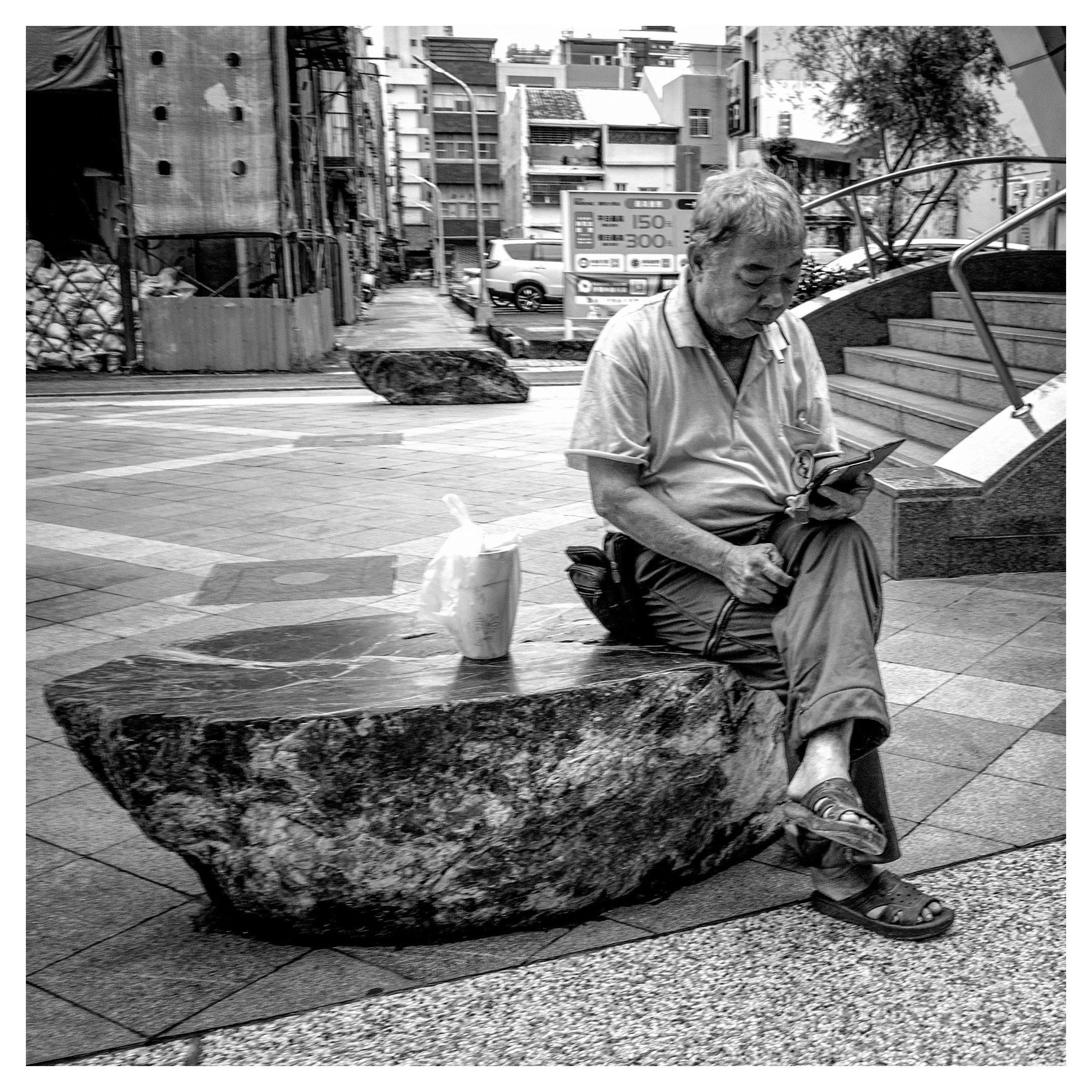
What happens when the timeless grit of street photography meets modern digital isolation? In this critique, you'll learn why a simple moment on a stone bench in Kaohsiung becomes an engaging study of modern composition—and how tracking your technical metadata can elevate your craft over time.
EXIF Data
Camera Model: Ricoh GRIII
Shutter Speed: 1/320
Aperture: f8
ISO: 400
The Critique: Chiaroscuro and the Modern Subject
There is an arresting honesty in this frame. By rendering the scene in high-contrast monochrome, the daily textures of Kaohsiung are stripped down to their absolute essentials: form, light, and human posture. The subject—an elderly man deeply absorbed in his smartphone while resting on a massive, polished stone block—presents a beautiful tension between the ancient, unyielding permanence of the rock and the fleeting, immediate nature of digital life.
The choice of f/8 provides an excellent depth of field, keeping the intricate textures of the stone, the subject's clothing, and the background urban layers sharp and readable. The shutter speed of 1/320 effectively freezes the subtle details, such as the slight dangle of his sandal, ensuring the casual nature of the moment is perfectly preserved without motion blur.
Areas for Improvement
While the environmental portraiture here is compelling, a few adjustments could take this image from a strong snapshot to a gallery-worthy piece:
Tame the Background Distractions: The upper third of the frame is incredibly busy. The scaffolding to the left, the white car in the center, and the bright parking sign draw the eye away from the quiet intimacy of the subject. Dropping your camera angle slightly or taking a step to the right could have used the clean lines of the concrete staircase to block out those chaotic background elements.
Watch the Highlights: The plastic cup and bag on the stone bench are sitting right in a pocket of bright light, causing the highlights to blow out slightly. In high-contrast street photography, these small hot spots catch the eye immediately. Pulling down the whites and highlights slightly in post-processing would restore texture to the bag and keep the viewer’s focus firmly on the man's expression.
Building Your Practice: Compiling Photographic Data
To evolve as a photographer, you must look at your images not just as art, but as data. By maintaining a structured shooting log or analyzing your catalog metadata over time, you can systematically diagnose recurring habits.
If you systematically track your focal lengths, apertures, and success rates, you will begin to notice patterns. For instance, you might find that your most compelling street frames are consistently shot within a specific distance or under specific lighting conditions. Compiling this data allows you to recognize whether you are leaning on depth of field as a crutch to hide weak compositions, or if a fast shutter speed is saving frames you would have otherwise lost to camera shake. Use this technical analysis to challenge yourself intentionally on your next outing.
Master Studies: Books, Photographers, and Videos
To deepen your understanding of monochrome street portraiture and regional geometry, immerse yourself in the following curation of masters:
Photographers to Study
Chang Chao-Tang: A monumental figure in Taiwanese photography. His work masterfully blends existentialism, absurdity, and surrealism within the local landscape, offering a perfect blueprint for capturing the psychological weight of daily life.
Fan Ho: The legendary master of light, shadow, and geometric abstraction in mid-century Hong Kong. His ability to use dramatic light beams and clean negative space to isolate a single human figure is unparalleled.
Books to Read
Moments in Time 1959-2013 by Chang Chao-Tang: A profound retrospective that showcases how to find surrealism and deep emotion within mundane everyday environments.
Portrait of Hong Kong by Fan Ho: A masterclass in street composition, nostalgia, and the poetic use of deep shadows in a changing urban world.
Videos to Watch
Why Your Photos Are Too Cluttered (The Fan Ho Method): An exceptional visual breakdown by Tatiana Hopper on how to subtract clutter, embrace negative space, and use patience as a compositional tool on the street. Watch it on YouTube: https://www.youtube.com/watch?v=oPRXe9zx08w
SHADOW & GEOMETRY: How FAN HO Turned Hong Kong STREETS into ART: A deep dive into how a single fixed focal length lens can be used to sculpt dramatic, cinematic street art out of ordinary corners. Watch it on YouTube: https://www.youtube.com/watch?v=eRyZ76Pfdc4