

Day 249/365 Geometry of Stillness: Finding Order in the Urban Grid
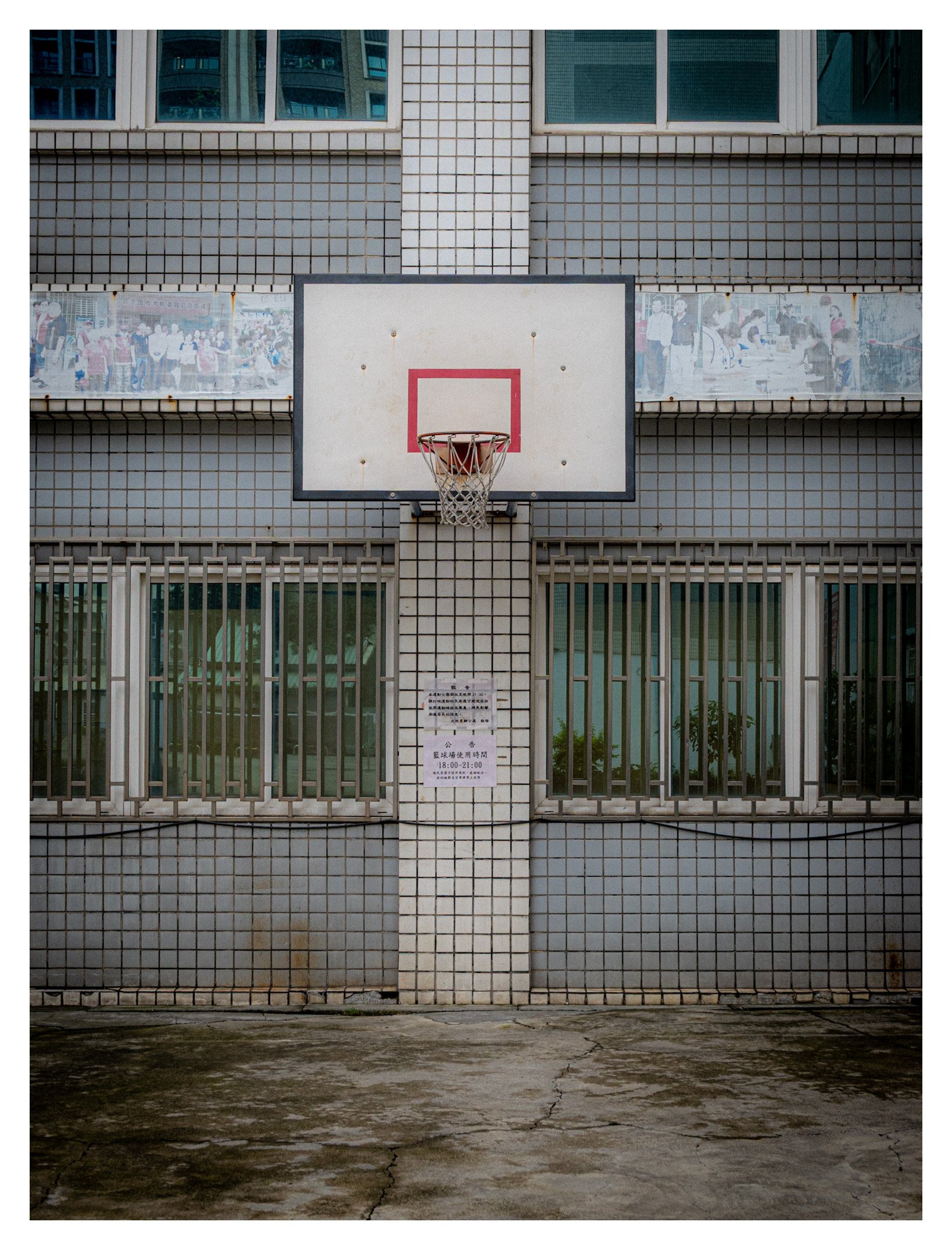
An ordinary street wall holds a hidden visual language. You will learn why structural discipline transforms a simple everyday scene into a powerful geometric study, and how compiling your own creative data can permanently sharpen your photographic eye.
EXIF Data
Leica D-Lux 8
1/200s
f/4.5
ISO 200
The Critique: Graphic Isolation and the Grid
There is a striking, meditative quietude in this frame that immediately pulls me in. The choice of central symmetry works beautifully here, transforming a mundane basketball hoop and a tiled school exterior into a formalist geometric study. By anchoring the backboard perfectly along the central vertical pillar, you have created a strong sense of architectural balance.
The color palette is wonderfully restrained. The desaturated, cool grey tiles contrast effectively with the warm, weathered patina of the concrete floor and the sharp red rectangle on the backboard. Shot at f/4.5, the image maintains critical sharpness from the foreground cracks to the background windows, preserving the textures that give this space its unique character. It is an excellent example of finding minimalism within a dense urban environment.
Refining the Frame: Opportunities for Improvement
Even within a strong composition, micro-adjustments can elevate a photograph from a great graphic record to a masterpiece of visual tension:
Eliminating the Lens Tilt: Look closely at the vertical lines of the tiled pillar and the window bars. There is a very slight keystoning effect, meaning the vertical lines gently converge toward the top because the camera was tilted slightly upward. To achieve absolute, clinical geometric perfection, keep the camera sensor perfectly parallel to the wall, or correct the perspective slightly in post-processing to square the grid completely.
Chasing Light and Shadow: The current lighting is soft and even, which suits the flat, graphic quality of the image. However, shooting this exact spot when a harsh, angular shadow cuts across the lower third of the frame would introduce a powerful diagonal element, disrupting the rigid grid in a visually thrilling way.
The Dilemma of the Human Element: This frame sits in a fascinating middle ground. It would be incredibly powerful as a completely sterile, deadpan architectural shot—which means you might want to clone out or wait for a day without the uneven wet patches on the ground. Alternatively, waiting for a single person to walk past, capturing just their legs or a motion-blurred silhouette on the court, would provide a perfect narrative counterpoint to the stillness.
Compiling Data to Sharpen Your Eye
To grow from a photographer who takes great images into a visual artist with a defined, unmistakable style, you need to start analyzing your work like a scientist. I highly recommend building a personal spreadsheet to track the anatomy of your successful frames:
Log Structural Choices: Create columns not just for technical settings, but for composition styles (e.g., central symmetry, layers, leading lines), weather conditions, and time of day.
Look for Your "Visual Core": After logging fifty or a hundred of your favorite images, filter the data. You will start to see patterns. Do your best frames consistently happen on overcast days? Are you drawn to flat, two-dimensional planes over deep perspective?
Deliberately Break the Pattern: Once your data reveals your comfort zone, use it to assign yourself creative challenges. If the data shows you overwhelmingly favor clean, unpeopled geometry, force yourself out into the midday chaos to shoot high-contrast, layered human interactions.
Masterclass Studies: Photographers, Books, and Media
To expand your visual vocabulary, look to artists who understand how to compress space, handle geometry, and find poetry in the quiet corners of the world.
Master Photographers to Research
Stephen Shore: A pioneer of the New Topographics movement. Look at his work in Uncommon Places to see how he turns ordinary American street scenes, structural facades, and mundane objects into brilliant, deadpan art through precise framing and color.
Chien-Chi Chang: A master of framing within structured, often isolating environments. Study his iconic book The Chain to observe how he handles space, repetition, and deep emotional resonance within a very confined visual canvas.
Essential Reading
"Bystander: A History of Street Photography" by Colin Westerbeck and Joel Meyerowitz: This is the absolute definitive encyclopedia of the genre. It will give you a deep understanding of how street documentation has evolved, from classic geometry to raw, spontaneous energy.
"The Decisive Moment" by Henri Cartier-Bresson: The bible of photographic composition. Reading his essays on how geometry, time, and intuition intersect will completely change how you wait for a frame to come together.
Instructional Videos to Watch
Garry Winogrand: All Things are Photographable
To contrast your clean, quiet approach, watch this look into Winogrand's chaotic, high-energy style. It is a fantastic lesson in how to embed raw social energy and wide-angle dynamism into the frame.
William Eggleston — The Creative Process Documented
An incredible glimpse into how a master of color photography looks at the most ordinary, mundane details of the world and coaxes absolute brilliance out of them without overcomplicating the technical side.