

Day 251/365 Framing Transience: A Critical Breakdown at Qijin Ferry
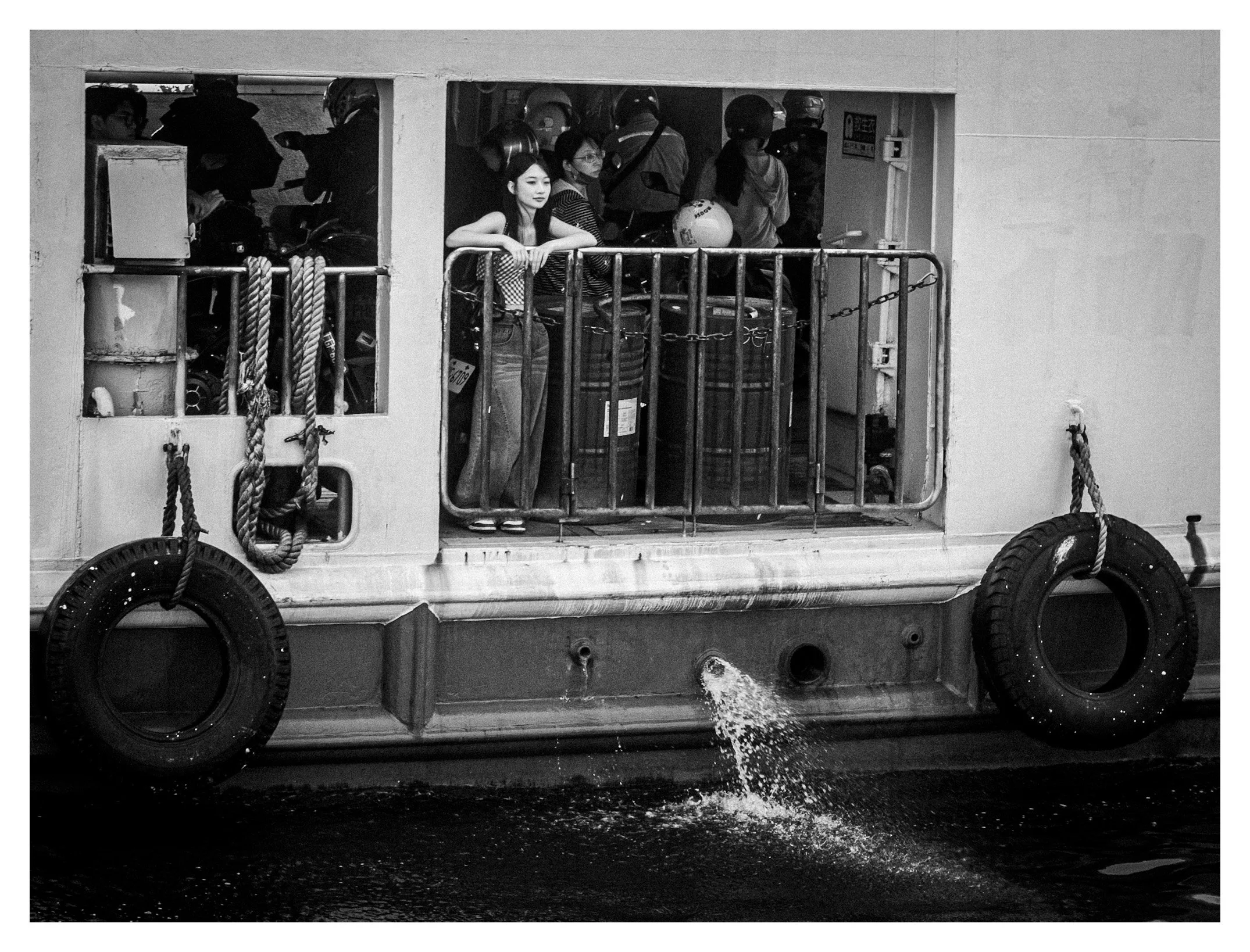
While passing through Kaohsiung's waters, a singular moment caught the eye, suspended between mechanical chaos and human serenity. You will learn why a slight structural shift could alter the emotional weight of this frame and how data tracking transforms casual street observation into a deliberate photographic mastery.
EXIF Data
Camera Model: Leica D-Lux 8
Shutter Speed: 1/250
Aperture: f5.6
ISO: 200
The Critique
This frame presents a compelling juxtaposition of urban transit and deep, introspective stillness. Standing on the ferry deck at Qijin, the primary subject leans against a metal guardrail, her calm, detached gaze contrasting sharply with the obscured, helmeted commuters packed into the vessel's dark interior. The frame is anchored beautifully by the heavy industrial geometry of the boat's hull—the worn textures of the hanging tire bumpers and the sudden, dynamic burst of water discharging from a drainage pipe. This churning water provides an excellent sense of immediate motion, slicing through the rigid horizontal planes of the ship. The choice of a high-contrast monochrome treatment lends a timeless documentary quality to the scene, stripping away the distractions of modern color to focus entirely on texture, shape, and expression.
Opportunities for Improvement
To elevate this composition from an excellent slice-of-life capture to a truly definitive street portrait, consider the spatial relationships within the internal windows of the ship. The central subject is slightly crowded by the geometry around her. A minor adjustment in your physical positioning—perhaps taking half a step to your right—would have separated her profile from the passenger wearing glasses directly behind her. This would create a cleaner silhouette and eliminate visual clutter around her face.
Additionally, waiting a fraction of a second longer, or utilizing a slightly lower camera angle, might have prevented the top edges of the window frame from clipping the helmets of the commuters inside. Balancing the deep blacks of the interior during post-processing to recover just a hint of shadow detail could also enhance the environmental storytelling hidden within the deck's recess.
Developing Your Craft Through Data
To transform your photographic intuition into a repeatable science, you must move beyond reviewing images purely by feel and begin analyzing them through data. By maintaining a structured metadata journal of your work, you can map out trends across thousands of frames. Track the focal lengths, apertures, and shutter speeds of your most successful images alongside environmental variables like weather, time of day, and location.
Over time, this database will expose your unconscious habits. You will discover whether your sharpest candid work consistently thrives at a specific zone-focus distance, or if your composition falls apart under certain lighting ratios. Analyzing these metrics turns a disparate portfolio into a precise diagnostic tool, revealing exactly where your technical choices either liberate or restrict your creative vision.
Research and Study Resources
Photographers to Study
Fan Ho: A master of utilizing bold geometry, dramatic shafts of light, and human scale within complex urban environments. His ability to turn chaotic streets into poetic, minimalist cinema is essential viewing for anyone working with monochrome framing.
Henri Cartier-Bresson: The pioneer of the "decisive moment," whose immaculate sense of geometric composition and precise candor defines the foundation of classic street photography.
Books to Read
"Bystander: A History of Street Photography" by Joel Meyerowitz and Colin Westerbeck. This comprehensive text provides an invaluable historical and academic framework for the evolution of candid photography on the move.
"The Decisive Moment" by Henri Cartier-Bresson. An absolute prerequisite for understanding the exact instant where the head, the eye, and the heart align to capture a fleeting truth.
Videos to Watch
To learn how to subtract clutter and build a frame using geometry and light, watch the analysis "Why Your Photos Are Too Cluttered (The Fan Ho Method)" on YouTube.
To understand the philosophy, training, and timing behind the father of photojournalism, explore the documentary "The Decisive Moment | Henri Cartier-Bresson's Genius" on YouTube.