

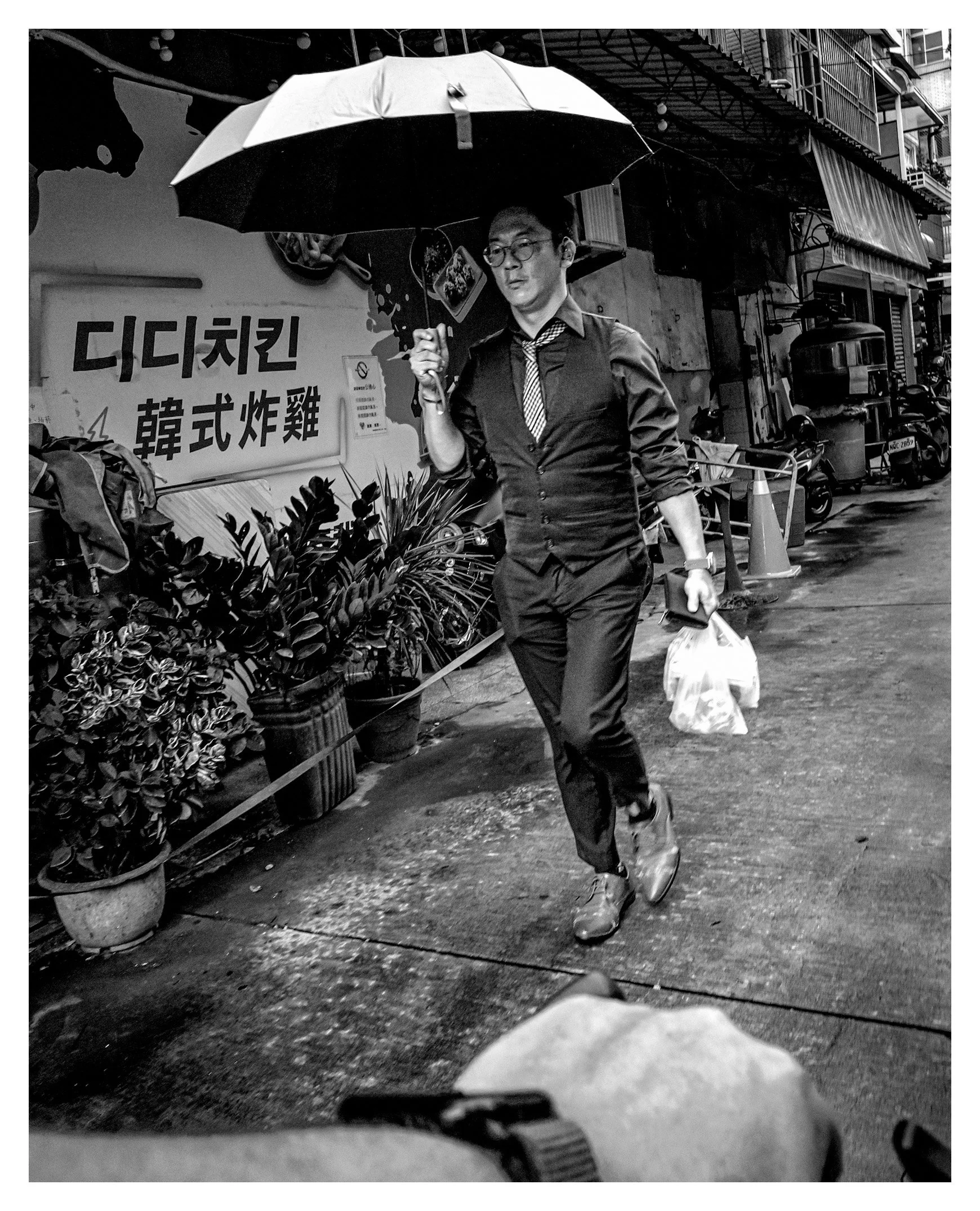
A sharply dressed man strides through a Kaohsiung alley under an angled umbrella, takeout bag swinging, a stranger’s shoulder cutting into the foreground. A close, wide-angle burst of urban energy in the tradition of the great American street snapshot.
Camera Model: Ricoh GR III
Shutter Speed: 1/320 sec
Aperture: f/8
ISO: 3200
The Critique
This photograph sits squarely in the tradition Garry Winogrand built his career on — a wide-angle lens on a handheld camera, shot from an intimate distance , close enough to the subject that the frame practically vibrates with proximity. Working with a wide lens at close range meant closing in on subjects while containing more peripheral detail, often without worrying about verticals or horizontals being perfectly true — and that description fits this frame precisely. The man strides directly toward the lens, umbrella tilted at a sharp angle overhead, and the wide 28mm-equivalent field of view captures not just him but the full theater around him: the Korean fried chicken signage, the potted plants, the scooters parked along the alley wall.
What makes this image genuinely alive, rather than simply well-observed, is the blurred foreground element intruding at the bottom of the frame — almost certainly a bag or shoulder belonging to someone passing close to the lens. Winogrand embraced exactly this kind of accidental layering; he did not strive for the classical composition of traditional photography, instead favoring what became known as the “snapshot aesthetic,” shooting many frames in quick succession and capturing bizarre configurations of people, places, and things . That soft, out-of-focus mass at the bottom edge does real work here — it adds a sense of the photographer being genuinely embedded in the crowd rather than observing from a comfortable remove, and it gives the image a layered, almost stereoscopic depth that a cleaner, more deliberate composition would lose.
The subject himself is a wonderful character study: waistcoat and tie in the rain, sleeves rolled, wallet visible in one hand and a plastic takeout bag in the other, glasses catching the light, his gaze fixed somewhere just past the camera with an expression that reads as mid-thought rather than posed. There’s real narrative tension between his formal dress and the utterly unglamorous business of hurrying home with dinner in the rain — the kind of incongruity Winogrand hunted for constantly on the streets of New York.
Technically, stopping down to f/8 was the right call given the wide lens and close working distance — it holds both the man and the signage behind him in reasonably sharp focus, while the high ISO grain adds a gritty, immediate texture appropriate to the frame’s kinetic energy. If there’s a place to push further, it’s in the crop at the very top — the umbrella’s edge and the signage above feel slightly compressed against the frame boundary, and a touch more headroom might have let the whole scene breathe.
How This Image Could Be Improved
• Give a touch more headroom above the umbrella. The current crop feels slightly tight against the top edge; a small step back or a marginally wider frame would ease that compression.
• Consider the foreground blur as a repeatable device, not an accident. If this worked as well as it did here, it’s worth experimenting with deliberately — shooting through or past close foreground elements is a technique, not just a happy accident.
• Watch the sign readability. The Korean signage in the background is a strong graphic element; a slightly different angle might have kept more of it legible without competing against the subject’s face.
Becoming a Better Photographer Over Time
• Practice shooting close and wide, deliberately. Winogrand’s own advice was essentially to shoot constantly with a wide lens, staying in the thick of the action rather than retreating to a telephoto . Dedicate outings specifically to working at this proximity to build comfort with it.
• Study accidental foreground elements as compositional tools. Review your own archive for frames where something unplanned intrudes into the foreground, and notice which of those add to the image rather than distract.
• Track your hit rate at high shutter speed versus deep depth of field trade-offs, particularly in fast-moving scenes like this one, to build intuition for when f/8 serves you better than a wider aperture.
Photographers to Study
• Garry Winogrand — the essential reference for this frame’s proximity, wide angle, and embrace of visual chaos.
• William Klein — for his aggressive, high-contrast, close-quarters approach to New York street photography.
• Weegee — for his unflinching, immediate documentation of urban life, often shot with flash at close range.
• Larry Fink — for his kinetic, socially attuned close-range photography of people in motion.
• Mary Ellen Mark — for her ability to find dignity and narrative complexity within chaotic, unposed urban scenes.
Books Worth Reading
• Women Are Beautiful by Garry Winogrand
• Life Is Good & Good for You in New York by William Klein
• Naked City by Weegee
• Social Graces by Larry Fink
• Streetwise by Mary Ellen Mark
Videos Worth Watching
• “Garry Winogrand: All Things Are Photographable” — the definitive documentary on Winogrand’s technique and philosophy, directly relevant to this frame.
• Ted Forbes, The Art of Photography channel — for further historical context on Winogrand, Klein, and the wide-angle, close-proximity tradition of street photography.