

Day 278/365 Peggy and the Painting: A Study in Quiet Observation
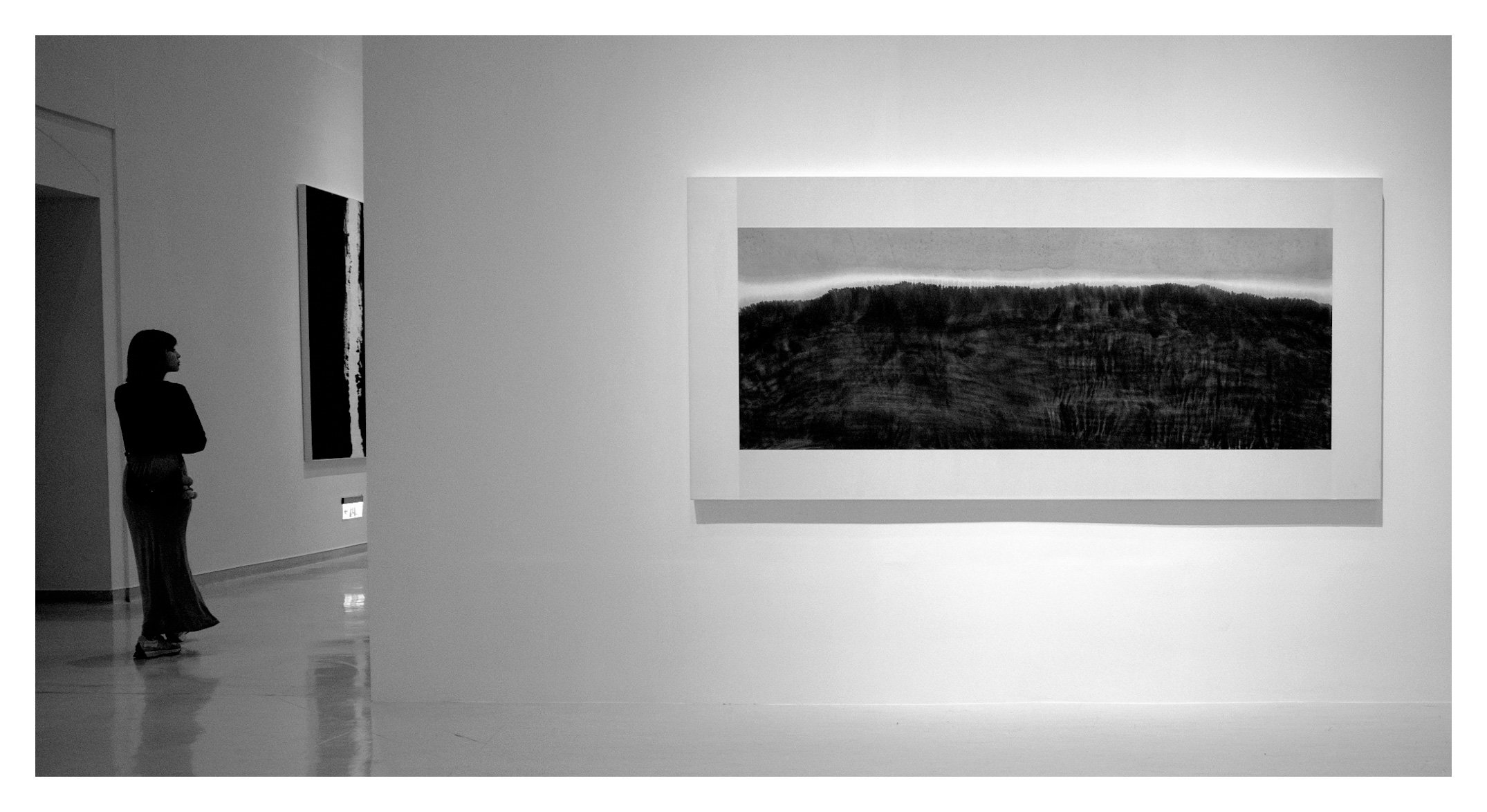
A silhouetted figure contemplates a large abstract landscape in a Kaohsiung gallery, dwarfed by clean architectural whitespace. A study in negative space, scale, and the quiet ritual of looking at art.
Camera Model: Ricoh GR III
Shutter Speed: 1/320 sec
Aperture: f/2.8
ISO: 1000
The Critique
This photograph belongs directly to the lineage Thomas Struth established with his celebrated Museum Photographs series — large-format images of visitors caught in the act of viewing paintings in the world’s leading museums, where the human figure becomes as much the subject as the artwork itself. Struth spent hours or days in each museum he visited before deciding which work he wanted to capture on camera, and while this frame was clearly made more spontaneously, the underlying idea is the same: the act of looking at art is itself worth photographing.
Peggy, reduced to pure silhouette against the gallery’s brilliant white walls, becomes almost a punctuation mark in the frame — arms crossed, weight settled, entirely absorbed in the sweeping dark landscape print before her. That silhouetting is the photograph’s great formal decision. By allowing her to fall into complete shadow rather than exposing for her features, the image sidesteps portraiture entirely and becomes instead about posture, attention, and scale — the universal shape of a person looking, rather than the specifics of who she is. It’s a smart and generous choice, both compositionally and ethically, letting her stand in for anyone who has ever paused, arms folded, in front of something too large to take in at a glance.
The architecture itself does enormous compositional work. The clean geometric planes of the gallery walls, the recessed lighting washing the artwork in a soft halo, and the sheer scale of the horizontal landscape print create a rhythm of rectangles within rectangles — wall, frame, painting, doorway — that gives the whole image a satisfying, almost musical structure. The second, smaller dark canvas visible on the left wall adds useful depth and a secondary point of interest without ever competing with the main relationship between Peggy and the large piece she’s studying.
Technically, the exposure handles the extreme contrast between the gallery’s bright walls and Peggy’s silhouette with real control — the whites hold detail without blowing out, and the shadow of her figure stays a clean, graphic black rather than a muddy gray. The reflection on the polished floor adds a final layer of quiet symmetry, doubling the sense of stillness in the room.
If there’s a place to push further, it’s in the framing at the far left, where the doorway and second painting feel slightly compressed against the edge — a touch more room might have let that secondary space breathe as its own compositional element rather than reading as an afterthought.
How This Image Could Be Improved
• Give the left edge more room. The doorway and smaller painting on the left wall are compositionally valuable but sit close to the frame boundary; a slightly wider capture would let that space read more intentionally.
• Consider the floor reflection as a deliberate device. It’s working well here — worth exploring further in future gallery shots, perhaps from an angle that makes the reflected symmetry even more pronounced.
• Watch for a second beat. A photograph like this often has an even stronger variant a few seconds later or earlier, when the subject’s posture shifts slightly — worth taking a small burst next time rather than a single frame.
Becoming a Better Photographer Over Time
• Study museum and gallery photography as its own discipline. The genre rewards patience — waiting for a visitor to occupy the right relationship to an artwork takes real time, much as Struth’s own practice did.
• Practice deliberate silhouetting. Exposing for a bright background and letting a foreground figure fall to black is a specific technical skill worth isolating and practicing on its own.
• Build a habit of scouting architecture before subjects. In spaces like this, the walls, light, and geometry are often fixed and predictable — understanding them first lets you react faster when a person enters the frame.
Photographers to Study
• Thomas Struth — the essential reference point for this image; study his Museum Photographs series directly.
• Candida Höfer — for her grand, symmetrical documentation of libraries, museums, and other cultural interiors.
• Andreas Gursky — for his large-scale, architecturally precise treatment of interior and public spaces.
• Hiroshi Sugimoto — for his disciplined, meditative approach to minimalism and tonal control.
• Idris Khan — for his layered, contemplative engagement with archival and museum-adjacent imagery.
Books Worth Reading
• Thomas Struth: Museum Photographs
• Candida Höfer: Libraries
• Andreas Gursky (Aperture monograph)
• Hiroshi Sugimoto: Black Box
• Idris Khan: Beyond the Black
Videos Worth Watching
• “The Secret to MINIMALIST Street Photography - Learn Negative Space” — directly relevant to the whitespace and silhouette technique on display here.
• “How To Use Negative Space In Photography” — a solid technical grounding in the composition principles this frame relies on.
• “Minimalist Photography Tutorial (Using Negative Space)” — Mango Street’s practical approach to uncluttered, whitespace-driven composition.