

Day 279 The Order: Color and Layers at a Kaohsiung Night Market
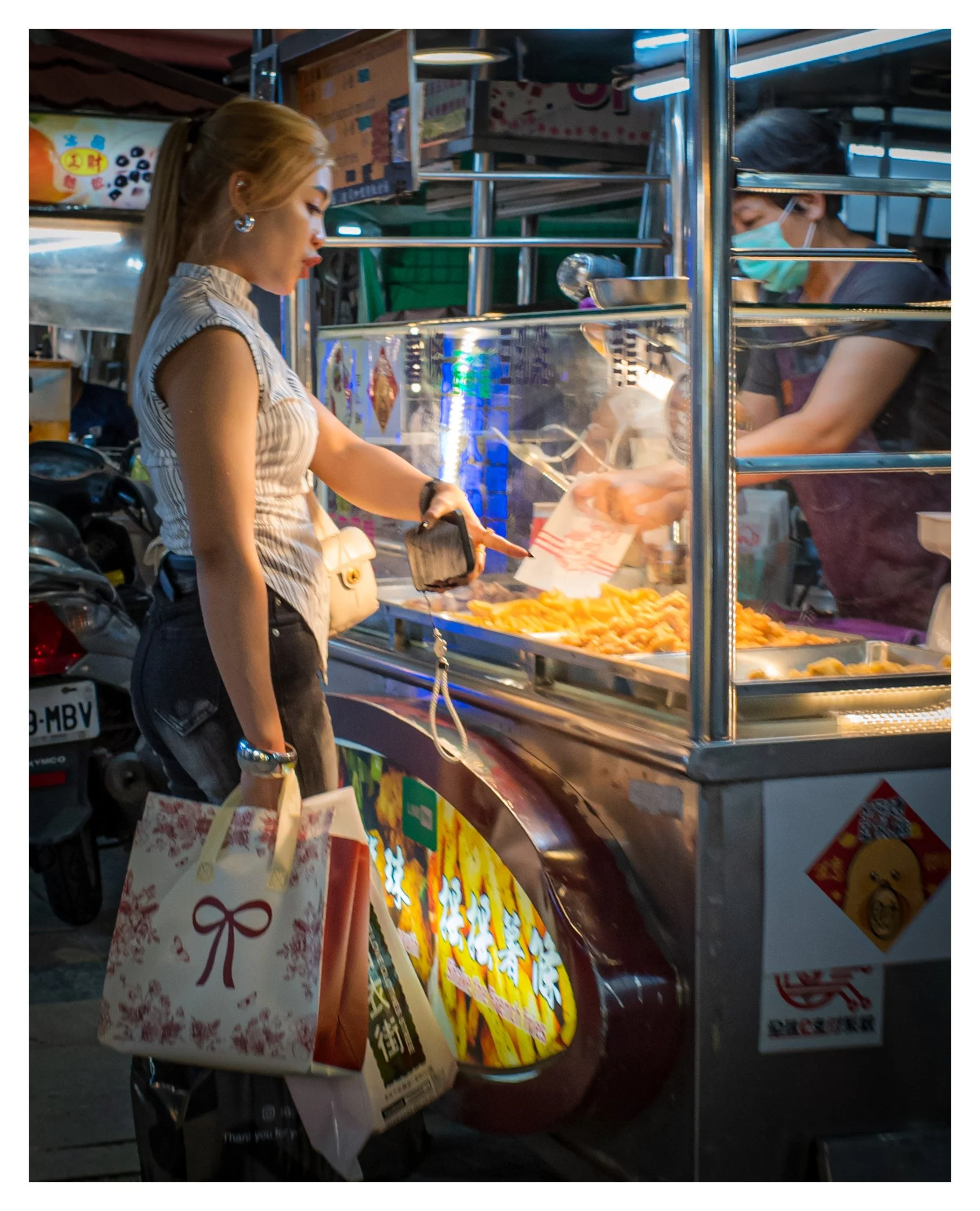
A customer points decisively at the fried food she wants while a vendor works behind the glass, warm light pooling over golden fritters. A layered study in color, gesture, and the choreography of a night market stall in full swing.
Camera Model: Ricoh GR III
Shutter Speed: 1/125 sec
Aperture: f/4
ISO: 800
The Critique
This photograph captures one of street photography’s richest and most demanding subjects: the layered, multi-planar chaos of a night market order being placed. A customer stands in profile, arm extended, finger pointed decisively at the fried food behind the glass, while the vendor works with practiced speed, her hands blurred mid-motion as she bags the selection. The frame is built almost entirely on depth — foreground figure, middle-ground food display, background vendor — and that structural layering is what elevates this beyond a simple documentary snapshot into something closer to genuine visual storytelling.
Color is doing tremendous work here, and it’s worth noting how well the mixed lighting has been handled. Night markets are notoriously difficult to photograph precisely because they throw warm tungsten, cool fluorescent, and colored signage light all into the same frame simultaneously — and rather than fighting that chaos, this image leans into it. The golden fritters glowing under warm cabinet lighting sit against the cooler blue-white of the fluorescent tubes above, while the woman’s pale outfit catches a warm rim of light against the darker background. That mix of color temperatures, rather than reading as a technical flaw, gives the frame real atmospheric authenticity — this unmistakably looks and feels like a Taiwanese night market after dark.
The composition benefits enormously from its layering of glass and reflection. The stall’s glass display case doubles as a secondary framing device, its surface catching soft reflected highlights that add visual complexity without becoming distracting. The customer’s pointed finger creates a clean diagonal that leads the eye directly into the fried food itself — the actual object of desire driving the whole scene — while the vendor’s masked, focused expression in the background adds a quiet human counterpoint to the customer’s more decisive foreground gesture. There’s a nice narrative clarity in that: want, and the fulfillment of want, both visible in a single frame.
Where the image could be tightened is in the right edge, where the second stall element and additional signage crowd the frame slightly; a small step left or a marginally tighter crop might let the core gesture breathe more. There’s also a slight risk, at 1/125s in a scene with two moving hands, of motion blur working against the image rather than for it — though here it mostly reads as intentional energy rather than a technical miss, it’s a fine line worth watching.
How This Image Could Be Improved
• Consider a marginally tighter right-edge crop to reduce competing signage and keep focus on the pointing gesture and the food it’s aimed at.
• Watch shutter speed against hand motion. At 1/125s the vendor’s hands blur usefully here, but a stop faster would give more control over how much of that motion reads as intentional versus accidental.
• Look for the vendor’s eyes. A frame where she glances up, even briefly, would add a second point of human connection to complement the customer’s decisive gesture.
Becoming a Better Photographer Over Time
• Practice reading mixed light rather than correcting it. Night markets are one of the best training grounds for learning to work with, rather than against, color temperature chaos — deliberately shoot in RAW and study how much of that mixed light to preserve versus neutralize in post.
• Build a habit of scouting before shooting. A first pass through a market without the camera raised, noting which stalls have the best light and busiest rhythm, pays off enormously once you start shooting.
• Study layered depth and gesture as a specific compositional skill. Log which of your market and street images successfully use a pointing hand or reaching gesture to direct the viewer’s eye, and practice seeking that structure deliberately.
Photographers to Study
• David Alan Harvey — for his vibrant, layered color documentary work across markets and street scenes worldwide.
• Alex Majoli — for his dramatic use of light and shadow within complex, crowded public scenes.
• Zhang Xiao — for his color-driven documentation of everyday Chinese public and market life.
• Nan Goldin — for her intimate use of color and available light to capture unguarded human moments.
• Christopher Anderson — for his richly layered, color-saturated approach to street and documentary photography.
Books Worth Reading
• Divided Soul by David Alan Harvey
• Congo by Alex Majoli
• Coastline by Zhang Xiao
• The Ballad of Sexual Dependency by Nan Goldin
• Capitolio by Christopher Anderson
Videos Worth Watching
• “Night Street Photography for Beginners (Settings, Light & Editing)” — practical grounding for shooting in exactly this kind of mixed-light environment.
• “NIGHT STREET PHOTOGRAPHY TIPS” — further technique for working available light in busy night scenes.
• Night Market Food Photography: Low-Light Techniques (streetfoodphotographer.com) — a focused written guide on reading and using the specific mixed lighting found at food stalls like this one.