

Day 291/365 Silhouettes of Steel: The Great Wave at Kaohsiung Music Center
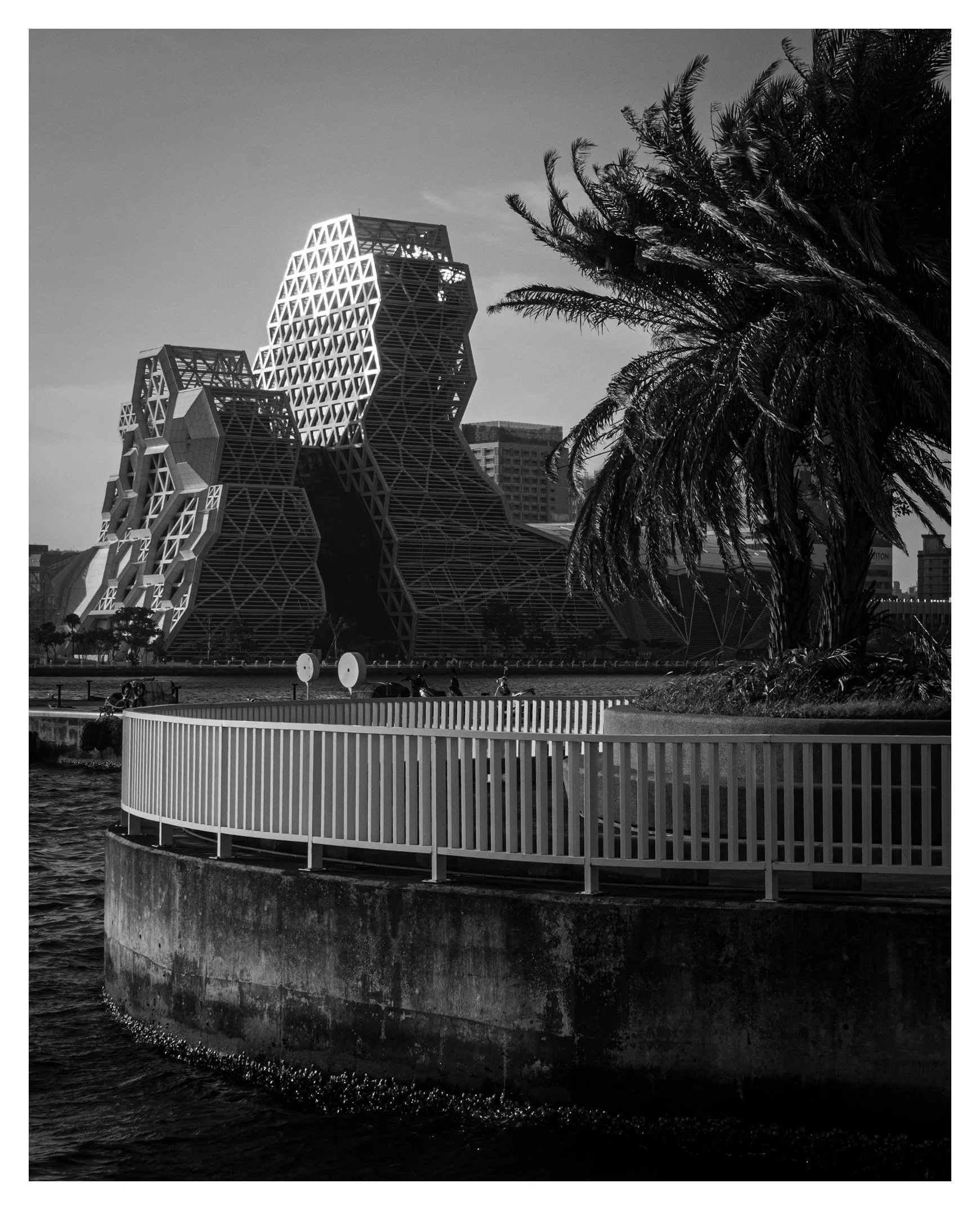
The twin towers of the Kaohsiung Music Center’s “Great Wave” catch low sun across the harbor, a palm tree standing silhouetted beside them like a natural counterpoint to all that engineered geometry. A black-and-white study in light, form, and how a city frames its own landmark architecture against nature.
Camera Model: Leica D-Lux 8
Shutter Speed: 1/640 sec
Aperture: f/8
ISO: 200
The Critique
This photograph captures the Kaohsiung Music Center’s most striking structure — known locally as the “Great Wave,” the twin-tower centerpiece of the wider Music Center complex designed by Spanish architect Manuel Monteserín and opened in 2021. Its faceted, hexagonal surfaces catch low sun in a way that makes the building itself appear to glow from within, and the photograph frames it with exactly the kind of contextual awareness that separates memorable architectural photography from mere documentation. Rather than isolating the structure against a clean sky, the image includes the full waterfront scene: dark water in the foreground, a curved concrete pier with white railing, and crucially, a large palm tree silhouetted against the sky on the right, its fronds providing a soft, organic counterpoint to the building’s hard geometric angles.
That inclusion of context is worth dwelling on, because it’s precisely what distinguishes photographers like Iwan Baan from purely formal architectural documentation. Baan’s real talent lies in looking at how a building becomes part of the city fabric and interacts with the urban landscape around it, rather than treating structures as isolated objects — his work consistently places buildings within their surrounding environment rather than photographing them as if they exist in a vacuum. This frame does something similar: the palm tree, the water, the pier railing, and even the more conventional high-rise visible behind the sculptural towers all work together to root this landmark building within a specific, lived urban waterfront rather than presenting it as an abstract architectural specimen.
Knowing the building adds a layer worth mentioning too: the hexagonal grid isn’t decorative flourish but the project’s organizing logic, repeated across the tower’s skin, the roofline of the nearby “Whales” live houses, and even the paving of the promenade below — the whole complex was conceived around marine imagery, waves, coral, sea foam, translated into architecture. What reads in the photograph as a striking abstract pattern is actually the building’s structural DNA made visible by the raking light.
The black-and-white treatment does real work with that light. The tower’s triangulated surface, catching direct sun on its upper portions, blows out into near-pure white in places, creating a dramatic tonal contrast against the darker, shadowed lower sections and the deep black of the palm tree’s silhouette. Compositionally, the curved pier and railing in the foreground do valuable work leading the eye from the immediate foreground back toward the building across the water. Where the image could be pushed further is in the very brightest sections of the tower, which sit right at the edge of losing all detail — a touch more exposure control might preserve a bit more of that intricate hexagonal structure at its most illuminated point.
How This Image Could Be Improved
• Consider slightly less aggressive contrast in post for the tower’s brightest sections, to hold onto a touch more structural detail in the most illuminated hexagonal panels.
• Watch the balance between the palm tree’s mass and the building’s visual weight. They’re working well together here, but it’s worth experimenting with a version where the tree occupies less of the frame, to see whether the “Great Wave” gains more dominance.
• Return at a different time of day. The low, raking light here is doing wonderful work; a shot at dusk, when the building’s own lighting comes on, would reveal an entirely different character — the Music Center is known locally for vibrant night illumination.
Becoming a Better Photographer Over Time
• Study architecture in its urban context, not in isolation. Iwan Baan’s guiding principle — that a building’s relationship to its surroundings is as important as the building itself — is a genuinely useful lens to apply deliberately to your own architectural work.
• Research a landmark before you shoot it again. Knowing the “Great Wave” is organized around a hexagonal marine motif changes how you might frame a return visit — perhaps seeking out the paving pattern below or the “Whales” nearby to build a fuller visual essay on the complex.
• Build comfort with extreme tonal contrast in black and white. Log which of your architectural images benefit from letting highlights blow out for drama versus which need more controlled exposure to preserve structural detail.
Photographers to Study
• Iwan Baan — for his humanistic approach to placing architecture within its living urban and cultural context.
• Julius Shulman — for his moody, dramatic mid-century black-and-white treatment of modern architecture.
• Hélène Binet — for her poetic, highly controlled use of light and shadow on architectural form.
• Ezra Stoller — for his disciplined, classic approach to documenting modernist architecture.
• Lucien Hervé — for his dramatic geometric abstraction of architectural form, most famously in his work with Le Corbusier.
Books Worth Reading
• Iwan Baan: Moments in Architecture
• Julius Shulman: Modernism Rediscovered
• Hélène Binet: Composing Space
• Ezra Stoller: Photographing Architecture
• Lucien Hervé: Le Corbusier
Videos Worth Watching
• “Iwan Baan: Architecture photos that put people in focus” — a BBC interview on his approach to placing buildings within their human and environmental context.
• “Opening Talk: Iwan Baan – Moments in Architecture” — a fuller talk on his career and philosophy of architectural photography.
• Mastering Black and White Architecture Photography guide (seashorepics.com) — practical technique for reading light and shadow on architectural surfaces.