

Day 292/365 Crossed Arms, One Moment: A Group Portrait in Motion
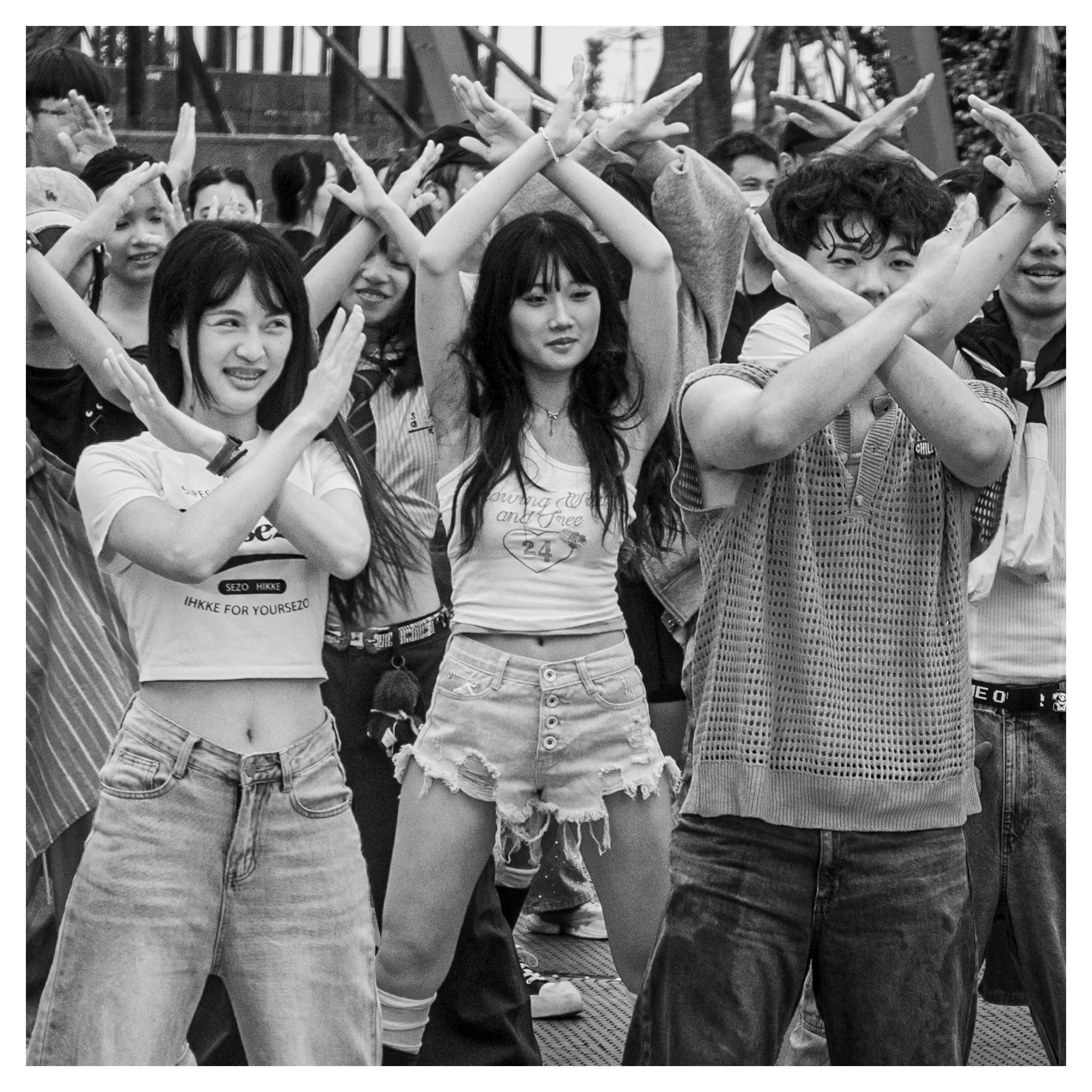
A crowd throws their arms into an identical crossed pose, a single synchronized gesture caught mid-beat. A black-and-white study in choreography, group energy, and the split second where dozens of individual movements align into one.
Camera Model: Leica D-Lux 8
Shutter Speed: 1/320 sec
Aperture: f/2.8
ISO: 400
The Critique
This photograph captures something genuinely difficult to time well: a large group performing a synchronized dance gesture, arms crossed overhead in an identical X shape, frozen at the precise instant the movement peaks. Dance and movement photography lives or dies on exactly this kind of timing — catching a pose not a beat too early or too late, when every participant’s gesture reads clearly and the overall shape of the composition locks into place. That’s the achievement here: three figures in sharp focus in the foreground, each with arms crossed at the identical angle, while a full crowd behind them mirrors the same gesture in a receding wave of repeated form.
Gjon Mili, who pioneered the use of stroboscopic light to study and freeze dance movement in the 1930s and 40s, spent his career proving that a single frozen instant could reveal the underlying structure of movement that the eye alone could never fully register. This image works in a related spirit, if by more traditional means — the shutter speed here is fast enough to render the crossed arms crisp and legible rather than blurred, which matters enormously, since the entire visual power of the image depends on the viewer being able to instantly read the repeated gesture across multiple bodies.
The black-and-white treatment is doing important work simplifying what could otherwise be a visually chaotic crowd scene into a clean, graphic study of repeated form. Stripped of color, the crossed arms become the dominant visual motif, repeating across the frame like a printed pattern — three, four, five instances of the same X shape multiplying back through the group. That repetition, combined with the genuine variety of individual facial expressions (a smile here, a look of concentration there), keeps the image from feeling mechanical; it reads as a group of individuals who happen to be moving in perfect unison, rather than an anonymous mass.
Compositionally, the choice to let three figures dominate the foreground while allowing the rest of the crowd to recede slightly out of focus behind them gives the eye a clear entry point before it travels back into the fuller group. Where the image could be pushed further is in the crop at the very top, where several raised arms are cut off at the frame edge — a slightly wider capture would have let the full gesture read cleanly for every visible participant rather than truncating a few at the boundary.
How This Image Could Be Improved
• Give more headroom at the top of the frame. Several raised arms are cropped at the very edge; a touch more space above would let every crossed-arm gesture read completely.
• Consider a burst sequence around this exact moment. Group synchronization photography benefits enormously from shooting several frames in the second surrounding the peak gesture, then selecting the one where the most participants are simultaneously aligned.
• Watch focus fall-off into the crowd. The three foreground figures are pleasingly sharp; a touch more depth of field could extend that clarity slightly further back for an even stronger sense of the full group’s unison.
Becoming a Better Photographer Over Time
• Study anticipation as a specific skill for group and movement photography. Timing a synchronized gesture across dozens of people requires reading the rhythm of the movement before it peaks — practice this deliberately at dance events, parades, or any coordinated public performance.
• Shoot in bursts for anything involving synchronized motion. A single frame rarely captures the ideal instant when working with groups; build the habit of firing several frames around the moment you anticipate the peak.
• Log which of your group images succeed because of individual expression versus pure repeated form. This frame works because it has both — refine your eye for balancing graphic pattern against genuine human variety within a crowd.
Photographers to Study
• Gjon Mili — the essential reference for using photography to freeze and study the structure of movement and dance.
• Lois Greenfield — for her extraordinary ability to time dancers at the precise peak of gravity-defying motion.
• Barbara Morgan — for her dynamic, formally rigorous documentation of modern dance.
• Jack Mitchell — for his decades of disciplined American dance photography.
• Herb Ritts — for his bold, graphic treatment of the human body in motion and group composition.
Books Worth Reading
• Gjon Mili: Photographs and Recollections
• Breaking Bounds: The Dance Photography of Lois Greenfield
• Barbara Morgan: Prints from the Archive
• Jack Mitchell: American Dance Photography
• Herb Ritts: Work
Videos Worth Watching
• “Lois Greenfield: The Anticipatory Art of Dance Photography” — a direct look at timing and anticipation in movement photography, the central skill this image required.
• “B&H Prospectives: Dance Photography | Lois Greenfield” — further technical grounding in capturing bodies at the peak of motion.
• “Lois Greenfield Talks Dance Photography” — a fuller conversation on her process and philosophy for working with movement.