

Day 290/365 The Living Furniture of Central Park: A Study in Communal Rest
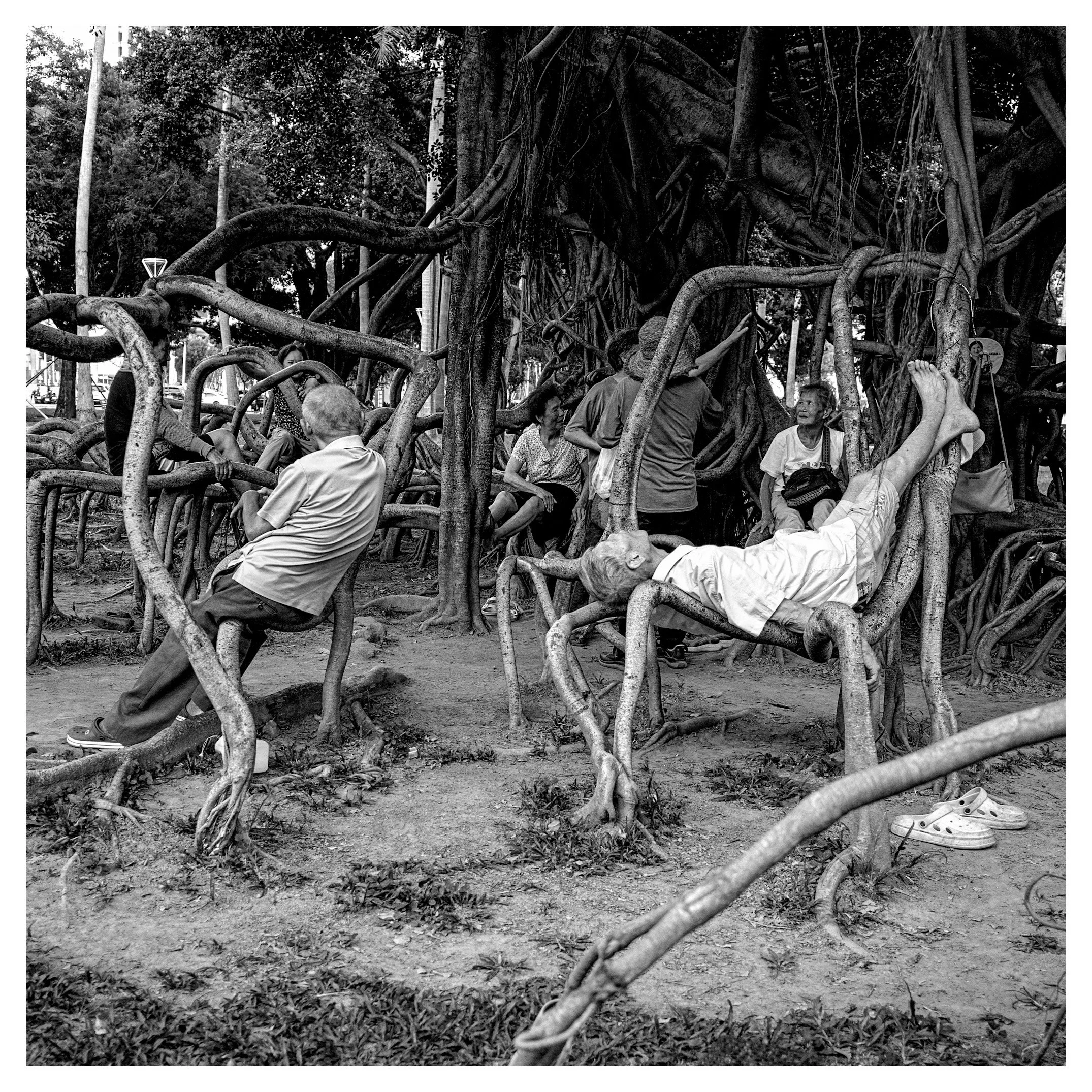
A tangle of banyan roots forms natural chairs, and Kaohsiung’s elders settle into them as though the tree grew this way just for them. A surreal, humanist study in shared space, texture, and the quiet sociability of an ordinary afternoon.
Camera Model: Ricoh GR III
Shutter Speed: 1/125 sec
Aperture: f/2.8
ISO: 500
The Critique
This photograph captures something genuinely rare — a piece of urban nature that has, through decades of growth, formed itself into functional furniture, and a community that has fully accepted the invitation. The banyan’s aerial roots twist and loop across the frame in organic, almost anatomical curves, and scattered among them are several elderly park-goers, seated, reclining, and conversing as naturally as if they were on ordinary park benches. One man lies fully stretched out, feet propped on a root, using the tree the way you might use a hammock. That casual, practiced ease is the photograph’s real subject — this clearly isn’t the first time anyone here has used the tree this way.
There’s a genuine sculptural quality to the root structure that recalls Sally Mann’s engagement with Southern trees as bearers of history and memory — her Deep South work approached trees not as passive landscape elements but as active participants in human history, holding meaning and memory within their physical form. This banyan, while carrying none of the violent history Mann’s Southern trees allude to, shares that same quality of a tree functioning as more than backdrop — here it’s become genuine social infrastructure, shaping how an entire community gathers and rests.
The black-and-white treatment serves the tangled root structure beautifully, turning what could be a visually overwhelming tangle of organic form into a rich, readable field of texture and tone. The roots’ bark, deeply grooved and gnarled, holds detail across a wide tonal range, while the darker canopy above recedes into deep shadow, giving the composition a natural vignette that draws the eye down toward the human activity at ground level. Compositionally, the frame does something quite sophisticated: multiple separate groups and individuals are visible simultaneously — a woman in the left background, a cluster of three or four people conversing centrally, the reclining man dominating the right foreground — creating a genuine sense of a small society occupying this space together, each finding their own pocket within the tree’s architecture.
Where the image could be pushed further is in the sheer density of visual information; the root structure is so complex that some secondary figures risk getting lost against the tangled background. A viewer’s eye needs real time to sort human figures from root forms in a few areas of the frame, which, while perhaps appropriate to the image’s meditative, “take your time” quality, is worth being aware of as a deliberate trade-off rather than an accident.
How This Image Could Be Improved
• Consider a version with slightly more separation between figures and roots. In a few spots, clothing tone blends closely with the bark’s gray value; a small adjustment in contrast or dodging could help those secondary figures read more clearly at first glance.
• Watch the bright root crossing the lower right foreground. It’s compositionally interesting but slightly overexposed relative to the rest of the frame; a touch of highlight recovery would bring it into better tonal balance.
• Explore a tighter series focused on individual “root chairs.” This wide, populated view is strong, but a companion set of closer studies on individual people settled into specific root formations could extend this into a genuinely compelling documentary series.
Becoming a Better Photographer Over Time
• Seek out places where nature and human use intersect unexpectedly. This banyan is a rare find precisely because so few urban trees invite this kind of use — train yourself to notice these opportunities as you move through a city.
• Study how to balance complexity and legibility in dense compositions. Log which of your busiest frames still successfully guide the eye versus which ones become genuinely confusing, and refine your instinct for when density serves an image versus when it works against it.
• Return to social gathering spots at different times. A location like this will have different groups, different light, and different configurations of people across a day or a season — repeat visits could build a genuinely rich long-term study.
Photographers to Study
• Sally Mann — for her deep engagement with trees and Southern landscape as bearers of memory and meaning.
• Édouard Boubat — for his warm, humanist documentation of everyday people at rest and leisure.
• Willy Ronis — for his tender, unposed documentation of ordinary community life in public spaces.
• Graciela Iturbide — for her poetic, surreal documentary approach to communities and their relationship with the natural world.
• Robert Doisneau — for his affectionate, narrative-rich eye toward people occupying and enjoying public space together.
Books Worth Reading
• Sally Mann: Deep South
• Boubat (Édouard Boubat retrospective monograph)
• Willy Ronis: A Retrospective
• Graciela Iturbide: Trees
• Robert Doisneau: Paris
Videos Worth Watching
• “Sally Mann - A deep connection with the American South” — a close look at how Mann treats Southern trees and landscape as historically resonant subjects, relevant to thinking about this banyan’s own accumulated meaning.
• “Picturing the South: Sally Mann” — further context on her landscape and place-based work.
• Ted Forbes, The Art of Photography channel — for broader historical grounding in humanist documentary photography of communities at rest and leisure.