

Day 281/365 The Clockwise Line: An Aerial Study of Kaohsiung’s Light Rail
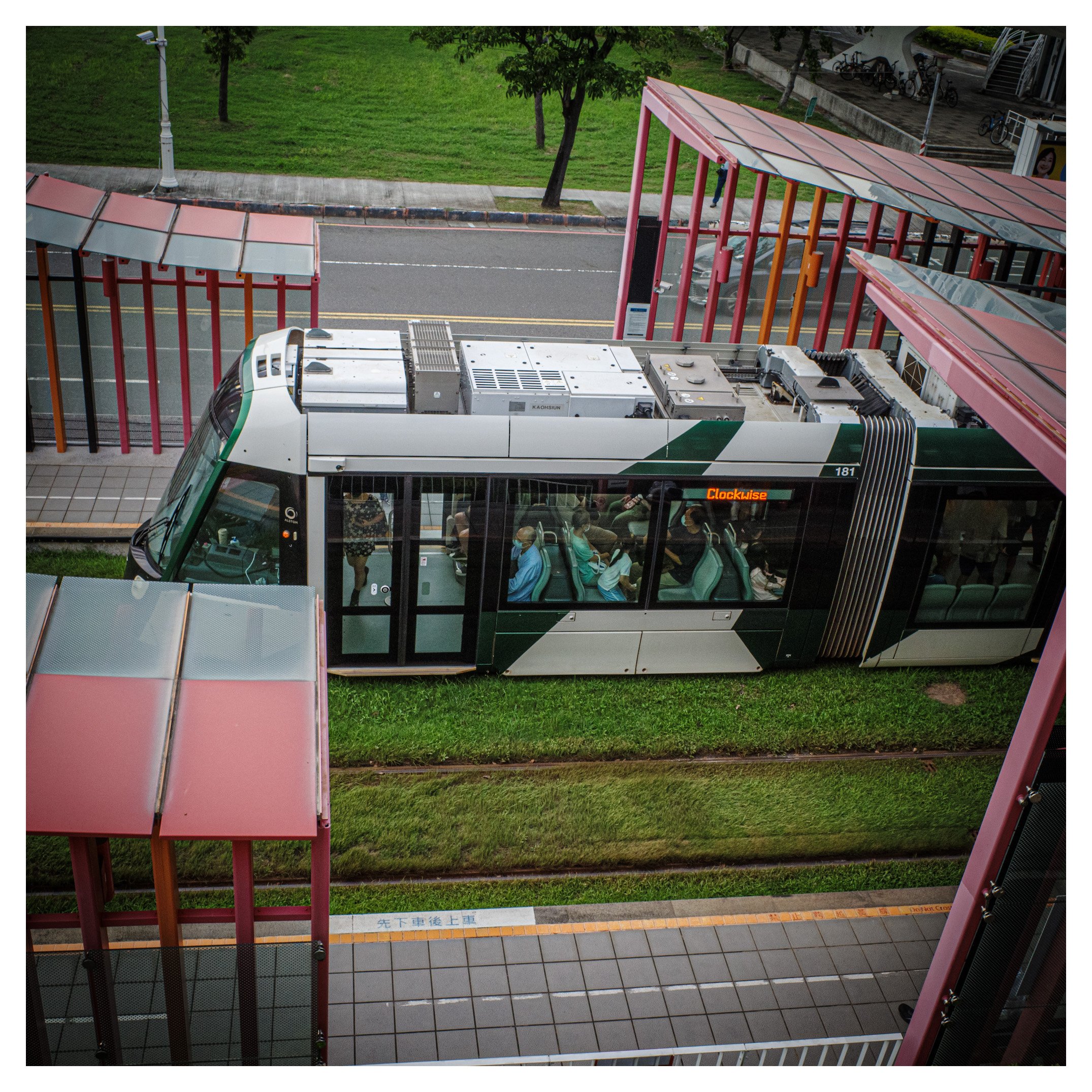
A tram glides through the grass-lined tracks between two red-roofed stations, passengers visible through the glass like figures in a diorama. A high-angle study in infrastructure, color, and the quiet geometry of a city’s transit system.
Camera Model: Ricoh GR III
Shutter Speed: 1/320 sec
Aperture: f/8
ISO: 800
The Critique
This photograph belongs to a tradition of elevated, distanced infrastructure photography that treats the built systems of a city — transit lines, grids, industrial architecture — as compositions in their own right rather than mere backdrops. Shot from a high vantage looking almost straight down, the frame captures Kaohsiung’s light rail gliding along its green track bed between two matching station shelters, their coral-red roofs creating strong repeated geometric anchors on either side of the frame.
The color relationships here are doing significant work. The tram’s dark green and white livery echoes the grass growing directly in the trackbed — an unusual and rather lovely piece of urban infrastructure design in its own right — while the warm coral-red of the shelter roofs provides a striking complementary counterpoint against all that green. This kind of considered color palette, observed rather than staged, recalls the disciplined eye Andreas Gursky and Edward Burtynsky bring to large-scale infrastructure and industrial subjects, where civilization’s engineered systems become the evidence of how a society organizes and moves itself.
The passengers visible through the tram’s windows add a crucial human layer without ever becoming the primary subject — a masked figure here, a woman in a patterned dress there, small and slightly abstracted at this distance and through glass, functioning almost like Michael Wolf’s compressed commuter studies: individuals rendered as part of a larger systemic pattern rather than as individuated portraits. The illuminated “Clockwise” destination sign adds a nice piece of specific, legible information within an otherwise abstracted composition, grounding the image in the practical function of the system being photographed.
Compositionally, the framing device created by the two shelter roofs — one closer and slightly out of focus in the foreground, one more distant and sharp in the middle distance — creates genuine depth and a sense of looking through the city’s infrastructure rather than simply at it. The diagonal thrust of the tram itself, cutting across the frame from lower-left toward upper-right, gives the composition real dynamic energy despite the essentially static, documentary nature of the subject.
Where the image could be tightened is in the upper right, where the second station shelter and background elements (cyclists, a pedestrian bridge) start to compete visually with the main subject; a slightly tighter crop or a marginally different vantage point might resolve that busyness. The foreground shelter roof, while useful as a framing device, also eats a meaningful portion of the lower left quadrant — worth considering whether a touch less of it would better balance the frame.
How This Image Could Be Improved
• Consider trimming the busiest section of the upper right. The distant shelter and background activity pull some attention away from the tram itself; a tighter crop could resolve this.
• Watch the foreground shelter’s weight in the frame. It’s a useful framing device, but slightly less of it in the lower left might create better balance with the tram’s diagonal.
• Try the same vantage point at a different time of day. Late afternoon or early evening light would likely make the tram’s interior lighting and passengers even more legible against a darkening exterior.
Becoming a Better Photographer Over Time
• Scout elevated vantage points over transit infrastructure specifically. Trams, train platforms, and bus interchanges photographed from above reveal patterns invisible from ground level — build a habit of seeking these out.
• Study how color repetition across built and natural elements (like the tram’s green matching the trackbed grass here) can unify a composition; actively look for this kind of intentional or coincidental color echo in future infrastructure shots.
• Practice using framing devices with intentional focus falloff, as the foreground shelter roof does here, to add depth without needing multiple focal planes to be equally sharp.
Photographers to Study
• Andreas Gursky — for his large-scale, formally rigorous treatment of infrastructure and systems of movement.
• Edward Burtynsky — for his large-scale photographs of landscapes transformed by industry, treating civilization’s engineered systems as both beautiful and consequential.
• Michael Wolf — for his compressed, pattern-driven studies of commuters and urban density.
• Alex MacLean — for his aerial photography revealing the hidden geometry of American infrastructure and land use.
• George Steinmetz — for his aerial documentation of human systems and infrastructure across the globe.
Books Worth Reading
• Andreas Gursky (Hayward Gallery / Fundación MAPFRE monograph)
• Manufactured Landscapes by Edward Burtynsky
• Tokyo Compression by Michael Wolf
• Up on the Roof by Alex MacLean
• The Human Planet by George Steinmetz
Videos Worth Watching
• “Edward Burtynsky: Manufactured Landscapes” — Burtynsky’s own TED talk on photographing humanity’s effect on the landscape, directly relevant to this frame’s treatment of infrastructure.
• “Manufactured Landscapes | Official Trailer” — a documentary that extends Burtynsky’s photographic narratives into film, meditating on humanity’s impact on engineered landscapes.
• Ted Forbes, The Art of Photography channel — for further historical and critical context on Gursky and large-scale infrastructure photography.