

Day 282/365 Blade of Light: A Still Life in Red and Shadow
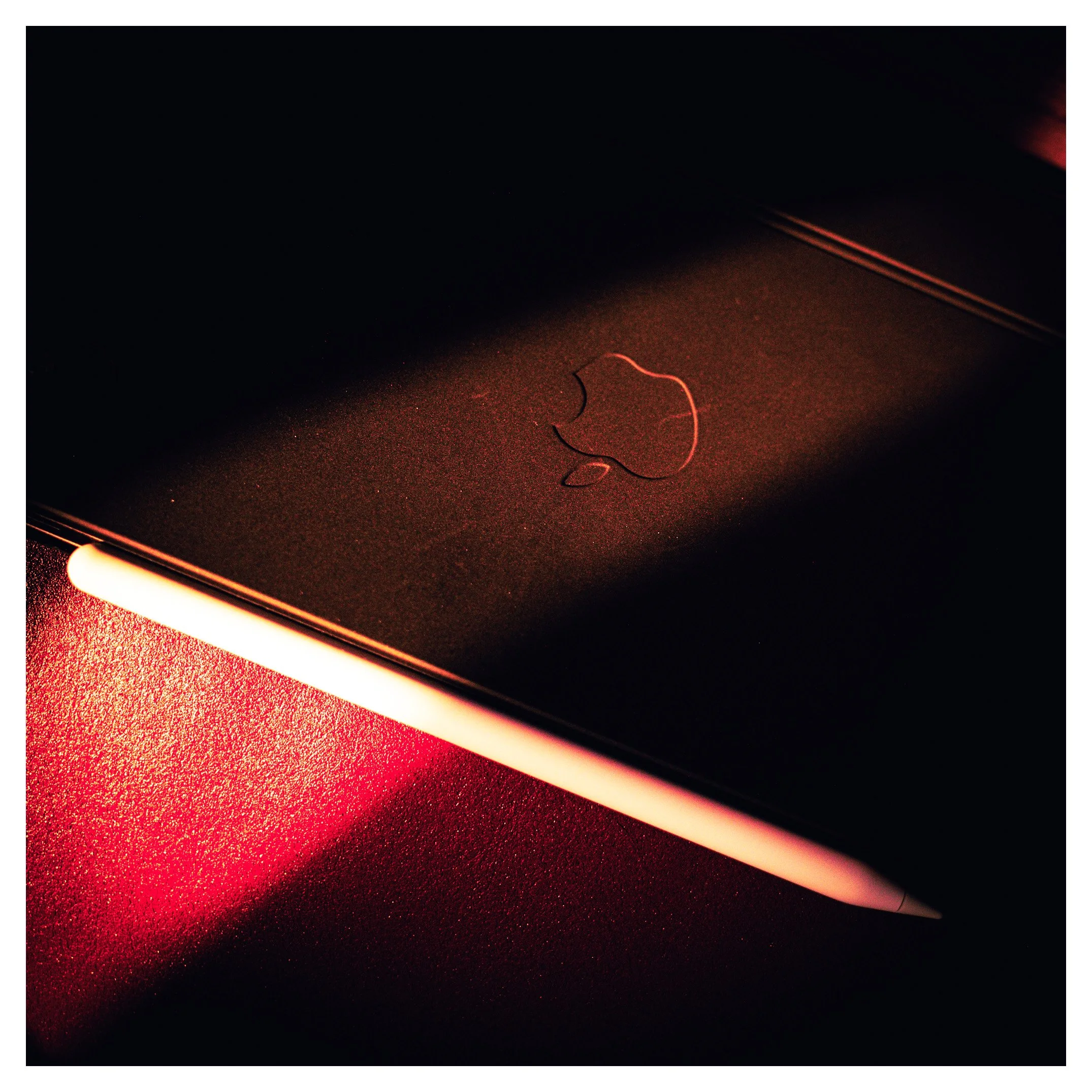
An Apple Pencil rests diagonally across a dark iPad, a single sharp shaft of red light slicing across the frame. A moody, minimal study in reduction — one object, one light source, and the faint ghost of a logo caught in shadow.
Camera Model: Ricoh GR III
Shutter Speed: 1/125 sec
Aperture: f/2.8
ISO: 400
The Critique
This photograph works through radical reduction — a single object, a single light source, and a composition built almost entirely on the tension between illuminated and unlit space. The Apple Pencil lies diagonally across the frame, caught in a hard shaft of red light that reads less like ambient room lighting and more like something deliberately staged or found and exploited on the spot. That red light is the entire photograph’s engine: without it, this is simply a pencil on a dark surface; with it, the image becomes something closer to a still life painting, chiaroscuro rendered in a single saturated hue rather than the more conventional warm-white or cool-blue most photographers reach for.
There’s a lineage here that runs through photographers who treated commercial and manufactured objects with the same formal seriousness as fine art still life — Paul Outerbridge’s early modernist product photography comes to mind, where ordinary manufactured objects were photographed with dramatic, sculptural light long before “product photography” became a commercial category. The faint outline of the Apple logo, barely visible etched into the surface and catching just enough of the red spill to register, adds a wonderful secondary detail that rewards patient looking — it’s there, but you have to work for it, which suits the image’s overall mood of things half-revealed rather than fully lit.
The diagonal composition is doing real work too. The Pencil’s line runs from the lower-left corner toward the upper-right, while the red light band runs roughly parallel to it, creating a kind of visual channel that guides the eye directly along the object’s length toward its tip, which disappears into shadow at the frame’s edge. That interplay of parallel diagonals gives the otherwise simple composition genuine structural intelligence.
Where the image could be pushed further is in the highlight on the Pencil itself — it’s bright, nearly blown in places, which works for drama but sacrifices some of the object’s actual material quality (the slight sheen and matte transition on its barrel). A touch more control there might preserve the mood while adding back a bit of tactile realism. The visible grain, likely a product of both the ISO and a heavy shadow recovery in post, adds texture that suits the mood here, though it’s worth being deliberate about how far to push that in future images versus letting it happen as a byproduct.
How This Image Could Be Improved
• Pull back the Pencil’s brightest highlight slightly. A touch of highlight recovery would preserve more surface texture without sacrificing the dramatic contrast that makes the image work.
• Consider a second frame with the red light hitting the logo more directly. The etched Apple mark is a lovely detail; a composition that lets more light fall directly on it could make it a stronger secondary point of interest.
• Be deliberate about grain going forward. It reads well here, but decide consciously whether it’s a stylistic signature you want to develop or an artifact of low-light shooting to manage more carefully.
Becoming a Better Photographer Over Time
• Practice reductive still life specifically. Working with a single object and single light source, as here, is one of the fastest ways to develop a precise understanding of how light shapes form — it removes every variable except the essential ones.
• Study color-gelled or colored-light still life as its own discipline. Most photographers default to neutral or warm light; deliberately working with strong single-hue light, as this red source demonstrates, opens up a different emotional register worth exploring further.
• Build a personal catalog of “found” dramatic light. This image likely exploited an existing light source (a lamp, a reflection, an LED) rather than a studio setup — train yourself to notice and use these opportunistic light sources as they occur.
Photographers to Study
• Paul Outerbridge — for his pioneering modernist treatment of manufactured objects as fine art subjects, using dramatic light and controlled color.
• Chema Madoz — for his surreal, conceptually driven approach to ordinary objects photographed in stark black and white.
• Robert Mapplethorpe — for his disciplined, sculptural approach to lighting objects with dramatic, focused precision.
• Sarah Moon — for her painterly, moody use of color and shadow across still life and fashion work.
• Ralph Gibson — for his high-contrast, minimalist close studies of objects and form.
Books Worth Reading
• Paul Outerbridge: Photographs
• Chema Madoz (Fundación MAPFRE monograph)
• Robert Mapplethorpe: Flowers
• Sarah Moon: Coincidences
• The Somnambulist by Ralph Gibson
Videos Worth Watching
• “Moody Macro Photography: The secret of sculpting shadows” — directly relevant to the directional, shadow-sculpting light at play in this frame.
• “Studio Lighting Secrets for Moody Macro Photography” — further grounding in single-light, high-drama macro technique.
• “Macro Photography at Home: Lighting and Focus Stacking for Product Shots” — practical technique for close, controlled object photography like this.