

Day 284/365 The Almond Eye: A Macro Study in Fur and Focus
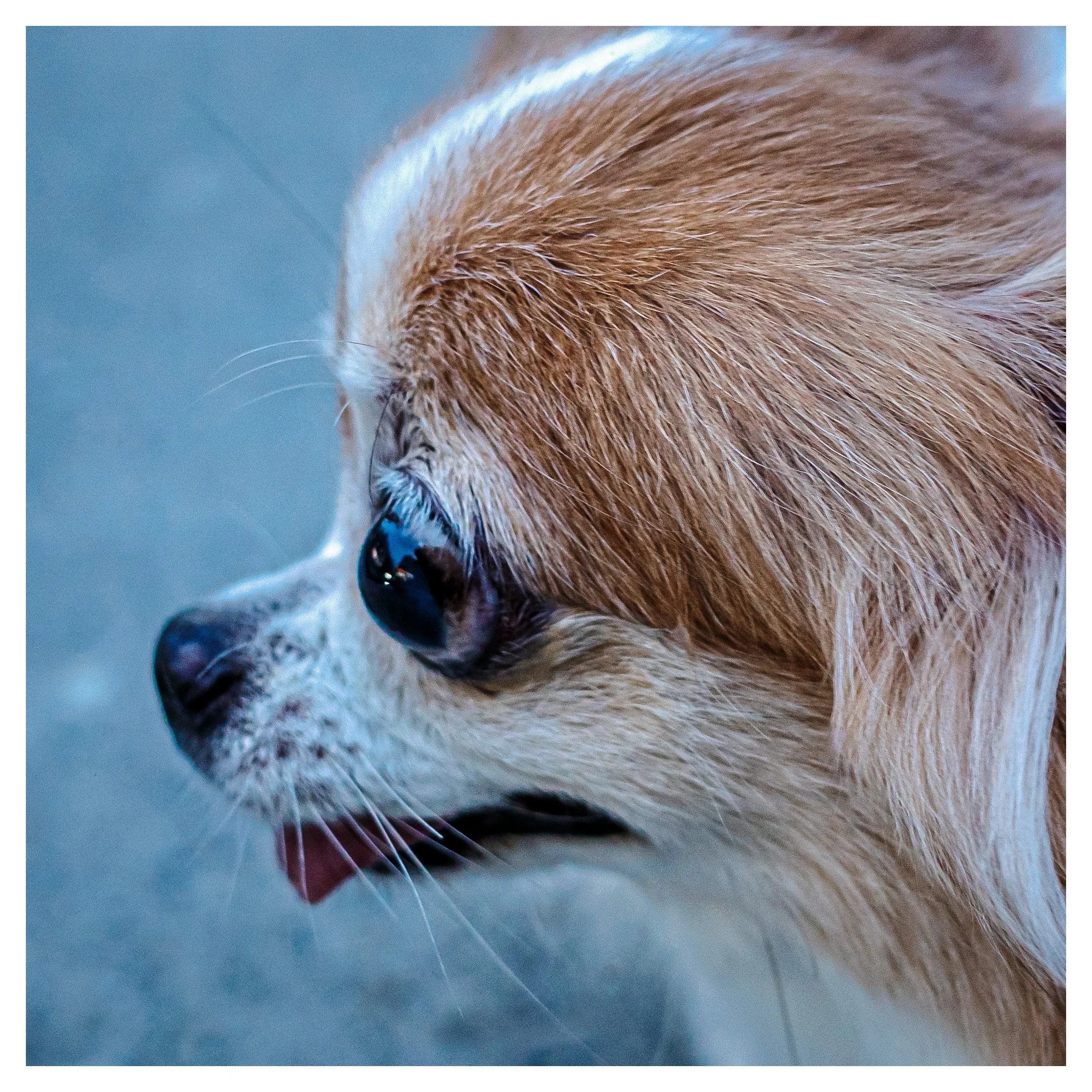
A tight profile of a small dog’s face, whiskers catching stray light, one dark eye holding a tiny reflected world. A close, textural study in focus falloff, color contrast, and the strange intimacy of getting this close to another creature’s face.
Camera Model: Ricoh GR III
Shutter Speed: 1/125 sec
Aperture: f/2.8
ISO: 800
The Critique
This photograph does something genuinely difficult well: it gets close enough to an animal’s face that the image stops being a “cute pet photo” and starts becoming a study in texture, form, and the strange otherness of another creature’s anatomy examined this closely. Shot in tight profile, the dog’s large dark eye sits almost dead-center in the frame, ringed by fine pale eyelashes and surrounded by a gradient of warm caramel fur that shifts to nearly white along the muzzle. Tim Flach has built an entire career on deliberately ambiguous, extreme close-ups presented at unusual angles specifically to provoke questions from the viewer rather than settle for straightforward cuteness, and this frame, whether by instinct or deliberate choice, works in that same register — it asks you to actually look at the animal rather than simply register “dog” and move on.
The whiskers are doing wonderful work here, backlit and catching just enough rim light to stand out crisply against the soft blue-gray background, adding a delicate linear counterpoint to the dense, directional fur texture that dominates the rest of the frame. That fur itself has real sculptural quality — you can trace its growth pattern, see how it swirls and lies in slightly different directions across the skull and cheek, which is the kind of detail only this close a working distance reveals.
The color palette is quietly sophisticated: warm caramel and cream fur against a cool, desaturated blue-gray backdrop, a complementary relationship that makes the animal’s coloring feel richer than it might against a neutral background. The eye itself, catching a small bright highlight and a hint of reflected color, becomes the clear focal anchor of the composition — dark, wet-looking, and slightly unsettling in its size relative to the rest of the face, which is precisely the kind of “bulging eyes” observation that prompted this photograph in the first place.
Where the image could be pushed further is in the depth of field’s falloff — at f/2.8 and this working distance, only a narrow band around the eye holds critical sharpness, and the nose, while still legible, is noticeably softer. That’s a reasonable trade-off for a shot like this, but a stop or two narrower might have held slightly more of the face in acceptable focus without sacrificing the overall shallow, intimate feel.
How This Image Could Be Improved
• Consider stopping down slightly. f/4 or f/5.6 would extend the sharp zone enough to bring the nose into fuller focus while keeping the background comfortably soft.
• Watch for catchlight placement. The eye’s highlight is a little off-center within the pupil; a small shift in angle or light position could center it more precisely for extra clarity and life in the eye.
• Explore the same framing from slightly different angles. A few degrees higher or lower could change how much of the ear and skull texture reads versus how much emphasis falls purely on the eye and muzzle.
Becoming a Better Photographer Over Time
• Practice extreme close-focus work specifically. Working this near to a subject teaches you things about depth of field and focus precision that broader compositions never will — dedicate practice sessions purely to this working distance.
• Study texture as a compositional element in its own right, not just as supporting detail. Log which of your close images succeed specifically because of surface texture (fur, skin, fabric) rather than form or color alone.
• Build patience for animal subjects. Unlike people, animals can’t be directed, so the best frames often come from waiting through many unusable ones — track your patience-to-keeper ratio over a body of animal work and watch it improve.
Photographers to Study
• Tim Flach — the essential contemporary reference for extreme, texturally rich animal close-ups that provoke genuine looking rather than easy cuteness.
• Elliott Erwitt — for his warm, wry, and technically superb body of dog photography spanning decades.
• Walter Chandoha — for his pioneering mid-century studio pet photography, foundational to the entire genre.
• William Wegman — for his inventive, conceptually playful approach to photographing dogs as expressive subjects.
• Keith Carter — for his mystical, texturally rich black-and-white treatment of animals and everyday objects alike.
Books Worth Reading
• More Than Human by Tim Flach
• Dogs by Elliott Erwitt
• Walter Chandoha: Cats (or his broader pet photography collections)
• William Wegman: Being Human
• Keith Carter: Bones
Videos Worth Watching
• ”‘More Than Human’: Animal Portraits” — a direct look at the extreme-close-up animal portraiture tradition this image belongs to.
• “How To | Capture Animal Portraits with Tim Flach on Felines” — a practical masterclass in close-range animal photography technique, transferable across species.
• “Animal Photographer Tim Flach | Euromaxx” — further insight into Flach’s philosophy on getting this close to an animal subject.