

Day 285/365 The Beast on the Rubble: A Monument to Demolition
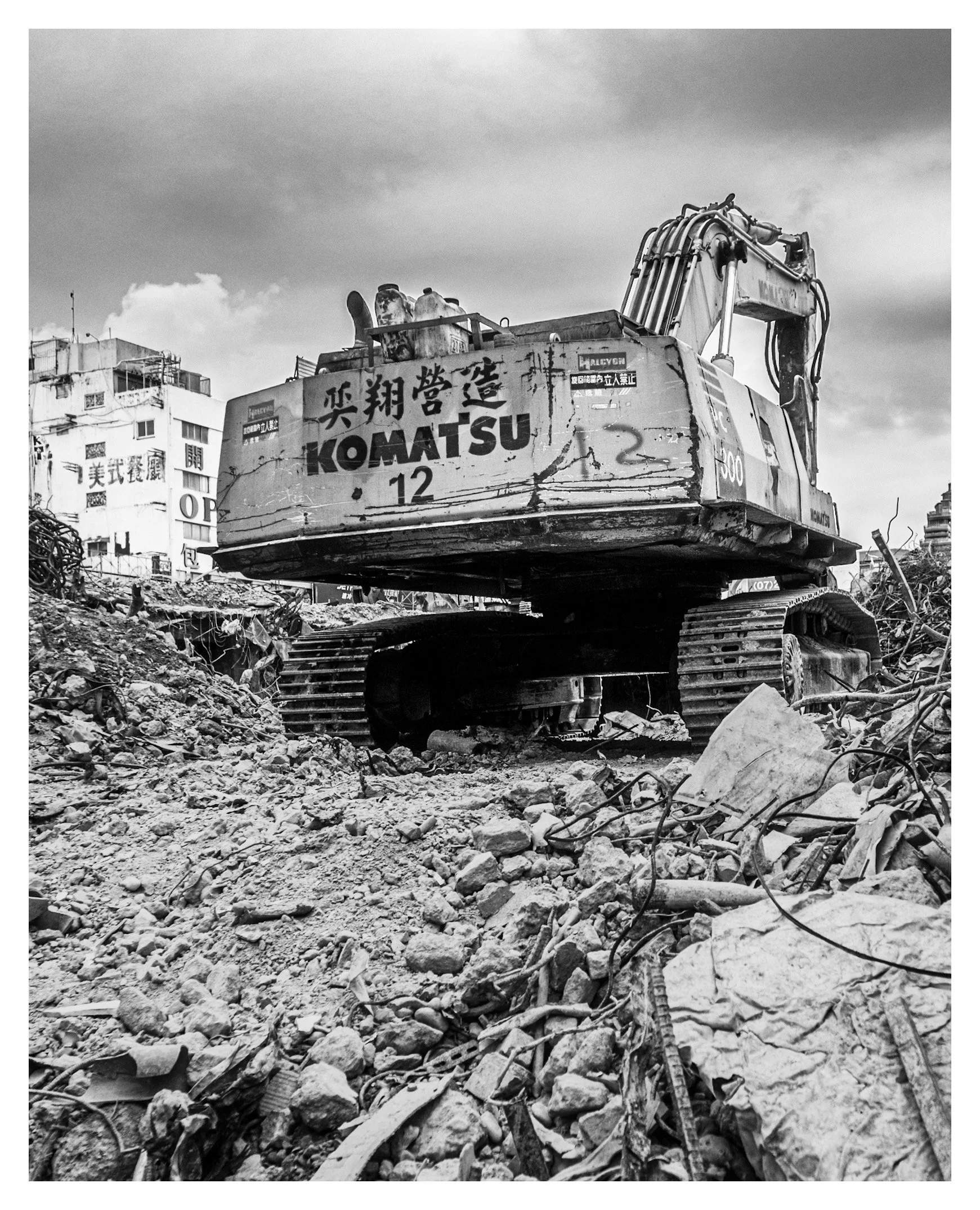
A Komatsu excavator perches atop a mound of shattered concrete and rebar, its hulking form silhouetted against a churning gray sky. A black-and-white study in industrial monumentality, scale, and the machinery that quietly reshapes a city.
Camera Model: Leica D-Lux 8
Shutter Speed: 1/250 sec
Aperture: f/2.3
ISO: 320
The Critique
This photograph belongs to a tradition of industrial monumentalism that Margaret Bourke-White helped establish nearly a century ago, when she made her name photographing steel mills and heavy machinery with the same formal seriousness typically reserved for portraiture or landscape. She approached the industrial world with a precise objectivity, though her creative framing techniques brought out the inherent beauty in industrial and architectural structures — and this frame, shot from a deliberately low angle that lets the excavator loom against the sky, does exactly that. The machine isn’t documented from a comfortable, neutral distance; it’s monumentalized, treated with the same reverence a photographer might bring to a cathedral or a mountain.
The low vantage point is the composition’s defining decision, and it pays off enormously. Shooting up at the excavator transforms it from a piece of construction equipment into something closer to a colossus — its tracks, hydraulic arms, and battered cab body all rendered with the kind of scale and presence usually reserved for monuments. The Komatsu branding and hand-painted Chinese characters on its flank add specific, legible detail without undercutting that monumentality; if anything, the visible wear, rust streaks, and scrawled numbers humanize the machine, giving it the character of a veteran rather than a showroom object.
Black and white was the right call here. The tonal range across the churning sky, weathered metal, and jumbled rubble creates a rich, almost sculptural gradient from near-black shadow beneath the tracks to blown-out highlight in the clouds, and stripping color out lets the viewer focus entirely on form, texture, and scale rather than being distracted by the incidental colors of a construction site. The rubble field in the foreground — broken concrete, twisted rebar, scattered debris — does important compositional work too, creating a chaotic, textured base that makes the excavator’s geometric solidity above it read as even more commanding by contrast.
The background building, with its “美式餐廳” signage still legible, adds a quiet but important narrative layer: a functioning storefront persisting right at the edge of active demolition, a reminder that this destruction is happening within a living, working city rather than an abandoned industrial zone. Where the composition could be pushed slightly further is in the right edge, where the excavator’s arm and hydraulic assembly crowd close to the frame boundary; a touch more room on that side would let the machine’s full silhouette breathe against the sky.
How This Image Could Be Improved
• Give the arm assembly a touch more room on the right. The hydraulic cylinders and boom currently crowd the frame edge; a slightly wider capture would let that mechanical complexity read more clearly against open sky.
• Consider the sky’s tonal weight. The clouds are dramatic but sit close to blown in places; a touch of highlight recovery could preserve a bit more texture up there to match the rich detail in the machine and rubble.
• Explore a companion frame at eye level. The low angle here is the image’s strength, but a second, more neutral perspective could serve as a useful counterpoint documenting the same machine and site from a human scale.
Becoming a Better Photographer Over Time
• Practice treating machinery and infrastructure as portrait subjects. Bourke-White’s legacy rests on exactly this idea — approach construction and industrial equipment with the same compositional care you’d give a person, considering angle, light, and monumentality deliberately.
• Study low-angle photography as a specific technical and psychological tool. Log how shooting from below versus at eye level or above changes the emotional register of a subject, and build intentional control over that choice.
• Return to active demolition or construction sites over time. These are rapidly changing environments that reward repeat visits — the same location can offer dramatically different compositions week to week as a site evolves.
Photographers to Study
• Margaret Bourke-White — the essential reference for treating industrial machinery with monumental, formal seriousness.
• Charles Sheeler — for his Precisionist approach to industrial architecture and machinery as sculptural form.
• David Plowden — for his extensive documentation of American industrial landscapes and their decline.
• Michael Kenna — for his meditative, high-contrast black-and-white treatment of industrial subjects.
• Bernd and Hilla Becher — for their disciplined typological approach to industrial structures, relevant to how this excavator is presented almost as a specimen.
Books Worth Reading
• Margaret Bourke-White: Portrait of Myself
• Charles Sheeler: Across Media
• David Plowden: Industrial Landscape
• Michael Kenna: A Twenty Year Retrospective
• Bernd and Hilla Becher: Typologies of Industrial Buildings
Videos Worth Watching
• “Margaret Bourke-White Photographer (Documentary): Part II - Industrial Photography & Soviet Russia” — direct grounding in the industrial photography tradition this frame draws from.
• “Margaret Bourke-White Photographer (Documentary) - Part I: The First Female Photojournalist” — broader context on her career and approach to monumentalizing industrial subjects.
• Ted Forbes, The Art of Photography channel — for further historical context on industrial and architectural photography traditions.