

Day 286/365 The Chained Giant: A Portrait of an Abandoned Bicycle
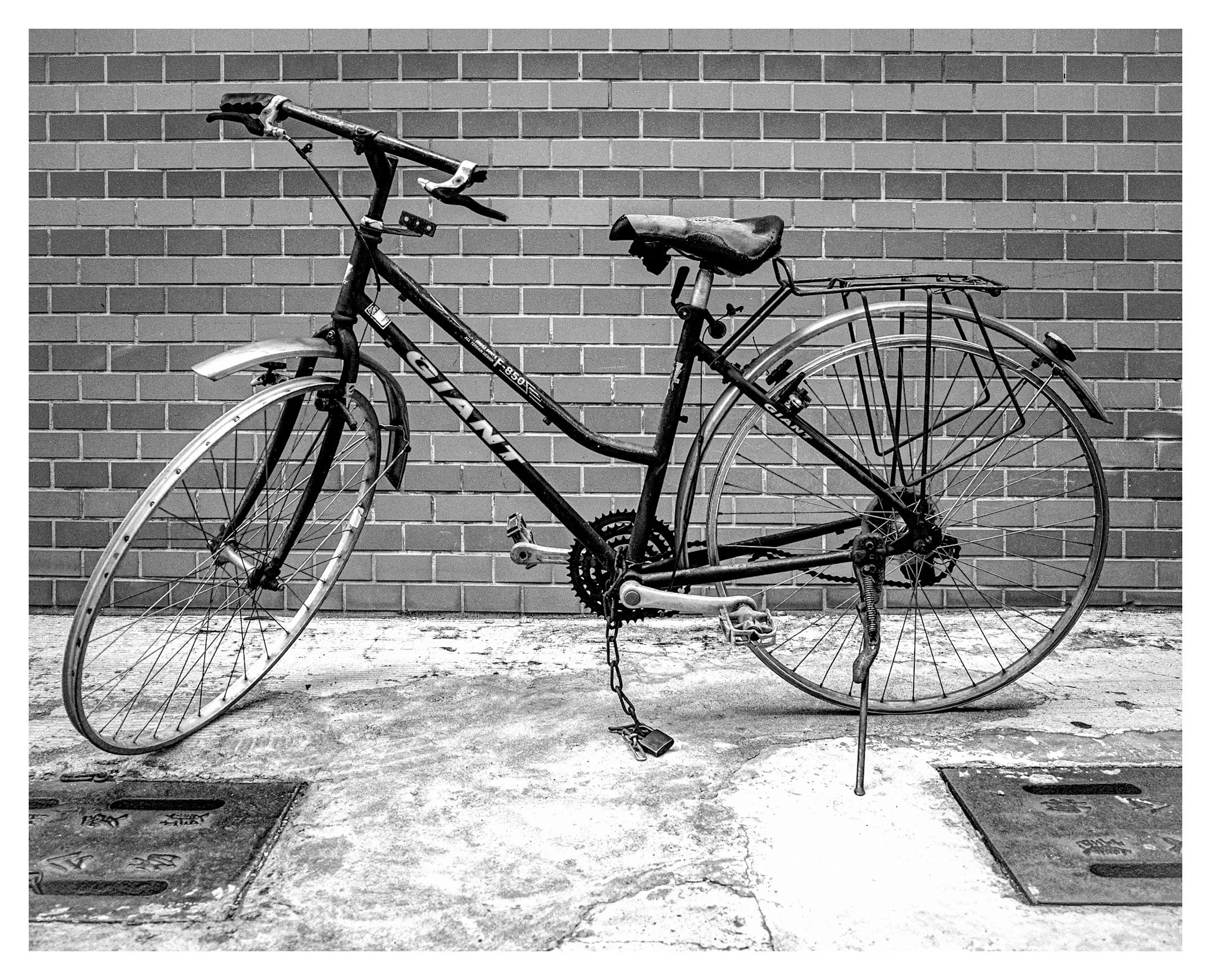
A vintage Giant bicycle, rusted and locked to nothing in particular, stands frozen against a brick wall. A frontal, dignified study in decay, mechanical detail, and the quiet mystery of objects left behind on a Kaohsiung street.
Camera Model: Ricoh GR III
Shutter Speed: 1/125 sec
Aperture: f/2.8
ISO: 1000
The Critique
This photograph draws directly on a tradition that goes back further than most people realize — Eugène Atget himself devoted an entire 1910 album, La Voiture à Paris, to photographing wheeled vehicles of Paris with the same formal seriousness typically reserved for grand architecture, transforming what might seem like uninspiring subject matter into a genuine meditation on urban life and its castoffs. This image of a weathered Giant bicycle, shot in strict profile against a brick wall, belongs squarely in that lineage: an object photographed not as documentation but as portraiture, with real attention to how light, texture, and mechanical detail combine to give an inanimate thing presence.
The strict side-on framing is the composition’s smartest decision. By treating the bicycle almost like a technical elevation drawing — full profile, centered, isolated against a flat, evenly patterned brick backdrop — the photograph strips away any narrative distraction and forces total attention onto the bike’s own form and condition. Every detail becomes legible: the rust bleeding down the frame, the sagging, cracked seat, the tangled chain looped uselessly around the pedal crank, the small padlock and chain dangling loose beneath the frame like a forgotten afterthought. That padlock is the photograph’s quiet punchline — evidence that someone once cared enough to lock this bicycle up, and that whatever story led to its current state happened sometime after that act of care.
The black-and-white treatment serves the image exactly as it should, turning the brick wall’s regular grid into a a rich textural backdrop that echoes the bicycle’s own grid of spokes without ever competing with it. There’s a lovely visual rhyme between the wall’s brick coursing and the wheel’s radiating spokes — two different systems of repeated pattern, one architectural and one mechanical, sitting side by side in quiet formal conversation.
Where the image could be pushed further is in the ground plane — the cracked, stained pavement and manhole covers at the bottom of the frame carry real textural interest but currently split attention with the bike itself; a slightly lower crop that gave more weight to the ground’s own decay, or conversely a tighter one that eliminated some of it, might sharpen the composition’s focus. There’s also a small tension in the exposure balance between the darker frame and the brighter wheel rims, which occasionally clip toward pure white.
How This Image Could Be Improved
• Consider the ground plane’s role more deliberately. The cracked, marked pavement is compositionally interesting but currently competes somewhat with the bicycle for attention — decide whether to lean into it or crop it down.
• Watch highlight clipping on the chrome rims. They’re beautifully lit but occasionally blow out; a touch of highlight recovery would preserve more of that metallic texture.
• Explore a closer detail study as a companion image. The padlock and tangled chain are a wonderful narrative detail that could support its own tighter, more intimate frame alongside this wider portrait.
Becoming a Better Photographer Over Time
• Practice treating found objects as formal portrait subjects, the way Atget did with Parisian carriages. Look for abandoned or overlooked objects — bicycles, furniture, machinery — and photograph them with the same care you’d bring to a person.
• Study strict profile framing as a specific compositional choice. It removes perspective distortion and depth cues, forcing attention onto silhouette and surface detail — practice recognizing when a subject calls for this treatment versus a more dynamic angle.
• Build a personal “urban archaeology” project. Objects like this abandoned bicycle carry real narrative weight precisely because we don’t know their full story — a dedicated body of work around these kinds of urban remnants could become a genuinely compelling long-term project.
Photographers to Study
• Eugène Atget — the essential reference for treating everyday objects and vehicles as worthy documentary and artistic subjects.
• Walker Evans — for his disciplined, frontal approach to vernacular American objects and architecture.
• Bernd and Hilla Becher — for their typological rigor in photographing industrial and mechanical objects.
• Irving Penn — for his formal, almost sculptural treatment of discarded and everyday objects later in his career.
• Josef Sudek — for finding poetry and quiet emotional weight in ordinary, often decaying objects.
Books Worth Reading
• Atget’s Paris
• Walker Evans: American Photographs
• Bernd and Hilla Becher: Typologies of Industrial Buildings
• Irving Penn: Still Life
• Josef Sudek: Poet of Prague
Videos Worth Watching
• “Eugène Atget: The Photographer Who Preserved Old Paris” — quick but relevant context on the tradition of documenting ordinary urban objects.
• “EUGÈNE ATGET: The First Street Photographer” — deeper background on Atget’s approach and legacy, directly relevant to this frame’s method.
• Ted Forbes, The Art of Photography channel — for further historical grounding in object and vernacular photography traditions.