

Day 287/365 Still Life at the Back Wall: A Kaohsiung Nocturne
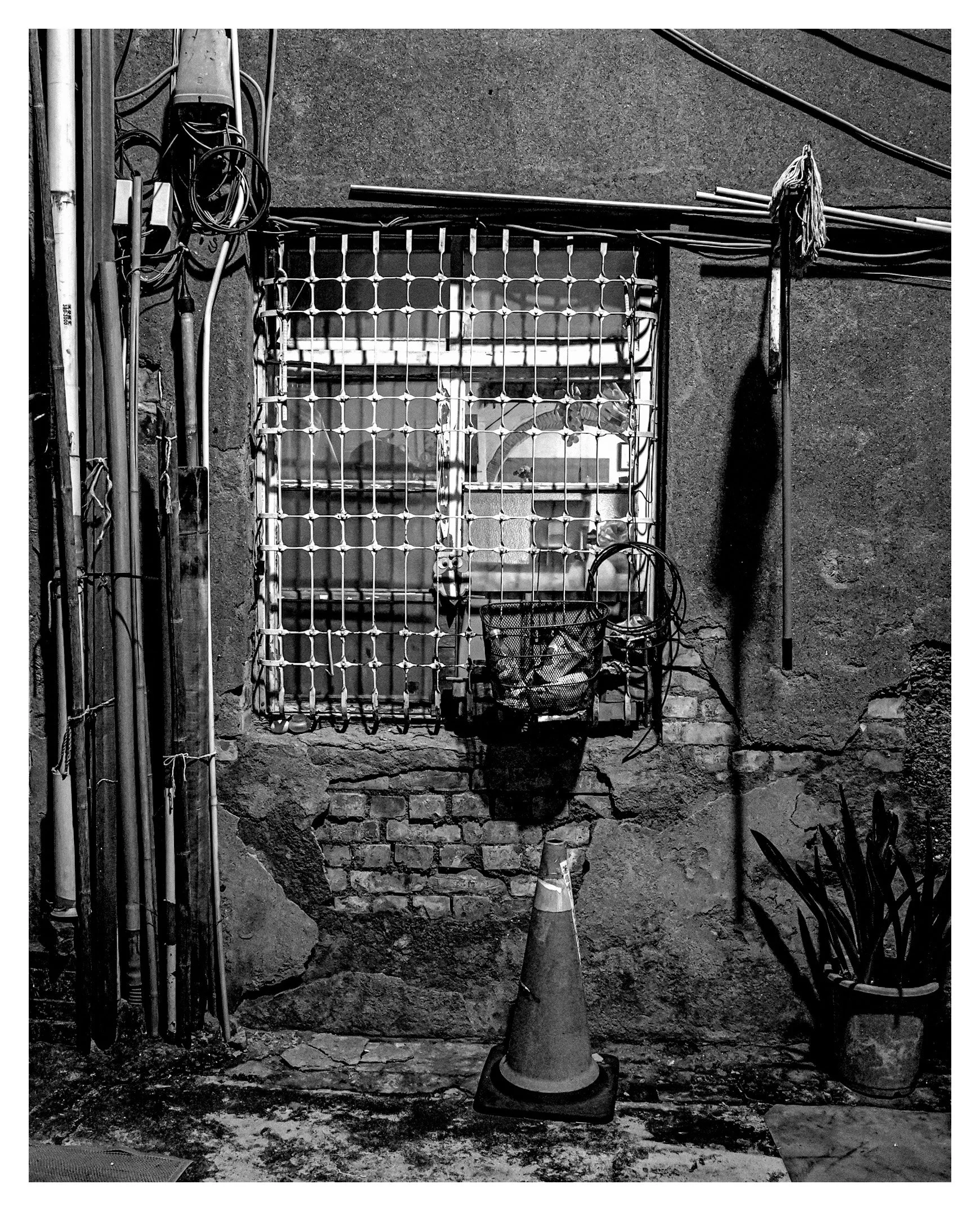
A traffic cone stands sentinel before a barred window, wires trailing overhead and a mop hanging like a scarecrow. A symmetrical, quietly surreal study of a Kaohsiung back alley at night, where ordinary maintenance objects arrange themselves into something close to still life.
Camera Model: Ricoh GR III
Shutter Speed: 1/100 sec
Aperture: f/4
ISO: 6400
The Critique
This photograph belongs to a quiet, patient tradition of urban still life — the kind of image that finds a scene already composed by accident and simply recognizes it. A barred window sits centered in a weathered wall, a wire mesh security grille catching light in a tight, orderly grid. Below it hangs a wastebasket and coiled cable; to the right, a mop leans against the wall like a tired figure taking a break from its work; and directly in front, almost comically formal, a single orange traffic cone stands at attention on the cracked pavement. Nothing here was arranged for the camera, and yet the composition reads as though it had been.
The symmetry is doing real work. The window sits almost precisely centered, flanked by roughly balanced masses of clutter on either side — poles and cables on the left, the hanging mop and dangling wires on the right — creating a loose but genuine bilateral structure that gives the frame an odd formality despite its subject being pure urban debris. That tension between chaotic subject matter and orderly composition is the photograph’s real achievement, and it recalls the patient, deadpan observational eye of photographers who’ve spent careers finding accidental order in overlooked corners of cities.
Texture is doing enormous work throughout — the pitted, patched plaster wall, exposed brick where render has fallen away, the metallic weave of the security grille, the frayed strands of the mop head all sit together in a rich tonal range that black and white renders beautifully. At ISO 6400, there’s visible grain throughout, but it reads as consistent with the gritty, textured surfaces being photographed rather than working against them — a case where high ISO noise and subject matter happen to suit each other.
The traffic cone deserves particular credit as the image’s punctuation mark. Placed dead center in the foreground, slightly out of the strict symmetry of everything behind it, it functions almost like a small sculptural intervention — an object whose normal job is to mark hazards or direct traffic, here simply standing sentry in front of a window for no evident functional reason, adding a note of quiet, unintentional absurdity to an otherwise straightforward documentary frame.
How This Image Could Be Improved
• Consider the framing at the very top. The tangle of wires crossing the upper portion is visually busy in a way that doesn’t quite resolve; a slightly lower framing, or embracing that chaos more fully with a wider shot, might commit more clearly to one approach or the other.
• Watch noise in the darkest shadow areas. At ISO 6400 the deepest shadows show some color noise even in black and white conversion; a touch of noise reduction targeted specifically at those darkest zones could clean up the image without sacrificing the grain that suits the rest of the frame.
• Try a version with the cone slightly off-center. The current near-centered placement works, but a deliberate shift to a rule-of-thirds position might add a touch more dynamic tension to what is otherwise a very symmetrical, static composition.
Becoming a Better Photographer Over Time
• Practice recognizing “accidental” formal composition. This kind of found symmetry and balance is everywhere in cities but easy to walk past. Train your eye specifically to notice when ordinary clutter has arranged itself into something resembling deliberate structure.
• Study high-ISO grain as an aesthetic choice, not just a technical limitation. Log which of your night images benefit from embracing visible grain versus which ones need noise reduction, and build intentional control over that decision.
• Build a personal “urban still life” series. Objects like traffic cones, mops, and utility clutter are everywhere and endlessly available — a dedicated project photographing these overlooked arrangements could become a genuinely distinctive long-term body of work.
Photographers to Study
• Robert Frank — for his unflinching, observational eye toward the overlooked corners and objects of ordinary life.
• John Gossage — for his patient, formally rigorous documentation of urban decay and vernacular detail, particularly in his landmark work The Pond.
• William Christenberry — for his deadpan, deeply attentive treatment of weathered vernacular architecture and its textures.
• Michael Schmidt — for his stark, disciplined black-and-white studies of urban surfaces and structures.
• Guido Guidi — for his minimalist, contemplative approach to facades, walls, and quiet urban corners.
Books Worth Reading
• The Americans by Robert Frank
• The Pond by John Gossage
• William Christenberry: Southern Views
• Michael Schmidt: Waffenruhe
• Guido Guidi: Per Strada
Videos Worth Watching
• “Urban Decay Photography - Basic Editing (Lightroom Tutorial)” — practical post-processing guidance directly relevant to a frame like this one.
• Urban Decay Tutorials playlist — a broader collection of technique videos on finding and composing decay and texture in urban environments.
• Ted Forbes, The Art of Photography channel — for historical grounding in the observational, deadpan documentary tradition this image belongs to.