

Day 288/365 Through the Glass: A Study in Layered Reflection
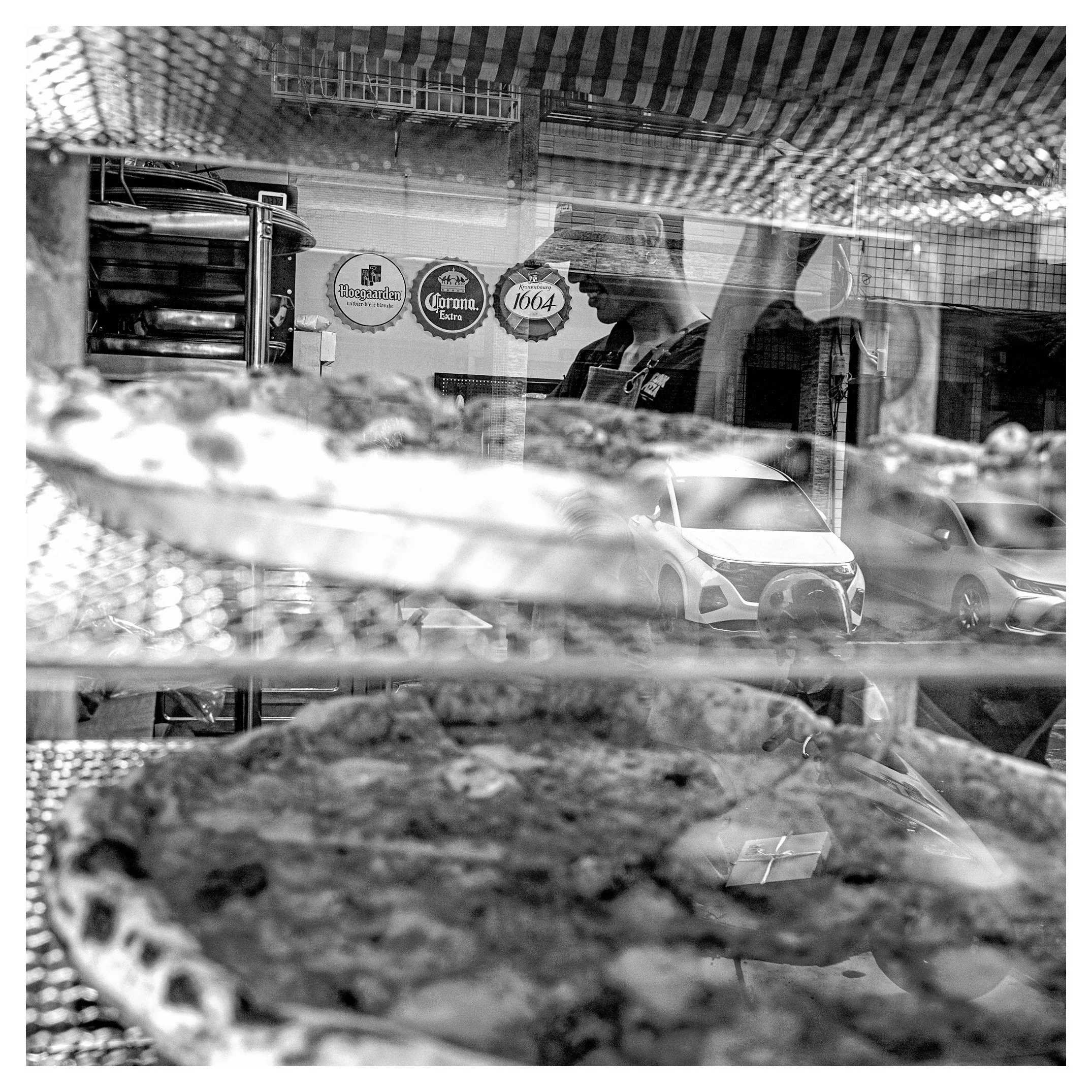
A pizza sits behind the glass while the street outside — a passing car, beer logos, a worker mid-motion — floats across its surface in reflection. A patient, layered study in what a single pane of glass can hold at once, if you actually stop to look.
Camera Model: Ricoh GR III
Shutter Speed: 1/125 sec
Aperture: f/4
ISO: 1000
The Critique
You’re right to ask whether the viewer will actually take the time — this is exactly the kind of photograph that rewards patience and punishes a quick glance. At first pass it might read as an accident, or as you note, something people assume is a multiple exposure. It isn’t. It’s a single frame shot through a shop window, and once you slow down, at least four distinct visual planes reveal themselves stacked on top of one another: a wire mesh grate closest to the lens, out of focus and catching hot points of light in its diamond pattern; a textured, cratered pizza crust filling the lower half of the frame, soft and close; and behind all of that, reflected in the glass rather than seen through it, the actual street outside — a white car mid-drive, a second vehicle behind it, striped awning fabric, and a row of circular beer-brand logos (Hoegaarden, Corona, Kronenbourg 1664) mounted on the wall inside. Threaded through the middle of all this sits a worker in cap and apron, caught mid-glance, half inside the shop and half dissolved into the reflected exterior.
This is Lee Friedlander territory almost exactly. Friedlander built decades of work around exactly this kind of accidental collage — shooting into store windows where reflections of the street superimpose onto the goods and people inside, producing images where it’s genuinely difficult to determine what’s being depicted, whether a figure is a reflection or something seen directly through the glass. That ambiguity isn’t a flaw in Friedlander’s work, and it isn’t one here either — it’s the entire point. He used reflections off windows and glass to screw with perspective, layering unrelated visual information into a single frame until the image demands active decoding rather than passive viewing.
What makes this particular frame work is the sheer density of information without it collapsing into visual noise. The pizza’s rough, cratered texture in the foreground gives the eye a tactile, close anchor point before it travels back through the layers to the sharper, more legible reflected street scene. The beer logos, oddly, become a wonderful found detail — circular forms echoing the round shape of the pizza itself, a visual rhyme that likely wasn’t planned but rewards the close look you’re asking for. The worker’s position, caught between the interior and the reflected exterior, embodies the whole image’s central idea: inside and outside occupying the same visual space simultaneously.
Where the image asks the most patience is in resolving what’s sharp versus reflected versus simply out of focus — the wire mesh in the extreme foreground never comes into focus, which is a reasonable choice given the layered concept, but it does compete somewhat with the more legible content behind it for the viewer’s very first moment of attention.
How This Image Could Be Improved
• Consider a version with the foreground mesh slightly softer or entirely eliminated from the frame, to let the eye move more directly into the richer layered content of pizza-plus-reflection without an intermediate visual obstacle.
• Watch the balance between reflected sharpness and interior softness. The reflected street elements (car, logos) are pleasingly crisp; a touch more depth of field might bring the worker’s face into slightly better focus as a secondary point of interest.
• Try this technique deliberately at different times of day. Reflection density and clarity change enormously with the angle and intensity of exterior light — worth returning to the same window at a different hour to see how the layering shifts.
Becoming a Better Photographer Over Time
• Study reflection photography as its own discipline, specifically the way multiple layered images can be captured within a single frame using windows, mirrors, and glass. Dedicate outings purely to shop windows and glass surfaces.
• Practice reading your own images the way you’re asking your audience to read this one. Slow down when reviewing your archive and look for accidental layering you might have captured without fully registering it in the moment.
• Build comfort with ambiguity. Not every strong photograph needs to be immediately legible — Friedlander’s best reflection work rewards a slower read, and cultivating that kind of complexity in your own images is a skill worth developing deliberately.
Photographers to Study
• Lee Friedlander — the essential reference for this frame’s entire approach; study his decades of work shooting into windows and glass.
• Saul Leiter — for his painterly use of glass, rain-streaked windows, and layered urban reflection.
• Harry Callahan — for his experimental use of multiple exposure and layered imagery within the urban landscape.
• Vivian Maier — for her frequent, inventive use of mirrors and reflective surfaces, often incorporating herself into the frame.
• Ernst Haas — for his pioneering use of reflection and motion blur to build complex, layered color compositions.
Books Worth Reading
• Lee Friedlander: Self Portrait
• Saul Leiter: Early Color
• Harry Callahan (Aperture monograph)
• Vivian Maier: Street Photographer
• Ernst Haas: Color Correction
Videos Worth Watching
• “How Lee Friedlander used shadows and reflections to reinvent street photography forever” — a quick, direct look at the technique this image draws on most closely.
• “Lee Friedlander Part 2 - What caught his eye?” — a deeper breakdown of his layering approach and what to look for in reflection-based composition.
• “The Painterly Photography Of Saul Leiter” — further context on glass, reflection, and obscured layering in street photography.